


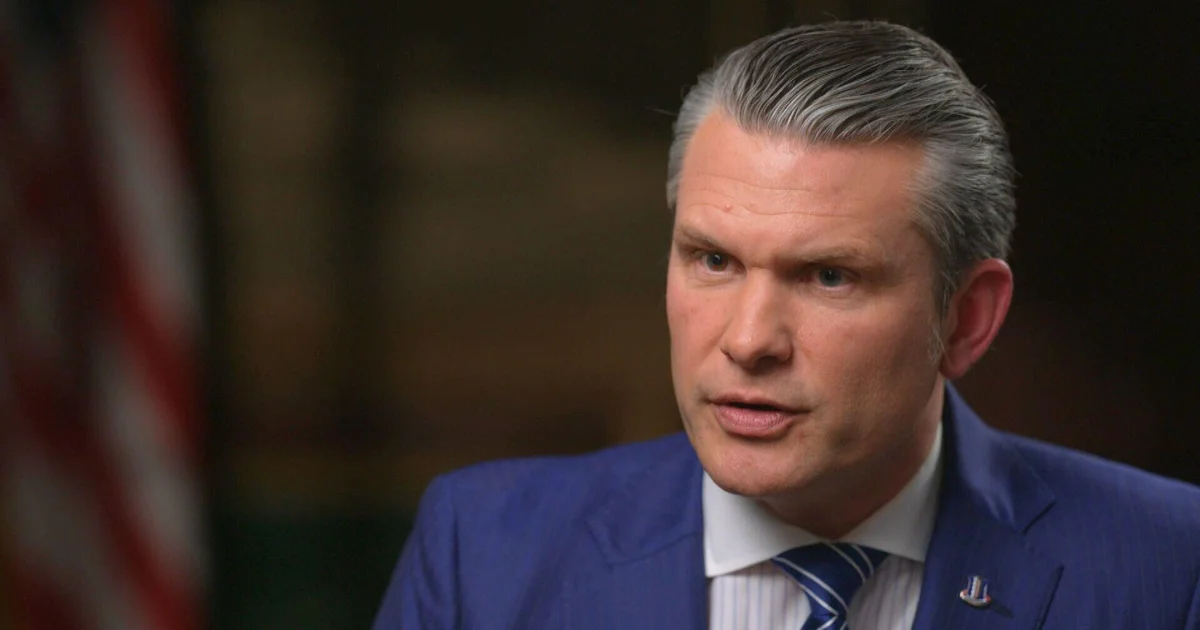
With U.S. and Israeli strikes on Iran in their second week, tonight, you will hear from Defense Secretary Pete Hegseth. According to the Pentagon, more than 50,000 members of the U.S. military are involved in the execution of what it calls “Operation Epic Fury.” Our CBS News colleague Major Garrett spoke with Hegseth about the war with Iran.
The U.S. military said it had already struck 3,000 targets inside Iran when we met with Secretary of Defense Pete Hegseth on Friday.
Major Garrett: The speaker of the House said late this week, “The mission is,” and I’m quoting him directly here, “nearly accomplished by all estimates.” Is that true?
Pete Hegseth: Oh, we’re very much on track, on plan. I was down at CENTCOM– yesterday–
Major Garrett: Someone might hear that and think it’s almost over–
Pete Hegseth: Well, there’s no– we’re not flying a mission accomplished banner– like George W. Bush on– on an aircraft carrier. We’re not doing that and we haven’t done that. But we can be clear with the American people that this is not a fair fight.
And that’s on purpose. Our capabilities are overwhelming compared to what Iran’s are. And frankly, when you combine our Air Force with the air force of the Israeli Defense Forces, it’s the two most powerful air forces in the world.
The ability for us to be up over the top and hunting with more conventional munitions, gravity bombs, 500-pound, 1,000-pound, 2,000-pound bombs on military targets– that– we haven’t even really begun to start that effort of the campaign, which is gonna showcase even more how– how we will execute on those objectives.
Major Garrett: President said recently there will be no deal with Iran except unconditional surrender. What does that look like, unconditional surrender? How will you know it’s real?
Pete Hegseth: It means we’re fightin’ to win. It means we set the terms. We’ll know when they’re not capable of fighting. There’ll be a point where they’ll have no choice but to do that. Whe– whether they know it or not, they will be combat-ineffective. They will surrender.
60 Minutes 

Major Garrett: Typically the understanding of a surrender is person-to-person. Is that what would be required in a matter like this?
Pete Hegseth: Well, there’s a lotta different ways. Whether they want to admit it or not, whether their pride lets them say it out loud or not– it’s President Trump who will set the terms of that.
The president of Iran said yesterday that the U.S. demand for unconditional surrender is, quote, “a dream that they should take to their grave.”
Major Garrett: There was a very long war between Iran and Iraq, almost eight years, and they never surrendered in that war. And I’m just wondering if that factors into your calculus or the president’s calculus as well–
Pete Hegseth: I mean, there was a really long fight that I was a part of, that my generation was a part of.
Major Garrett: Yes. I know that, sir.
Pete Hegseth: In Iraq and Afghanistan– where a lot of foolish approaches were used. This is war. This is conflict. This is bringing your enemy to their knees. Now, whether they will have a ceremony in– in– in Tehran Square and– and– and surrender, that’s up to them.
There are varying versions of how and why the war started when it did. Some normally enthusiastic supporters of the president have criticized him suggesting Israeli Prime Minister Benjamin Netanyahu pulled the U.S. into a war that to their minds did not put American interests first.
Major Garrett: Do you want to address that criticism?
Pete Hegseth: All I know is, I’m in the room every day and I see how President Trump operates and what he’s putting first, and it’s America, Americans, and American interests
Major Garrett: It has been said that the Israelis, through Benjamin Netanyahu, the Israeli prime minister, provided on February 23rd key information about intelligence they had developed about the likely whereabouts of Ali Khamenei and many in his inner circle.That the U.S. then checked it out through the CIA, confirmed that, and that was an opportunity that presented itself to the president. And that is the precipitating factor for this war. That’s the way it’s been reported. Is that accurate, Mr. Secretary?
Pete Hegseth: President Trump’s approach has been our interest in advancing those interests from the beginning. And so the fact that intelligence was gathered, whether from Israelis or ours, and always checked by our intel agencies to make sure– it’s accurate– a lotta times the best way to start operations is a trigger-based or condition-based moment. And you can work together on whether that makes sense. But we were always controlling the throttle about whether or not we go or not go. And ultimately, to advance American interests, and protect American lives.
Major Garrett: Some might look at that sequence of events and say, well, that it was an opportunity more than an imminent threat.
Pete Hegseth: I mean, I think much of that discussion is– silly and academic. They’ve been killing us for 48 years– 47 years. They have unabated nuclear ambitions.
And when we obliterated their nuclear program at the end of the 12-Day War and Operation Midnight Hammer— they should’ve come to the table and said, “Okay, we get it. You mean business. We’re not gonna have nukes.” And they haven’t.
And as a result, when the president looks at it, generationally he sees a threat that would continue to gather.
Despite the administration’s claim that it obliterated Iran’s nuclear infrastructure in June, international monitors estimate that Iran still has more than 970 pounds of nearly bomb-grade uranium.
Major Garrett: Is it possible to achieve the objectives President Trump has set before you if we don’t locate and obtain and extract the highly enriched uranium?
Pete Hegseth: There’s a lotta different ways we can get after that. They’ve used a conventional umbrella of– of missiles that was growing every single day, their production cap– capacity, to try to cover over their nuclear blackmail ambitions. As far as how you get at that nuclear option, we’ll make sure– that their nuclear ambitions are never achieved.
Major Garrett: Will we take it out ourselves?
Pete Hegseth: Oh I would never tell you or anybody else what our options are. That’s another thing. People keep asking–
Major Garrett: It’s not really–
Major Garrett: It’s a legitimate question.
Pete Hegseth: Very fair question. People ask boots on the ground, no boots on the ground, four weeks, two weeks, six weeks, go in, go in? President Trump knows, I know, you don’t tell the enemy, you don’t tell the press, you don’t tell anybody what– what your limits would be on an operation. We’re willing to go as far as we need to in order to be successful.
60 Minutes 
Major Garrett: Do we have any overt or covert forces inside Iran now?
Pete Hegseth: I wouldn’t tell you that if we did.
Major Garrett: Only reason I ask is, earlier this week you said no. Is that still the answer?
Pete Hegseth: Yeah, that’s still the answer. But we reserve the right. We would be completely unwise if we did not reserve the right to take any particular option, whether it included boots on the ground or no boots on the ground.
Major Garrett: CBS News has three sources telling us that Russia is providing intelligence to Iran on U.S. positions and movements. The average American might hear that and think that’s a big and dangerous deal. Is it?
Pete Hegseth: Well, we’re trackin’ everything. Our commanders are aware of everything. We have the best intelligence in the world. We’re aware of who’s talkin’ to who, why they’re talkin’ to ’em, how accurate that information might be, how we factor that into our battle plans, our CENTCOM commander. So– so we know what’s goin’ on. And the president– d– has an incredible– knack at knowing how to mitigate those risks. And so the American people can rest assured– their commander-in-chief is well aware of who’s talkin’ to who. And anything that shouldn’t be happening, whether it’s in public or back-channeled, is being confronted and confronted strongly.
Major Garrett: The American people can therefore expect conversations with the Russians to stop this?
Pete Hegseth: Well, I– President Trump, as people have seen, has a unique relationship with a lot of world leaders where he can get things done that other presidents, certainly Joe Biden, never could have. And through direct conversations or indirect, through him one-to-one or through his cabinet, messages– definitely can be delivered.
Major Garrett: Does this put U.S. personnel in any more danger than they otherwise would be?
Pete Hegseth: Well, no one’s–
Major Garrett: The Russian involvement?
Pete Hegseth: No one’s puttin’ us– us in danger. We’re puttin’ the other guys in danger, and that’s our job. So we’re not concerned about that. We mitigate it as we need to. Our commanders factor all of this. But the only ones that need to be worried right now are– are Iranians that think they’re gonna live.
Six U.S. Army reservists were killed in an Iranian drone attack in Kuwait last Sunday. President Trump and Secretary Hegseth attended the dignified transfer yesterday at Dover Air Force Base. One more service member’s death was announced this afternoon.
Pete Hegseth: The president’s been right to say there will be casualties. Things like this don’t happen without casualties. There will be more casualties. And no one is– I mean, especially our generation knows– knows what it’s like to see Americans come home in caskets. It’s– but that doesn’t weaken us one bit. It stiffens our spine and our resolve to say this is a fight we will finish—
So far, more than 1,600 Iranians have been killed, according to a group called Human Rights Activists in Iran. That includes 168 people, mostly children, at a school in the southern part of the country, an area the U.S. was attacking at the time.
Major Garrett: Have you made any conclusions about whether or not the United States, inadvertently or not, was involved in any military strike at that school?
Pete Hegseth: Well, we’re still investigating and that’s where I’ll leave it today. But what I will emphasize to you and to the world is that, unlike our adversaries, the Iranians, we never target civilians.
60 Minutes 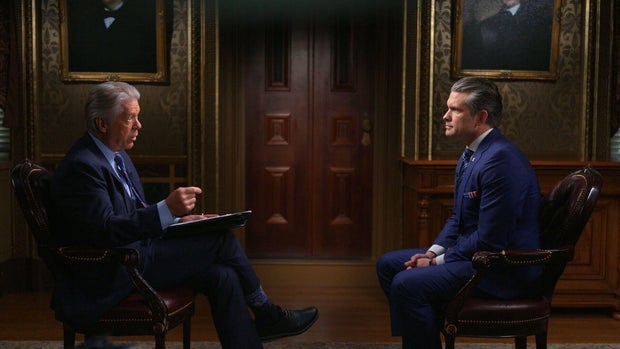
Major Garrett: There was a report late in the week from two officials that it was likely U.S. involvement. Is that report false?
Pete Hegseth: I’ve already said we’re investigating.
Major Garrett: If you could tell the American public, “It definitively was not us,” you would tell us, wouldn’t you?
Pete Hegseth: I would– I would say that it’s being investigated, which is the only answer I’m prepared to give.
Tonight, Iran announced that a son of its slain leader would replace him. President Trump said this morning any leader picked without his approval, is, quote “not going to last long.”
Major Garrett: You said this is not a regime-change war, but the regime has changed, that’s obvious. Can you square the two?
Pete Hegseth: Sure.
Major Garrett: Go ahead.
Pete Hegseth: I meant what I said. It’s not a regime-change war in a conventional George W. Bush context of hundreds of thousands of troops. I mean, in Afghanistan what I watched as a young captain was Americans thinking we were gonna remake– a society that was basically biblical times with AK-47s and cellphones.
The hubris of, “We’re gonna take Afghanistan and turn it into a Jeffersonian democracy by building western-style forces and western-style institutions,” it was never gonna work. “And I saw it and watched it play out. And it doesn’t dispel the courage of the Americans who fought there, who I know there.” But this is not a remaking of the Iranian society from an American perspective. We tried that. The American people have rejected that. President Trump called those wars dumb. And we’re not fighting that way.
Major Garrett: President Trump also said this week he would like to protect some of the people who he would like to come to power in Iran. Is that a new mission for your department?
Pete Hegseth: No.
Major Garrett: How would you protect people that are inside the country that he might think could rise to the level of leadership there?
Pete Hegseth: Well, the best way to– to protect them is what we’re doing right now. What you see right now between– American efforts and Israeli efforts is a generational opportunity for the people of Iran.
This past week, Iran launched missiles and drones at nearly a dozen Middle Eastern countries including American allies Qatar, Bahrain, and Saudi Arabia.
Major Garrett: There’s reporting from our Margaret Brennan that not us, but allies in the region are running very low on interceptors. Is that true, number one, number two, how prepared are we to help them restock interceptors to protect them as we continue this campaign?
Pete Hegseth: Very prepared. We– we plan for that. As you heard Admiral Cooper yesterday lay out, CENTCOM commander, their missile projection is down 90% from that height. So if– excuse me, missile shots. So if they can’t shoot anywhere near that volume– our projections of munitions are– are– are well beyond what we would need. And we can crossload for allies if need be, always ensuring that our forces and our troops and our bases are taken care of first. But where we can help allies– we will.
Since the war began, oil shipments through the Strait of Hormuz, through which 20% of the world’s oil flows, have stalled. U.S. gas prices are up an average of almost 50 cents a gallon.
Major Garrett: President said this week the Strait of Hormuz will be taken care of. How will that be taken care of and how will the ships that are there, that are not moving, start to move and be moving with a degree of confidence that they will not be inhibited by what remains of the Iranian either boats or gun emplacements along that strait?
Pete Hegseth: Well, we’re takin’ care of a lot of that.
Major Garrett: How?
Pete Hegseth: Well, American firepower. What was the– Iranian Navy is largely no more. There’ll be more boats to be sunk, for sure. So their ability to project any power in that area in a naval sense is being–
Major Garrett: Is diminishing–
Pete Hegseth: Diminishing and will be increasingly diminished. Again, what I– what I want your viewers to understand is this is only just the beginning.
Produced by Andy Court, Andrew Bast, Arden Farhi. Associate producers, Annabelle Hanflig and Emily Cameron. Broadcast associates, Erin DuCharme and Jane Greeley. Edited by Craig Crawford. Assistant editor, Aisha Crespo.