


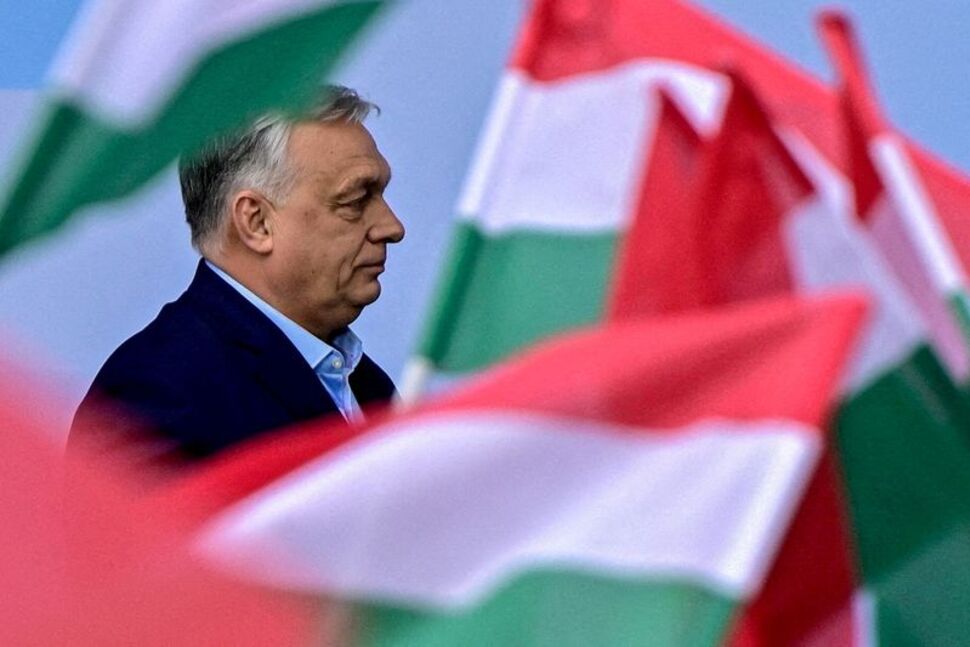
BUDAPEST, April 12 (Reuters) – Prime Minister Viktor Orban, a key opponent of European Union efforts to help Ukraine fend off Russia’s invasion, lost power after 16 years on Sunday as Hungarians voted in record numbers for a pro-EU course spearheaded by centre-right rival Peter Magyar.
Orban, 62, had won endorsements from U.S. President Donald Trump and some top European conservatives, but early results showed his nationalist Fidesz party losing to Peter Magyar L8N3Z00J1’s pro-EU Tisza party due to Hungary’s economic stagnation nL8N3XN0FC.
A fiery anti-Communist youth leader during the Cold War, Orban, the European Union’s longest-serving leader, is a patriotic hero to supporters, but critics at home and abroad have accused him of taking Hungary on an authoritarian path.
Born in 1963 in a village west of Budapest, Orban trained as a lawyer, briefly studied political philosophy at Oxford, and even played semi-professional soccer before becoming prime minister for the first time in 1998 aged just 35.
Hungary joined NATO on Orban’s watch but he lost power in 2002. After eight years in opposition, he won a landslide victory in 2010, enabling him to rewrite Hungary’s constitution and pass major laws aimed at creating an “illiberal democracy”.
His consolidation of executive power, new curbs on NGO activities and media freedoms, and a weakening of judicial independence led to clashes with the European Union over democratic standards, culminating in a decision to suspend billions of euros nL1N3TN01V in funding for Hungary.
But all that came crashing down for Orban on Sunday night as preliminary results put Magyar on course for a parliamentary supermajority, enabling his centre-right party to unwind all of Orban’s controversial reforms.
“What tonight’s election result means for the fate of our country and nation and what the deeper or higher meaning of all this is, remains unclear. We do not know it yet. Time will tell,” Orban told supporters, conceding defeat.
“But however it has turned out, we will keep serving our country and the Hungarian nation from opposition.”
‘RUBBING SHOULDERS WITH TRUMP’
During Europe’s 2015 migrant crisis, Orban cast himself as the guardian of Hungary’s national identity and Christian heritage, refusing to accept EU quotas for taking in asylum seekers, mostly Muslims from the Middle East and beyond. His government has gradually taken steps to erode LGBTQ+ rights nL1N3SV034.
His hard line on immigration and his efforts to revive Hungary’s declining birth rate earned him praise from other conservative leaders, including Trump.
Orban – who also racked up sweeping election wins in 2014, 2018 and 2022 – had secured endorsements this time from Italy’s Prime Minister Giorgia Meloni, Marine Le Pen of France’s National Rally, and Alice Weidel of the Alternative for Germany.
Trump has also endorsed nL1N3Z119G Orban, saying U.S.-Hungary relations have reached “new heights” owing to their leadership after years of conflict under Democratic administrations in Washington.
Orban has maintained close ties with Russia, a key energy supplier nL8N3ZG10C, and China, whose firms are building major EV and battery plants nFWN3UV0A2 in the landlocked central European country.
He has sought to frame the election as a choice between “war or peace” nL8N3Z71ND, suggesting Tisza wants to drag Hungary into the war raging in neighbouring Ukraine https://www.reuters.com/world/ukraine-russia-war/, which it strongly denies.
“For peace, Fidesz is the safe choice,” Orban said on the campaign trail in February. He has clashed frequently with Ukraine’s President Volodymyr Zelenskiy and infuriated Hungary’s EU partners by blocking a 90 billion euro aid package nL8N3ZJ0H5 for Kyiv.
But surveys showed Hungarian voters were more concerned with domestic issues such as healthcare and the economy, which has stagnated for the past three years.
Hungary experienced the EU’s worst inflationary surge following Russia’s February 2022 invasion of Ukraine, which lifted food prices close to EU average levels, while Hungarian wages are still third-lowest in the 27-member bloc.
Despite generous pro-family policies, including cheap loans and tax benefits, Orban appears to have lost the support of younger voters as he has lurched to the right.
Polls before the election showed young voters particularly eager for change, with Orban shifting back and forth between trying to woo the key demographic and deriding their opposition to his leadership as a ‘phony rebellion’.
“I know young people like to turn against their parents and this can cause political problems,” said Orban, a father of five and a grandfather.
Despite attending countless election rallies and keeping up a barrage of interviews and social media posts, he gave a rare glimpse late last year into the toll that the campaign may have taken after so many years at the helm.
“When I was a soldier (doing military service), they told us a soldier cannot be cold, he can only perceive the cold,” he said. “I am the same. I am not tired. It is just that my strength is running out.”
(Reporting by Gergely Szakacs; Editing by Gareth Jones, Andrew Cawthorne and Deepa Babington)
Copyright 2026 Thomson Reuters.
Photos You Should See – April 2026

