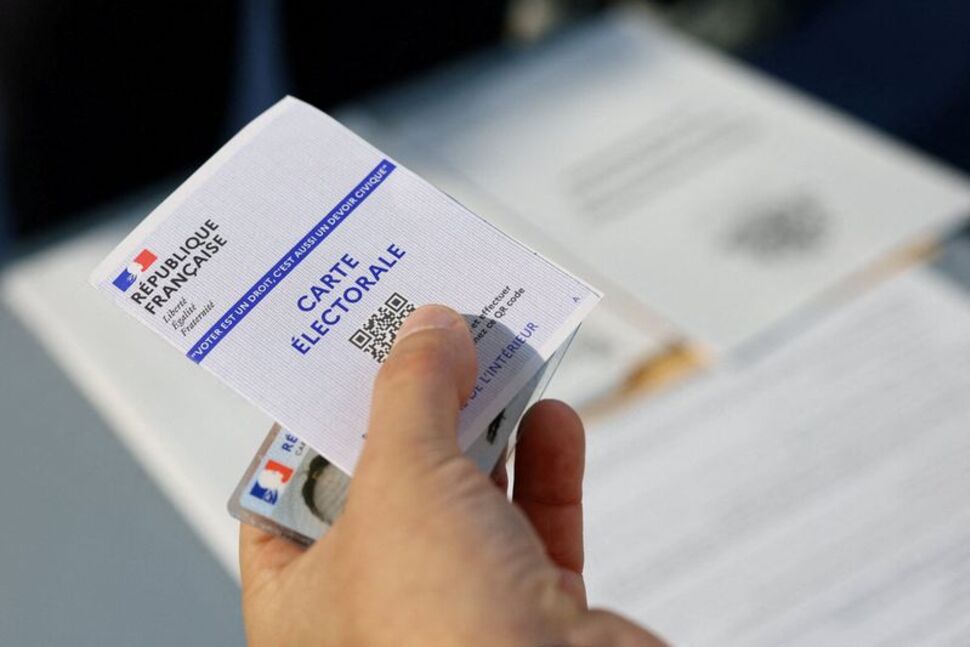
PARIS, March 22 (Reuters) – French voters will on Sunday elect mayors for Paris, Marseille and over 1,500 other cities and towns in ballots that will test the strength of the far right and the resilience of mainstream parties ahead of next year’s presidential election.
Heading nearly 35,000 municipalities – from major cities to villages with only a few dozen residents – mayors are France’s most trusted elected officials.
Many won enough votes to be elected in the first round last Sunday, but tight races in France’s biggest cities are going to runoff elections.
One of the key ballots will be in Marseille, the country’s second-biggest city, where the second round pits the far-right National Rally (RN) against the incumbent Socialist mayor. If the RN were to win, it would be a major victory for them.
In Paris, opinion polls show victory – for the conservatives or the left – is within their margins of error.
Voting starts at 8 a.m. (0700 GMT) and ends between 6 p.m. and 8 p.m. Results will trickle in through the evening.
The anti-immigration, eurosceptic RN has so far struggled to make meaningful gains in municipal elections.
The first round brought mixed results for the party, which got re-elected in several cities but failed to make major wins beyond its southern and northern bastions.
“It’s true that these 2026 municipal elections do not mark a landslide for the National Rally – far from that. But … it stands to confirm its territorial integration in France,” said Anne Muxel, a political science research director at Sciences Po university.
The RN’s chances of winning the biggest prize it covets – Marseille – took a hit when hard-left candidate Sebastien Delogu of France Unbowed (LFI) withdrew from the second round out of concern that splitting the left’s vote could help the RN.
However, in the French Riviera city of Nice, an ally of Le Pen’s party, renegade conservative Eric Ciotti, looks set to win against a candidate backed by the centre.
In Paris, which has been run by the left since 2001, the Socialist candidate was ahead in the first round. But a far-right candidate decided to pull out of the runoff to help Rachida Dati, a conservative former interior minister, snatch the city away from the left, meaning it is now a very close race.
The thousands of separate municipal ballots are often focused on very local issues and their outcome does not forecast who will win in the April 2027 presidential election.
But they show trends, in popularity and in the type of alliances that can be struck in an increasingly fragmented landscape – and how voters react to it.
SHIFTING ALLIANCES BETWEEN VOTING ROUNDS
One key question is what impact the alliances – or lack of alliances – struck between the two rounds will have.
Local party negotiations since Sunday’s first round have highlighted divisions on the left, with the Socialists striking deals with their hard-left arch-rivals from LFI in some cities, such as Lyon and Toulouse, but not in others such as Marseille or Lille.
LFI has never been strong in local elections, but it has focused more on them this time, and the key role it will be playing in who wins in some of the ballots shows its growing strength.
“We can clearly see that, because of the relatively good performance of France Unbowed in the municipal elections, this party and (leader) Jean-Luc Melenchon once again gain a position of power in what the balance of power in the left could constitute,” Sciences Po’s Muxel said.
(Additional reporting by Ardee Napolitano, Michel Rose; Writing by Ingrid Melander;Editing by Alison Williams)
Copyright 2026 Thomson Reuters.
Photos You Should See – March 2026
