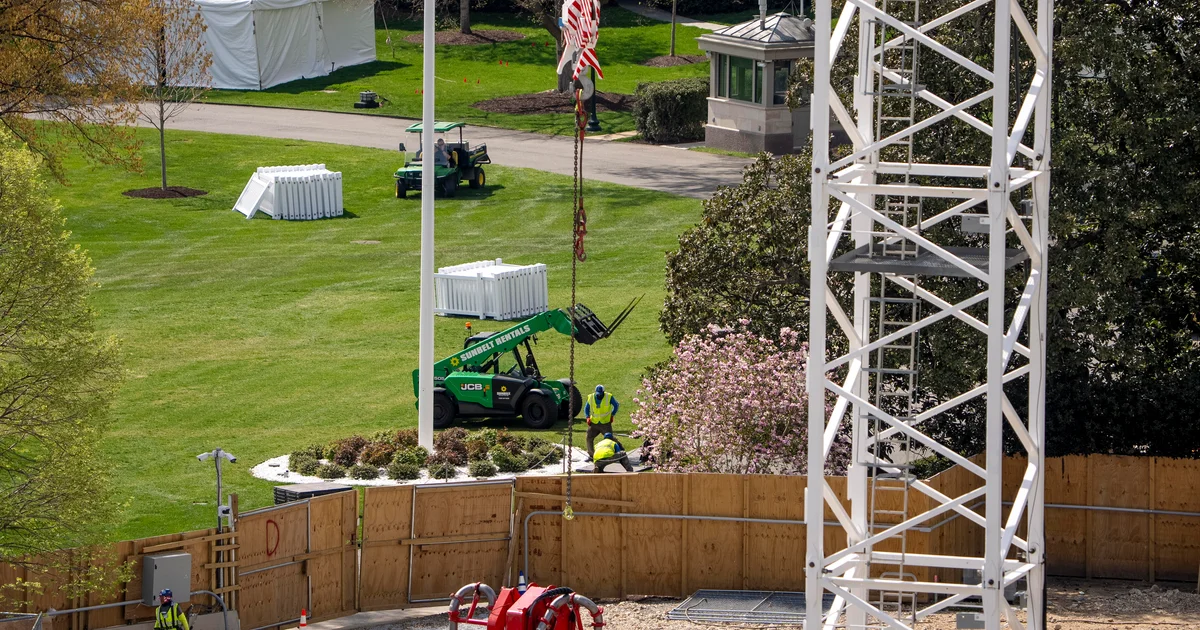
The National Capital Planning Commission voted Thursday to green light President Trump’s 90,000-square-foot East Wing makeoverthe final regulatory obstacle for a project that hit legal headwinds earlier this week.
The commission, which is chaired by a White House staffer, voted 9 to 1 to approve the design, which includes a ballroom with seating for 1,000 guests. Two commissioners voted present.
Even with the commission’s vote, above-ground construction is likely to soon be on hold. A federal judge ruled Tuesday that the administration must get congressional authorization before proceeding with the ballroom. The Department of Justice has already appealed.
The commission’s vote was delayed a month by public opposition to the project. Some 32,000 comments poured in online. More than 100 people, including architects and preservationists, signed up to speak at the March commission meeting.
James Blair, a commissioner and senior White House aide, called the critiques largely “unserious” and politically driven.
Mr. Trump has called the project the “finest ballroom of its kind anywhere in the world.”
The White House announced its intent to build a ballroom in July at a cost of $200 million. The privately financed endeavor’s price tag has since doubled. The new space will house offices for the first lady, kitchen space, a double-decker colonnade and upgrades to a secure underground military complex.
It is not clear whether taxpayer or private dollars are funding the military bunker.
Early on, Mr. Trump said the renovations would not impact the existing White House structure, but heavy machinery shredded the East Wing in October, demolishing what had been a White House fixture for generations.
Pieces of the structure were hauled off to a scrap yard in Maryland. Dirt has been trucked to a nearby golf course.
In December, the Trust for Historic Preservation sued to stop construction. A judge initially denied the Trust’s request for a temporary restraining order, but ultimately sided with the Trust, citing a lack of congressional authorization and a questionable financing arrangement.
Democrats have also objected to the president’s use of private donations to pay for the project. The president enlisted a nonprofit organization to collect donations from companies and individuals — some with business before the government, including tech giants and defense contractors.
“This vanity project has become an instrument of corruption,” Sen. Richard Blumenthal of Connecticut told CBS News. “We are demanding information not just from the government and the White House, but from the donors themselves about what they have at stake.”
Several Democratic members have introduced legislation to constrain this and future projects, but none have received a vote in the Republican-controlled Congress.
The White House has shared a partial list of donors and hosted a dinner recognizing them last fall. It has yet to disclose how much each donor has given and how much has been raised for construction.
The Commission of Fine Arts, another regulatory body with jurisdiction over federal construction in Washington, unanimously approved the East Wing design in February after being first briefed on it in December. The commission is composed of Trump appointees, including Chamberlain Harris, the president’s executive assistant.
Previous White House renovations, all of which were less significant than the East Wing project, have undergone months — and sometimes years — of scrutiny by the CFA and NCPC.
NCPC chairman Will Scharf defended the commission’s speedy approval timeline of just over three months. “The notion that we have been less than thorough, that we have not met our obligations is frankly insulting to the work that our team has done,” Scharf said, adding that he read every public comment the commission received.
“I think there is a lot of value to the iterative process and we have not had that,” said commissioner Phil Mendelson, a Democrat who serves as chairman of the D.C. council. “It’s just too large.”
Mendelson was the lone ‘no’ vote Thursday.
CFA’s rubber stamp came despite thousands of public comments that the commission’s secretary Thomas Luebke described as “overwhelmingly in opposition — over 99%.” Several comments cited the speed at which the president has moved.
Aboard Air Force One on Sunday, the president shared new architectural renderings of the ballroom which showed the annex’s south face without a grand staircase that had been in previous iterations, including the design that CFA had approved. An analysis of the previous plans by the New York Times pointed out some idiosyncrasies in the design, among them, that its grand staircase didn’t lead to the ballroom and there was no door on the side facing the staircase. Mr. Trump showed the new renderings soon after the Times’ article was published.
Luebke did not answer CBS News’ questions about whether the CFA will reconsider the project in light of the architectural changes.
NCPC was informed of the change Wednesday and voted to approve it Thursday.