


PARAISO, March 25 (Reuters) – Shortly before dawn on March 17, Guillermo Risso saw a distant flash of light illuminating the night sky and thought that the Olmeca refinery, owned by Mexico’s state oil company Pemex, must be on fire.
“It was an explosion, the entire refinery lit up,” said Risso, president of the community council of Puerto Ceiba, a coastal town near the refinery in Mexico’s southern state of Tabasco. “We saw flames and were alarmed,” he said.
The fire was caused by oily water overflowing from inside the refinery onto a nearby road and was quickly ignited as a vehicle passed by, resulting in the deaths of five people, the company said in a statement last week.
As of Sunday, the company said it had cleaned up 549 cubic meters — equivalent to 3,453 barrels — of fossil fuels in strategic areas within or adjacent to the refinery.
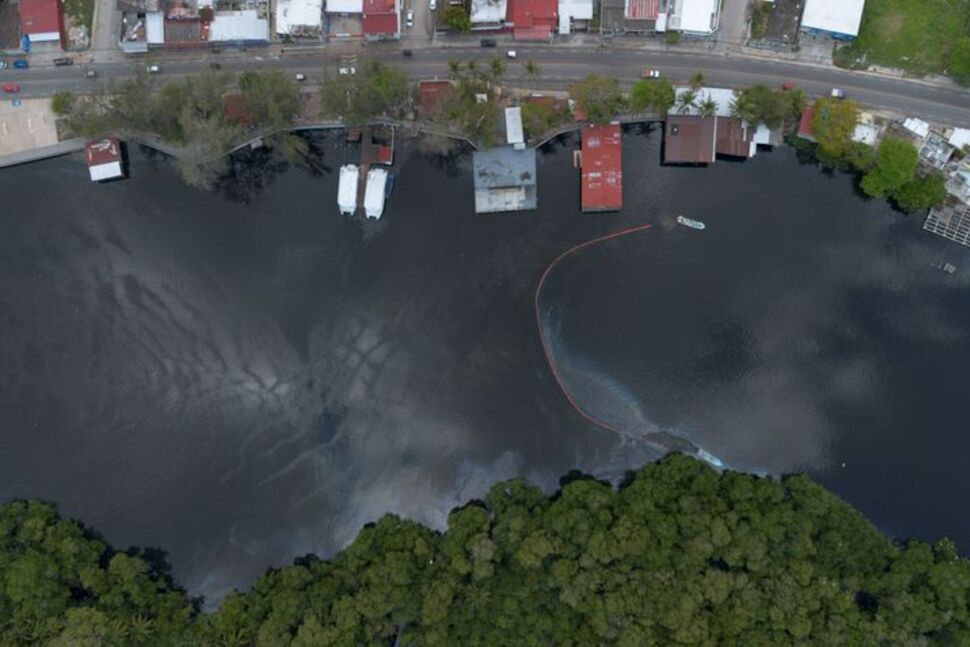
It also installed containment barriers along the Rio Seco, which surrounds the refinery and connects to the vast Mecoacan lagoon, where fishermen harvest oysters.
Pemex did not immediately reply to requests for further comment.
“The currents are deceptive, and it is possible that uncontrolled waste could reach the lagoon,” said biologist Alvaro Hernandez.
Hernandez noted that, for now, fishermen affected by the spill still plan to sell their catch during the upcoming Easter holidays, because they cannot withstand the loss of income caused by the crisis.
The spill in Olmeca is the latest, and the most serious to date, in a string of issues that the new refinery project has faced, including underproduction, an overrun budget, and delays in meeting targets.
It follows another spill reported in early March off the coasts of the states of Tabasco and Veracruz.
President Claudia Sheinbaum said that the company responsible for that disaster had not yet been identified, and environmental authorities were still investigating the cause of the spill.
Sheinbaum had previously stated that it might have originated from an oil tanker off the coast of Tabasco, a theory some experts are beginning to question given the extent of the damage.
The government agency responsible for environmental matters in the energy sector said that it did not yet have an estimate of the area affected by the spill.
The Olmeca refinery has a production capacity of 340,000 barrels per day (bpd), which it has not reached because the government is still ramping up production.
It is part of the Mexican government’s plan to refine more at home and wean the country off imports, most of which come from the U.S.
The Gulf of Mexico Reef Corridor Network, which brings together fishermen’s associations, indigenous groups, and environmentalists, recently issued a warning about the presence of oil along the coasts of Tuxpan and Cazones, in northern Veracruz.
It reported that at least seven sea turtles, two dolphins, two manatees, and one pelican have been found affected by the oil, most of them dead.
Red, black, and white mangroves in Laguna del Ostion, in Veracruz, have been affected, it said.
This unique ecosystem is home to the hairy crab and the blue crab, a protected species, as well as migratory birds and otters.
(Reporting by Luis Manuel López in Paraíso and Adriana Barrera in Mexico City; Writing by Iñigo Alexander; Editing by Stefanie Eschenbacher and Aurora Ellis)
Copyright 2026 Thomson Reuters.