


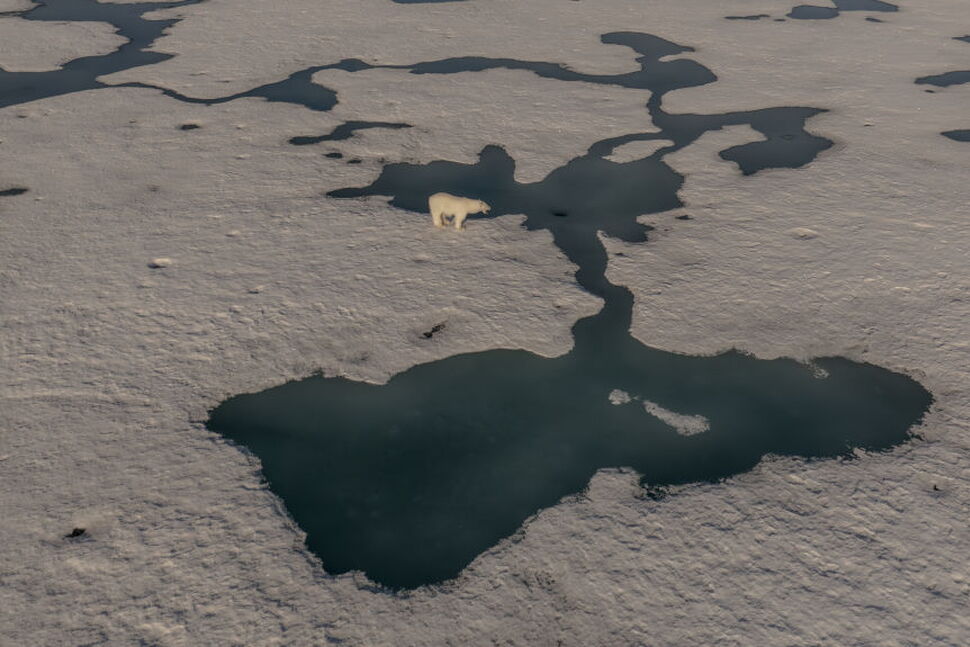
The Arctic Ocean may have reached a climate “tipping point,” according to researchers at the University of Edinburgh.
This week, they published a study in the Communications Earth & Environment journal detailing a massive loss of sea ice – that is, frozen water on the ocean’s surface – in the Arctic Ocean over the last few decades.
Sea ice plays an important role in moderating the temperatures of a body of water by reflecting sunlight. In its absence, water temperatures rise and, most critically, a nutrient known as nitrate is destroyed.
What role does nitrate play in the Arctic Ocean?
A reduction in nitrate could have impacts on the entire marine food chain – from sharks to seagulls to seals. Nitrate is directly responsible for the growth of plankton, which supports Arctic life. An absence of plankton could potentially lead to famine on the higher rungs of the food chain. The effects on commercial fishing, however, may require additional study.
How did the Arctic Ocean reach this point?
The researchers studied two decades’ worth of oceanographic data from the Fram Strait, where the Arctic spills into the Northern Atlantic, and found that around 2009 the ocean had reached an ecological tipping point. Decreasing sea ice led to a process called benthic denitrification. When sea ice decreases, a temporary algae blooms, sinks to the ocean floor and depletes oxygen. In that environment, the marine microbes consume nitrate.
What does this mean for climate change?
As the earth’s smallest ocean, the Arctic’s effect on the climate can be described as small but mighty, as it contains the most sea ice year-round. Sea ice, being reflective, reduces the absorption of solar radiation. According to the National Oceanic and Atmospheric Administration, it reflects roughly 50-70% of the sun’s energy on the planet. In its absence, this solar energy is instead absorbed, causing rising ocean temperatures and changes in the global climate.
Can it be reversed?
In short: Not meaningfully.
The resulting decrease in plankton due to reduced nitrates is “generally considered to be irreversible under continued warming,” the study says. Unfortunately, any changes in the Arctic’s Ocean’s climate are “unlikely to compensate for the magnitude of nitrogen losses described here.”