


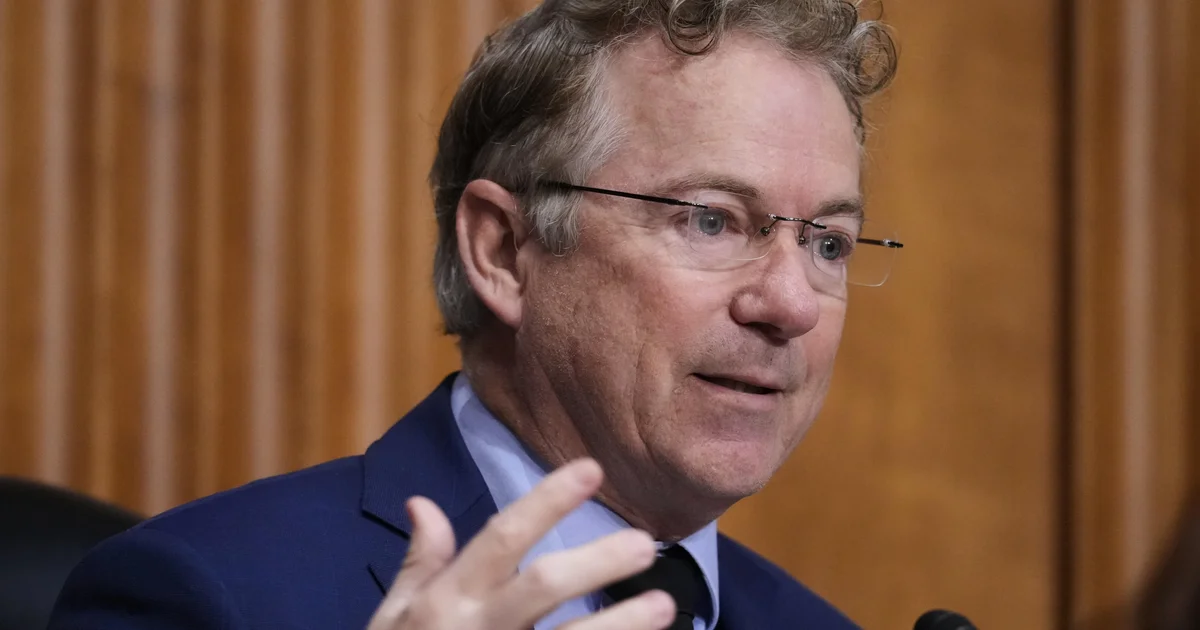
President Trump’s decision to launch strikes against Iran has won support from most Senate Republicans, but Kentucky Sen. Rand Paul is the lone exception.
Paul, the chairman of the Homeland Security Committee, said Mr. Trump should not have acted without congressional approval and argues that the president isn’t allowed to begin any military action in the absence of that approval or an imminent attack. For the senator, this moment is testing whether the Republican-controlled Congress will assert itself — as one of the country’s founding fathers, James Madison, intended.
“Madison said that we would give the legislature certain powers and the president certain powers. And as each tried to grasp for the power, they would check and balance each other,” said Paul. “I don’t think our founders ever imagined our current Congress that is completely lacking in ambition. They don’t check the president.”
As for checking Mr. Trump, Paul started doing that more than a decade ago, when they had competing White House bids leading up to the 2016 presidential election. Since then, the two have mostly patched things up. But the senator isn’t afraid to break with Mr. Trump, especially when he feels hawkish advisers are in the president’s ear.
“I think he was misled by some of the more aggressive people,” said Paul, adding that the president’s “basic instincts have been for less war.”
Should the Iran war escalate and continue, Paul said the political and economic costs could be significant.
“On the political landscape, I think the longer this goes on, the less likely Republicans are able to hold onto the House and Senate,” said the senator, who believes congressional Republicans may face another reckoning soon, as the Trump administration requests $200 billion of additional funding for the war.
Paul said he will not vote for the supplemental funding because he doesn’t want the war to continue. The Pentagon has not specifically responded to the news of how Paul has decided to vote.
“Most people will accept the argument and say, ‘Oh, you can’t quit funding ’em. They’re over there,'” he said of soldiers overseas. “But, actually, if they weren’t funded, they’d be brought home.”
Closer to home, the partial government shutdown continues over fully funding the U.S. Department of Homeland Security, snarling air travel and causing Transportation Security Administration workers to go for more than a month without pay.
On Friday, Mr. Trump signed an executive order to pay them using funds from the One Big Beautiful Bill that was passed late last year. But the government, Paul says, will keep facing fiscal standoffs.
“We’re going to have another one of these in six months, you know? The spending will expire come the end of September,” he said, since the bill to fund DHS would be effective through September. “So, I’m not against the fight. In fact, I want to make the fight such that we’re fighting over the increases and not the salaries.”
Making things even trickier on the homeland front is Paul’s testy relationship with Mr. Trump’s new pick to run DHS, Secretary Markwayne Mullin. Paul opposed the nomination over Mullin’s character and response to a 2017 incident where Paul was assaulted.
Mullin addressed the conflict with Paul in his opening statement after being sworn in as secretary, saying he “won’t back down from a challenge” and will also admit when he’s wrong.
Paul said he hasn’t had a conversation with Mullin since he was sworn in, but they’ll “operate in a professional manner as time goes on.”
The senator’s support of Kentucky Rep. Tom Massieanother Libertarian and Republican critic of the Trump administration’s handling of the Jeffrey Epstein files, is another flashpoint with Mr. Trump. The president has endorsed Ed Gallrein, Massie’s relatively unknown, pro-Trump opponent in the Kentucky primary election.
“You can like Donald Trump and Thomas Massie, because they represent a lot of the same things,” said Paul. “But Massie represents an independence of spirit that I think you want in your legislator. If you want a rubber stamp, we could just have AI.”
Paul’s maverick streak follows in the footsteps of his father, former Texas congressman Ron Paul, a Libertarian hero and three-time presidential hopeful. With the 2028 election just around the corner, the senator said he isn’t ruling out another run of his own.
“We’re thinking about it, and I would say 50/50,” he said, adding that he intends to decide after the midterms. “But I’m not going to do it just to do it. It would be, one, because we need to have a free market wing. We need to have a free trade wing in the party. And we need to have a wing of the party who’s not eager for war and tries to at least explore diplomacy as an option to war.”