Washington — The Senate will vote again Thursday on a measure to fund the Department of Homeland Security as an impasse over how to reform immigration enforcement agencies has grown ugly, nearly a month into a partial shutdown.
Since the fatal shootings of Alex Pretti and Renee Good by federal agents in Minnesota in January, Democrats have blocked all funding for DHS, holding out for reforms to Immigration and Customs Enforcement and Customs and Border Protection. Democrats and Republicans alike say they are nowhere near an agreement.
“We are in a negotiation, however, we are not close,” Democratic Sen. Brian Schatz of Hawaii said Wednesday.
The two sides have been trading blame in recent days as the shutdown’s strains have begun to be felt, with long security lines stretching through airports. TSA agents are set to miss their first full paycheck this week. Absences have more than doubled, and hundreds of TSA workers have quit.
“[Democrats] refused to sit down with us this week. Refused,” GOP Sen. Katie Britt of Alabama told reporters Tuesday. “That’s actually absurd.”
Republicans say Democrats aren’t coming to the negotiating table, claiming they refused a recent request to sit down with the White House.
But Senate Minority Leader Chuck Schumer told CBS News “that’s a lot of bull.” He said Democrats are “constantly in communication with the White House” and are “sending things back and forth.”
“It’s a substantive problem,” Schumer said. “The White House will not budge on things that Americans want — like warrants, like de-masking — plain and simple.”
Democrats have sought to restrict immigration agents from wearing masks and require them to display an ID and use body cameras. They have also demanded agents be banned from entering private property without judicial warrants, among other policy changes.
Senators brought the debate to the Senate floor on Wednesday. Democrats tried to approve a measure by unanimous consent to fund the other agencies that DHS oversees, including TSA, FEMA and the Coast Guard. Republicans blocked it, and countered with a measure to extend funding for all of DHS on a temporary basis to allow additional time to negotiate. Democrats blocked that.
Anna Moneymaker / Getty Images 
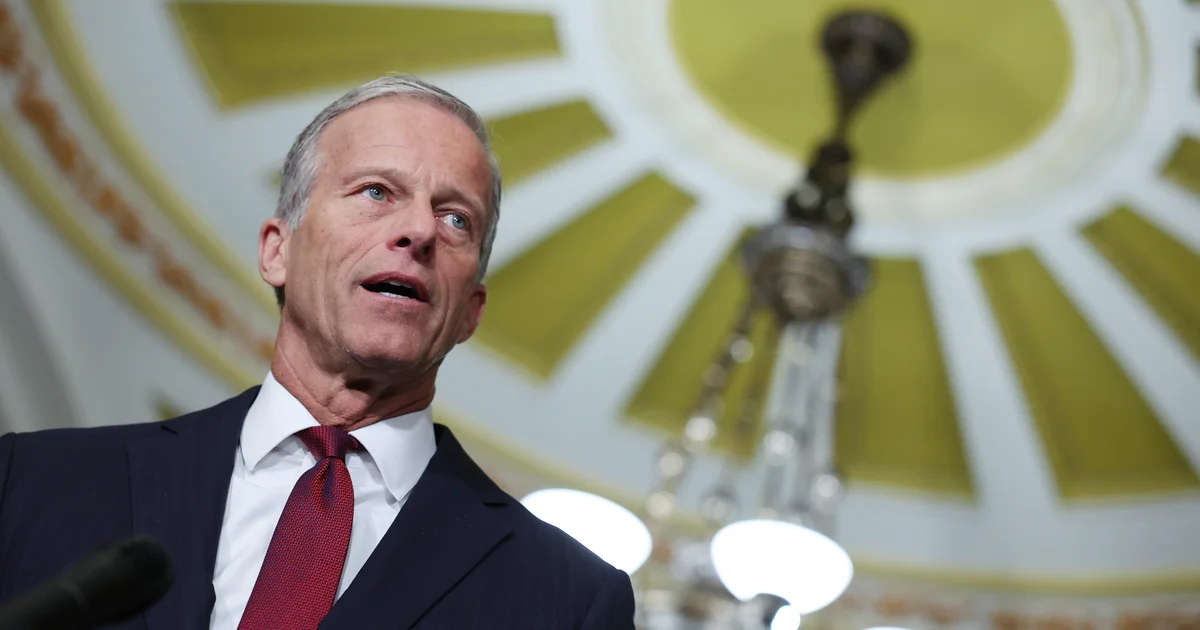
“We are trying to close a deal that would enable us to fund all the agencies that the Democrats say they want funded with reforms — with reforms to ICE,” an animated Senate Majority Leader John Thune said on the Senate floor amid the back and forth.
During the debate, Republicans noted that the latest proposal came from the White House more than 10 days ago, while railing against Democrats for their posture in the negotiations. Thune said that he’d seen the offer sheet from the White House, claiming that it goes “a lot farther” than even Democrats may have thought possible.
“This is a one-sided negotiation in which the White House has put forward a proposal, Senate Republicans have said repeatedly, ‘We are prepared to sit down and talk with Senate Democrats,’ and Senate Democrats … have said, ‘Sorry, we’re not ready to talk,'” Thune said.
Sen. Patty Murray of Washington, the top Democratic appropriator in the Senate, responded to the majority leader, saying that “having a few members talk is not going to resolve a situation where we need an understanding — and a clear understanding — from the White House.”
“I am willing to talk to people, but I’m not willing to sit in a room, have coffee, give away a few things, and have Stephen Miller override whatever we all agreed to,” Murray said.
Regarding the White House offers, Murray said there are “continual conversations at that level.” But she said it’s up to the White House to make it “very clear” that someone is willing to negotiate who “understands what has happened in cities across our country, and in particular in Minneapolis, where two people were murdered.”
“If we can hear those words, then I think we’re on the way to coming to an understanding,” she said.
Thursday’s vote comes after the Senate failed for a third time last week to advance the measure to fund DHS through September.
Asked what Democrats need to hear from the White House to get the negotiations on track, Schatz told CBS News on Wednesday that what the White House doesn’t understand is “the principles that we put forth at the outset, we just need to enact them.” He argued that doing so is also in the administration’s interest.
“They understand that they took one of their biggest political advantages and turned it into one of their biggest political disadvantages,” Schatz said. “So this idea that it’s a gift to us for them to get this rogue agency under control is a misunderstanding of the situation.”