


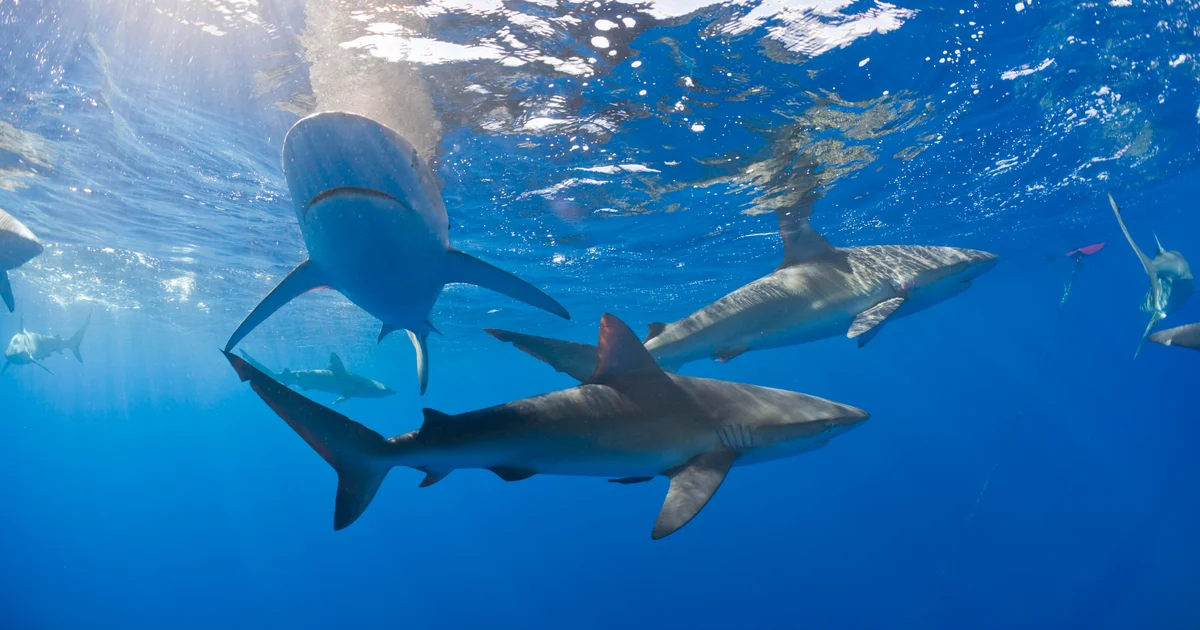
In recent years, local small-boat fishers who pursue prized bottomfish such as ehu, onaga and the red opakapaka that’s popular on table spreads across Hawaii each New Year’s have seen a troubling spike in sharks that swoop in and tear their catch off the hook.
“They’re basically losing money because they can’t bring in the fish,” said PhilFernandez, president of the advocacy group Hawaii Fishermen’s Alliance for Conservation and Tradition. “The fish markets won’t buy a fish that has a bite on it.”
The growing incidents, known as shark depredation, have grown so common in Hawaii’s coastal waters and other parts of the Pacific, he said, that many of those bottomfishers, trollers and others who rely on the catch for their livelihood are on the verge of giving up the trade.
Some fishers call such depredation “paying the tax man,” and the tax is growing. Reports indicate sharks now bite off catch in at least 1 of every 4 licensed fishing trips out on Hawaiian waters. The rates are currently at their highest on record in the 20 or so years the state has been collecting that data, aquatic biologist Bryan Ishida said.
Various shark repellents that exploit the animals’ aversion to certain chemicals, electric charges and magnetic fields are already for sale and used by ocean swimmers and fishers in other regions, such as Florida, where recreational fishing is a big draw.
However, researchers and fishers in the Pacific have only just started testing those repellents to see which types and designs might work best locally. So far, the results have been mixed.
“Personally, I didn’t really know anything about the Western Pacific, and so I would love to get out there and test,” said Eric Stroud, a managing partner with the research and development company SharkDefense, which makes chemical repellents.
He’s interested in getting to Guam in particular because incidents there are especially high. He wants to study how people there fish and see how his company could supply them with repellents.
Shark depredation was among the most pressing issues that fishers around the Pacific raised during a series of listening sessions that the Western Pacific Regional Fishery Management Council held last year. The group held a follow-up workshop in February on efforts to further address the problem and plans to report on the findings at Wespac’s next Scientific and Statistical Committee meeting March 17.
Meanwhile, scientists with the University of Hawaii Mānoa’s Hawaii Institute of Marine Biology are training local fishers to use forensic DNA kits on torn and bitten fish to trace which shark species nabbed their catch.
They’re also tracking shark movements over time to see how often they visit key fishing grounds, institute officials said, to ultimately try and reduce those encounters with small-boat fishers.
“We are building the first truly comprehensive effort,” institute research professor Carl Meyer said in an emailed summary, “to understand and mitigate shark depredation in these fisheries.”
Similar incidents of sharks stealing fish have unfolded in California, Massachusetts and South Carolina.
Magnetic fields and stinky erpellants
Fernandez, who’s been troll-fishing off the Kona Coast since the late 1980s, said shark depredation wasn’t an issue on Hawaii island when he started fishing there. The incidents only started to emerge in the past 20 years, he said, and then grew into a serious concern for small-boat fishers in the past several years.
It’s still not clear what’s causing the uptick in plundering, Stroud and others said. Some suspect it’s related to warming waters due to climate change driving the fish that sharks prey on to different areas.
“There’s a lot of speculation,” Fernandez said. Many fishermen think the local reef, Galapagos and tiger sharks as well as pelagic oceanic whitetips that visit the area have learned to associate small fishing boats with an easy way to grab a meal.
Reinhard Dirscherl/ullstein image via Getty Images 

Small boats that frequent the Penguin Banks fishing grounds — which are off of Molokaʻi — now constantly move around to avoid sharks spotted nearby. Some fishers turn off their engines the moment they catch a fish, Fernandez added, because they’re worried sharks connect the sound of the propeller to an easy meal.
“Sharks,” he said, “are very smart.”
They also have a unique sensitivity to magnetic fields that the ahi and other fish species sought by fishers don’t have. Developers have made products that use magnets and metal alloys to create magnetic fields in the water as a result to repel the sharks when they get within a few feet.
The magnetic fields can be very effective, Stroud said — akin to flashing a bright light in their eyes.
What’s needed to succeed, he said, is to design the repellents so they’re affordable and work seamlessly with the fishing gear used across various regions. Some of those tests have started off the Kona Coast, Fernandez said, but so far the electromagnetic repellents they’ve used aren’t very practical for fishing there.
“They’re too long and they’re the wrong shape,” he said. “The hooks tend to wrap around these devices, and now the hooks are all tangled up. So it’s a work in progress.”
Other repellents produce an electric charge in the water near the hook and bait, and Stroud said those devices tend to cost between $150 and $300 apiece.
Stroud’s company produces a chemical repellant that smells like decaying sharks. Some of the chemicals are synthetic, he said, but much of it is harvested from sharks caught legally off the Florida coast. In Hawaii, all shark fishing is prohibited.
The SharkDefense chemicals are part of a butter-like material, Stroud said, that’s either mixed into fishing chum or placed in a cage by the hook to melt in the water. It costs about $1 per hook, he said.
It might make sense, Stroud added, to use multiple types of repellants because sharks can sometimes “turn off” a sense temporarily when they get too stimulated or overwhelmed. If the shark turns off its electromagnetic sense, he said, the chemical repellent could work as a backup.
Mark Fitchett, a pelagic fisheries scientist, said local small-boat fishers hold a range of views on the sharks and their growing depredation. Many of them are fed up and believe the sharks benefit from too many environmental protections, Fitchett said, but other fishers see the changes as the cost of having a relatively healthy ecosystem.
“A lot of them also recognize that it’s part of their island culture that these animals are sort of … the gardeners of the water,” he said. “So there’s that respect for the animal.”
Now, Fitchett said, the question is how much depredation they can accept and still keep going.
Wespac will further discuss the issue at its next quarterly meeting, March 24-26, at the Ala Moana Hotel. Fitchett said the council plans to release a more detailed report on the situation several weeks after the meeting.