


By John O’Donnell and Andreas Rinke
BERLIN, March 31 (Reuters) – Germany’s far-right Alternative for Germany party has used surging energy prices to revive its longstanding call for Berlin to turn once more to Russia for cheap energy after scoring some of its best results in two state elections this month.
German petrol prices have jumped by more than 15% since the U.S. and Israel began their war on Iran a month ago, and the AfD’s argument won a ready hearing this month among voters in Baden-Wuerttemberg, a centre of the German car industry.
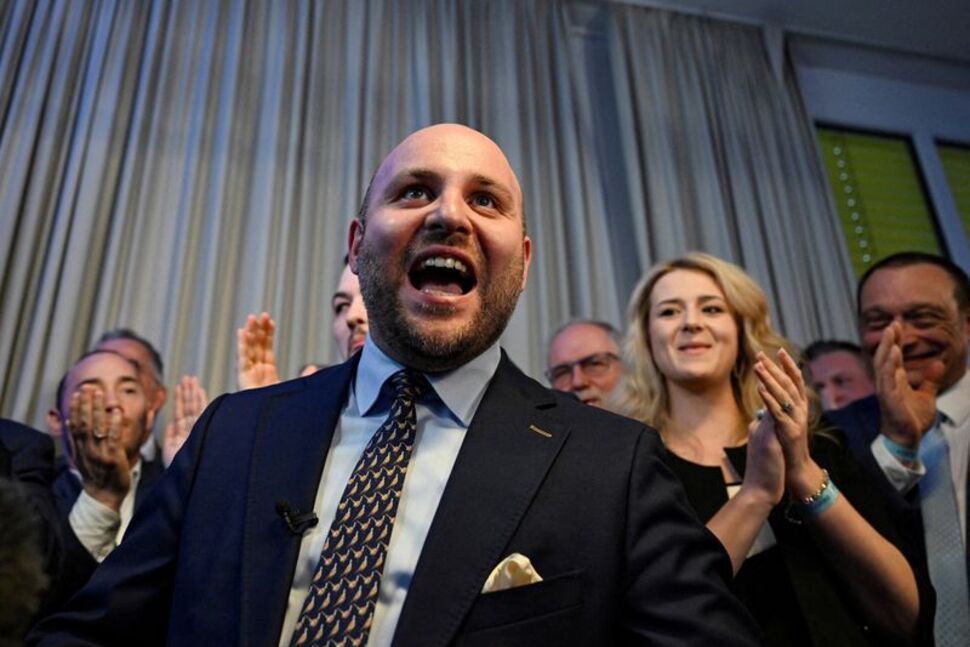
“That was the defining issue,” said Markus Frohnmaier, the AfD’s leading candidate in Baden-Wuerttemberg, pointing to energy prices around twice as high as those in China or the United States.
“This election campaign was all about the economy, the economy, the economy.”
AFD NOW GERMANY’S SECOND PARTY
The AfD consolidated its position as Germany’s second party by winning around 20% of the vote in both Baden-Wuerttemberg and in neighbouring Rhineland-Palatinate, where it recorded its best ever result in a western state.
“The situation in the German economy at the moment is dire,” Frohnmaier said. “It is essential for Germany’s energy sovereignty, as well as for affordable electricity … that Germany begins to import Russian gas and oil again.”
Russia had supplied over a third of Germany’s crude oil imports and more than half of its natural gas needs, until Moscow’s invasion of Ukraine in 2022 and the abrupt shutdown of the Nord Stream pipeline left Berlin scrambling to find alternative suppliers, which now include Norway, the Netherlands and Belgium.
With the exception of indirect imports of small quantities of liquefied natural gas, it has eliminated Russian oil and gas from its energy mix, statistics office data shows.
For two decades, under chancellors Gerhard Schroeder and Angela Merkel, Germany’s economic model had been built around access to cheap Russian energy. The shock helped push Germany into a two-year recession from which it has only just begun to emerge.
Combined with steadily mounting job losses at manufacturers squeezed by higher energy costs and growing competition from China, this has helped to create fertile ground for the AfD’s promotion of Russian energy.
“This argument is much more closely linked to people’s everyday lives than abstract geopolitical statements,” said Johannes Hillje, a political scientist and specialist in the AfD.
For many in Germany’s main parties, the calls for a return to Russian energy are part of a wider drive, by a party long accused of being sympathetic to Moscow, to undermine Russia’s isolation.
“The AfD is deliberately promoting Russian narratives in Germany,” said Roderich Kiesewetter, a member of parliament’s foreign affairs committee from Chancellor Friedrich Merz’s conservative Christian Democrats (CDU). “It would be disastrous for European security and the trust of our partners if imports of Russian oil and gas were to increase.”
GERMANY’S AFD HELPING TO END RUSSIA’S ISOLATION
But he acknowledged that, even among his fellow Christian Democrats and their Social Democrat coalition partners, some were making similar calls for the restoration of trade and economic ties with Russia.
The AfD, which last month won an injunction preventing Germany’s domestic intelligence agency classifying it as “extremist” for the moment, is often characterized as far-right, though it disputes the label. Shunned by other parties, it has made strong gains among younger and working-class voters.
Frohnmaier said it was not for German politicians to worry about the possible boost to Moscow’s war effort from buying Russian gas.
“We weren’t elected to represent the national interests of Ukraine,” he said.
The AfD initially made strong inroads among voters thanks to its opposition to a sharp rise in immigration over recent years, but has increasingly expanded its focus to include economic issues.
“People vote for the political party they believe is capable of solving the current problems,” Frohnmaier said, dismissing the argument that Germany had already secured alternative sources of oil and gas.
In eastern Germany, where the AfD has a strong chance of winning power in Saxony-Anhalt in one of three state elections being held in September, the argument is likely to have even more force.
“There is a widespread view in the German public that cutting ties with Russia was a mistake,” said Michael Kretschmer, CDU premier of the eastern state of Saxony. “The further east you go, the stronger this feeling becomes.”
(Writing by James Mackenzie; Editing by Kevin Liffey)
Copyright 2026 Thomson Reuters.
Photos You Should See – March 2026

