


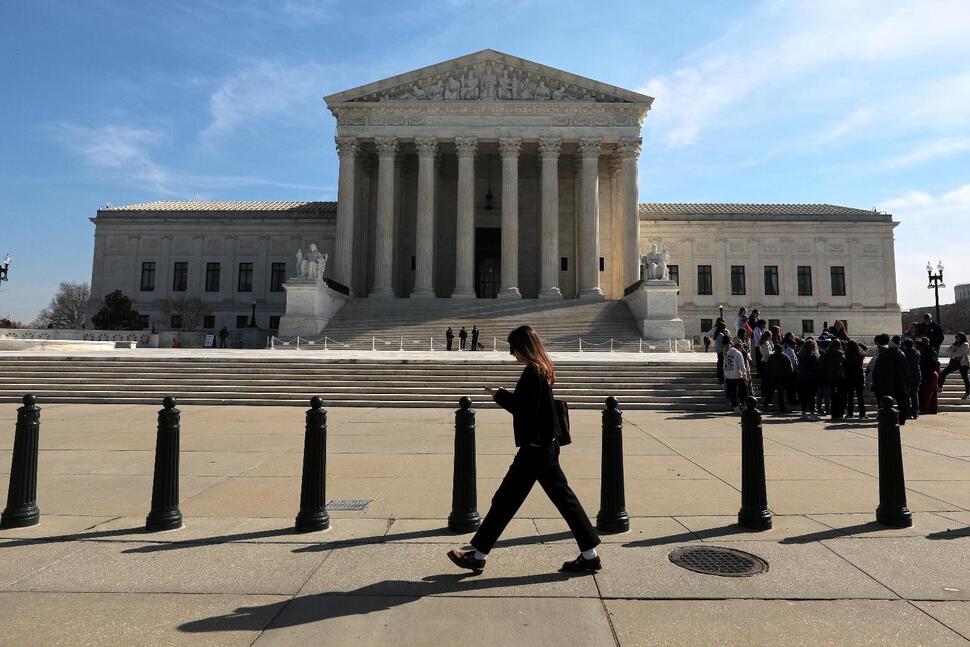
Doug Evans, a now-retired prosecutor with a history of dismissing Black jurors for discriminatory reasons, knocked all but one Black person off the jury that tried and convicted Terry Pitchford.
Judge Joseph Loper allowed it to happen. The state Supreme Court upheld the conviction.
Just seven years ago, in a case involving the same district attorney, trial judge and state high court, the Supreme Court overturned the death sentence and conviction of Curtis Flowers because of what Justice Brett Kavanaugh described as a “relentless, determined effort to rid the jury of Black individuals.”
Seven of the current nine justices were on the court then.
The Supreme Court has in recent years taken a dim view of defendants’ claims in capital cases, especially in the last-minute efforts to stave off execution. Last week, the court turned away the appeal of Texas death row inmate Rodney Reed over the dissent of three liberal justices, who believe he should be allowed to test evidence that he has argued would exonerate him.
Claim of racial discrimination
But the court in December agreed to hear Pitchford’s appeal relating to a claim of racial discrimination that, in other cases, has gained traction even among some conservative justices.
Pitchford was sentenced to death for his role in the 2004 killing of Reuben Britt, the owner of the Crossroads Grocery, just outside Grenada in northern Mississippi. Pitchford, 40, was 18 when he and a friend went to the store to rob it. The friend shot Britt three times, fatally wounding him, but was ineligible for the death penalty because he was younger than 18. Pitchford was tried for capital murder and sentenced to death.
The case has been making its way through the court system for 20 years. In 2023, U.S District Judge Michael P. Mills overturned Pitchford’s conviction, holding that the trial judge did not give Pitchford’s lawyers enough of a chance to argue that the prosecution was improperly dismissing Black jurors.
Mills wrote that his ruling was partially motivated by Evans’ actions in prior cases. A unanimous panel of the 5th U.S. Circuit Court of Appeals reversed the ruling.
In the course of selecting a jury, lawyers can excuse a juror merely because of a suspicion that a particular person would vote against their client.
The Supreme Court tried to stamp out discrimination in the composition of juries in Batson v. Kentucky in 1986. The court ruled then that jurors could not be excused from service because of their race and set up a system by which trial judges could evaluate claims of discrimination and the race-neutral explanations by prosecutors.
In Pitchford’s case, the prosecution excused four of the five remaining Black people in the jury pool and defense lawyers objected. Loper, the judge, accepted all four explanations and moved on without analyzing whether race was the reason, Mills wrote.
Issues in Pitchford’s case
The Supreme Court case focuses on whether Pitchford’s lawyers did enough to object to Loper’s rulings and whether the state Supreme Court acted reasonably in ruling they had not.
Joseph Perkovich, who will argue Pitchford’s case Tuesday, said the record in the case clearly favors his client. Loper “did not grasp he had to a constitutional duty to determine whether the reasons the district attorney gave for striking the Black citizens were credible and truthful,” Perkovich wrote in an email. “The judge simply failed even to try to discharge that critical duty, despite the defense’s efforts.”
In the state’s written filing, Mississippi Attorney General Lynn Fitch defended the state Supreme Court decision and said Evans did not inappropriately strike Black people from the jury.
Pitchford should be released or retried if he wins at the Supreme Court, his lawyers argued in written filings. Mississippi said the case should return to the state Supreme Court to review his arguments that the jury strikes were discriminatory.
Flowers was tried six times in the shooting deaths of four people. He was released from prison in 2019 and the state dropped the charges against him the following year, after Evans turned the case over to state officials. Evans stepped down from his job in 2023.
On its own, Mills wrote, the Flowers case does not prove anything. But he said that the Mississippi Supreme Court should have examined that history in considering Pitchford’s appeal.
“The court merely believes that it should have been included in a ‘totality of the circumstances’ analysis of the issue,” Mills wrote.
Copyright 2026 The Associated Press. All rights reserved. This material may not be published, broadcast, rewritten or redistributed.
Photos You Should See – March 2026

