For some 30 years, the U.S. Department of Agriculture has released an annual report on the number of Americans living with food insecurity. The Trump administration ended that report, calling it “redundant” and “politicized.” But getting rid of the data doesn’t erase the problem – or the desire to fix it.
At the Community Food Share near Boulder, Colorado, there is a traffic jam of shopping carts. Thirty-three-year-old Shannon Patrick waited patiently. She knows the routine. She’s a reluctant regular here.
With the way her 12-year-old is growing, she says her cart of goods may last a week.
Patrick is a single mother of three, working full time as a behavioral technician, helping kids with autism. But despite her profession and her education, she barely gets by on her $2,000 a month salary. Tack on rent, student loans, and clothes for the kids, and there’s very little left for food.
“I thought that if I got my bachelor’s degree, if I got my master’s degree, that that would open up so many doors,” she said. “I wouldn’t have to rely on the government. But it just seems like it’s not like that.”
CBS News 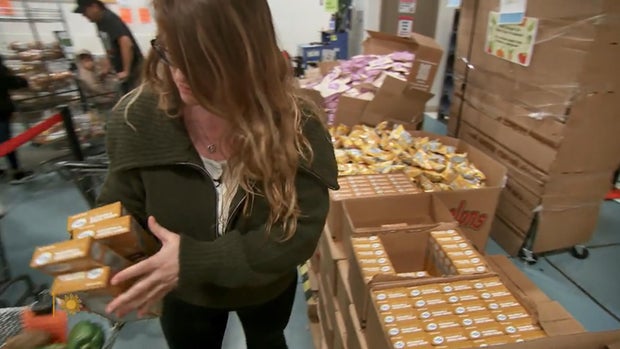
Like most dealing with food insecurity, she’d rather not talk about it. But she agreed to, for us, because she wanted to show others they’re not alone. “It’s just like this feeling that society puts on you that you’re less than, or you’re dirty, because you have to get this assistance,” she said. “And I feel almost guilty that, like, I have these children and I should be able to take care of them, but I’m failing.”
According to the USDA, almost 48 million Americans don’t get enough to eat. Shockingly, about 14 million of those are kids.
Claire Babineaux-Fontenot, the CEO of Feeding America, the nation’s largest hunger relief organization, said, “There’s a notion of earned hunger. The reality is, that is not manifestly true. Hunger happens here often times in spite of a lot of hard work.”
Just two years into Babineaux-Fontenot’s tenure, the pandemic hit. “During COVID, one of the areas that Congress had the most bipartisan engagement on was hunger,” she said. “Food insecurity rates went down to one of the lowest rates we’ve ever had. Most people have no idea that it’s true, but it is.”
But what happened after COVID? “I guess we thought it was done,” she said.
If nothing else, Babineaux-Fontenot says, COVID proved that hunger can be fixed.
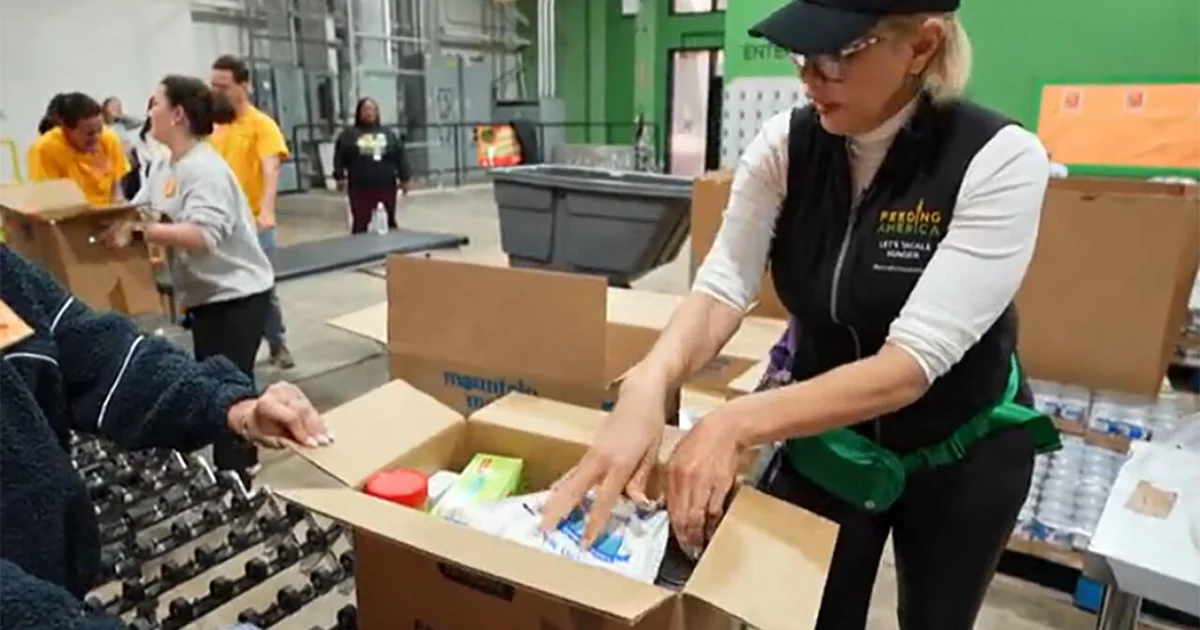
We caught up with her at Southern Louisiana’s Second Harvest Food Bank, one of the hundreds of pantries and food banks under the Feeding America umbrella. Out of kitchens like this one, Feeding America distributed nearly six billion meals last year.
But it still fell short.
CBS News 
“You can see in the shot of the camera a lot of food,” Babineaux-Fontenot said. “And that probably leads to a misconception that there is enough food. There’s not enough food. Some of the saddest things I’ve ever seen with food bankers is when they have to turn people away.”
One family’s beneficence
Claire was the first of her family to go to college. She put herself through law school, too. And then, she hit a bump in the road. “I went into my refrigerator, my little teeny-weeny apartment, and I realized that I literally had nothing to eat.”
The memory made her emotional. “It’s interesting how something can happen that long ago and how it can feel like it’s happening right now,” she said.
She’d heard of the Salvation Army. She didn’t want to go. She had to go. “I can remember barely talking above a whisper,” Babineaux-Fontenot said. “And then I remember this lady, she walked up to me and she just had this beautiful, warm smile, and she said, ‘You need some help, baby?’ And I said, ‘Yes, ma’am.'”
The power of that single act of kindness followed Babineaux-Fontenot the rest of her life. She went on to become a tax attorney, rising to executive vice president and global treasurer for Walmart, no small job. But in 2015, she was diagnosed with breast cancer. It was a tap on the shoulder, she says, to re-prioritize her life. So, she quit Walmart, and made a leap that she thought her parents would understand more than anyone.
Mary Alice and Warren Babineaux are both gone now. But in their hometown of Opelousas, Louisiana, the family was known for helping shelter, feed and love almost any child they knew was in trouble. So much so that Babineaux-Fontenot ended up with 107 siblings. Some of them are biological, some adopted, some fostered – but Babineaux-Fontenot won’t tell you which is which. “I don’t answer that question, mostly because, in the not answering, I get to say this: that is the least important thing about our family,” she said.
Cynthia, one of Claire’s multiple sisters, told us, “My parents truly believed in feeding the neighborhood. I will never forget one day, a young man came to the home, directly from the hospital, with his hospital gown. He said, ‘Mrs. Babineaux said if I’m hungry, come to the house and I will get food.’ And my response was, ‘Absolutely!’ And I prepared a meal for him.”
This past Christmas, about two dozen Babineauxes gathered at the old family house to make food boxes for a nearby senior center, just as their mom used to do.
Claire said, “As long as we do this, we keep the things that she thought were important, we keep those alive.”
CBS News 
Seeing need is something Claire was taught. Healing it is something she’s practiced. And recognizing need, even in herself, is opening the door to her next chapter.
After more than seven years, Claire Babineaux-Fontenot will be stepping down as Feeding America’s CEO next month. For what? She’s not really sure. At 61, she and her husband, with two grown kids of their own, might just start being foster parents themselves, she says: “I am deeply committed to this work, and I will always be committed to this work as long as there’s work to be done.”
Back in Colorado, Shannon Patrick is part of that unfinished work. The kids are cared for, but who is there to care for her? She says there are times she has gone hungry to make sure her children are fed. But this week there are breakfast burritos for dinner. Everyone seemed happy. Still, next week this family’s hunger clock resets back … to zero.
“That doesn’t mean that we’re bad people, or that we’re less worthy,’ Patrick said. “We still should be able to eat. Just because we’re low-income doesn’t mean that we don’t deserve to do the same things as other people.”
For more info:
Story produced by Michelle Kessel. Editor: Carol Ross.
See also: