


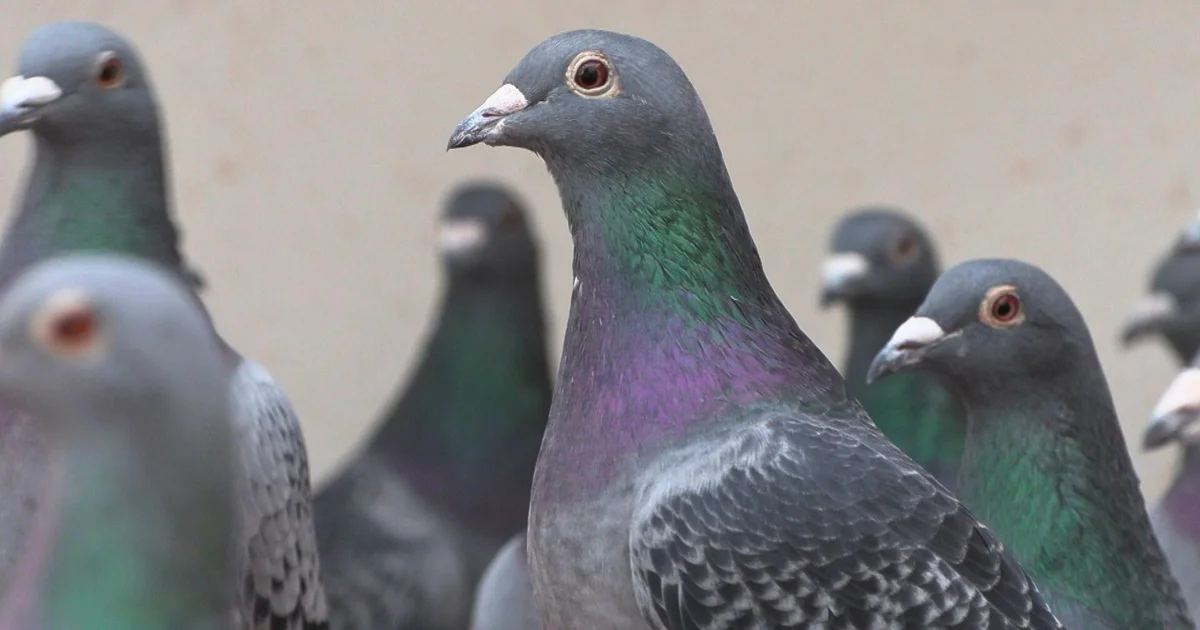
60 Minutes has reported on plenty of high-profile crimes before — but nothing like the “fowl play” involving the Columba livia domestica. That’s not some international crime syndicate. That’s the scientific name for pigeons, and they’re being stolen. We’re talking about elite racing pigeons. The finest compete at international events in which they are released far from home and must find their way back. As prizes have risen up into the millions, the birds have become targets for what insiders call — “the pigeon mafia.”
The Flemish region of Belgium is a land of medieval towers and fine chocolate. It’s also home to some of the most sought-after birds on earth. Yup – these guys.
What Kentucky is to thoroughbred horses, Belgium is to racing pigeons. and there are few better at breeding a champion than Tom Van Gaver. where some see a bird that looks like it’s trying to remember how to breathe, Van Gaver sees an elite athlete with a calculating gaze.
Sharyn Alfonsi: What makes this pigeon a great racer?
Tom Van Gaver: Yeah, he has everything a good racer need to have. But of course we cannot look in the head. You can have a very smart pigeon, but when the body is not strong enough, his head want to go home. But– the body cannot follow the others, so..
Van Gaver breeds, sells, and races his pigeons at events around the world such as this. The weight of his dominance can be seen inside his modest home.
But in his pigeon loft out back, are his real prizes. Pigeons that can fly hundreds of miles at highway speeds, feathered Ferraris worth a fortune.
60 Minutes 

Sharyn Alfonsi: How much could you get for all the pigeons out there?
Tom Van Gaver: I think around $10 million.
Sharyn Alfonsi: $10 million in pigeons?
Tom Van Gaver: Yeah, for these 300 sitting here.
This was his greatest. His name was Finn. In a sport in which pedigree is everything, Finn was the Secretariat of the sky. Pigeon breeders, known as fanciers, travelled across oceans just to take a picture with Finn.
Tom Van Gaver: People all recognize him because of his color. But, of course, he was a very good racer and, of course, a very good breeder.
Finn was not for sale, but he was a priceless stud. Fanciers paid up to $100,000 for Finn’s offspring. And then one night, as Van Gaver slept, a nightmare unfolded in his pigeon loft.
This surveillance video is from 2024. Finn was in his favorite spot when he was snatched by an intruder.
Tom Van Gaver: It’s like the Mona Lisa from the pigeon sport they stole.
Sharyn Alfonsi: Why the Mona Lisa?
Tom Van Gaver: Yeah, because it’s famous. Maybe it’s old and it’s not for sale but everybody wants to see it.
Six other pigeons were also abducted.
Tom Van Gaver: The first time you watch it, and the second time and the third time. And then start to look, “who-who who is he?”
The whodunnit was among 35 pigeon robberies across Belgium over the last three years. High value racing pigeons have also been stolen in Great Britain, South Africa, and the United States. This tape was from an unsolved caper in 2023 outside Philadelphia.
To understand what’s behind this avian crime wave and why a member of our species would risk jail time to steal a member of this species, we visited Ryan Zonnekeyn.
Sharyn Alfonsi: So what is different about this pigeon than the pigeon I’m gonna see in New York– defacing a statue?
Ryan Zonnekeyn: They’re bred for the performance, for their racing abilities.
Zonnekeyn is a Canadian fancier who calls himself “the pigeon boss.”
Sharyn Alfonsi: When you’re holding a pigeon in your hand, what is it you’re looking for?
Ryan Zonnekeyn: It’s gotta be like a steel bar. But then it has to be as light as an empty soda can. And the feathers have to be like the most beautiful woman’s hair: soft, and silky. That’s how it’s gotta be. And then the eye has to look like you’re at Tiffany’s.
Sharyn Alfonsi: Look like you’re at Tiffany’s. The pigeon eye?
Ryan Zonnekeyn: The eye of the pigeon, yeah.
That eye, to the uninitiated, looks more like a panic button. Pigeons don’t walk so much as glitch. Their coloring resembles concrete tinged with the broken rainbow of a parking lot oil slick. And when they take flight, they can make you look like a Disney princess that’s hit rock bottom.
Sharyn Alfonsi: No!
Ryan Zonnekeyn: They– they fixed your hair for you. See…
Zonnekeyn moved from Canada to Belgium because he loves pigeons — like a lot.
Ryan Zonnekeyn: If– if this was a room of hens, of women, pigeons, females– hens– and you came in here every day, and I said hello– “Hi, girls. Hi. Hi. Hi. Hi.” And I look– I look at her, and she sits up here, and I– ooh, ooh. You talk to her a little. Ooh. Talk a little bit. Look at her, and you make eye contact with her. Just like a girl at the bar.
The love affair Europe has for pigeon racing began in the 1800s and grew into a working class sport.
Ryan Zonnekeyn: There’s not a feeling like when you sit there on a weekend and wait for your pigeons, and you see them come home. It’s like, “Wow I did this.” You’re the coach, you’re the nutritionist, you’re the scout. It’s the best.
But purists have seen the sport change as prize money has soared. It started about 20 years ago with a new kind of competition called one loft racing, in which fanciers from around the world battle for millions of dollars.
Ryan Zonnekeyn: It’s a beautiful idea but when there’s money involved it’s not the same.
We went to a one-loft race in Portugal to see how it works. Months earlier, fanciers shipped their best young prospects to the race loft so the pigeons could learn to recognize it as their home. The cost to enter a bird is about $500. The more pigeons, the larger the pot of prize money.
all racing pigeons are identified by leg bands. Just before the race, each of the 3,300 birds is scanned into a database, and then driven 300 miles away to be released.
The first pigeon to find their way back into the loft wins. Six hours later a spotter at the finish blew a whistle to signal the leaders were circling above. The first into the loft got the biggest cuts of the $1.2 million purse.
Ryan Zonnekeyn: It’s crazy. You only see the last 30 seconds of a pigeon race. Isn’t that something?
Sharyn Alfonsi: People refer to it as a sport.
Ryan Zonnekeyn: It’s a sport.
Sharyn Alfonsi: Is it a sport?
Ryan Zonnekeyn: Sure, it is. Is horse racing a sport? It’s a sport.
And as the prizes have climbed, so has the demand for the fastest pigeons. One loft winners are considered blue chip assets. Their DNA is like an atm, producing descendents that can sell for hundreds of thousands of dollars.
Ryan Zonnekeyn pays his bills by auctioning Belgian birds online.
It all has an infomercial feel, well lubricated with gin and tonic.
On this night, the highest bids topped three grand. But that’s chicken feed compared to the largest auction player in Belgium. It’s called Pigeon Paradise or PIPA for short.
Sharyn Alfonsi: How many pigeons do you sell a year and about how much– total sales are we talking about?
Nikolaas Gyselbrecht: I think about 40 million euro.
Sharyn Alfonsi: Are you kidding me? (LAUGH) which is, like, $46 million in pigeon sales a year.
Nikolaas Gyselbrecht: Yeah.
Sharyn Alfonsi: Whoa.
Nikolaas Gyselbrecht: I mean, there is still a big potential.
Nikolaas Gyselbrecht started PIPA when he was 18. About half of the sales go to Chinese buyers, who are even more obsessed with pigeons than the Belgians. In 2020, a Chinese tycoon paid a record $1.8 million for one bird. China has over 400,000 registered pigeon fanciers, with 5-star luxury lofts and races offering as much as $16 million in prizes.
Nikolaas Gyselbrecht: If we don’t have China, it would be very hard to run the business.
Sharyn Alfonsi: Because why?
Nikolaas Gyselbrecht: Because they– they make the price.
More big spenders have followed from the Middle East. The result? A global arms race for wings. with so much money at stake, the bad guys moved in and began to steal the sports superstars.
Ryan Zonnekeyn: They’ll have the people come in and look at the pigeons. Somebody who’s or– orchestrating it. And then they send other people maybe a week later, a month later, a year later, take them. And normally the time when breeding starts, in the end of November, December, January. That’s when all the key birds will be paired together. Easy stealing, right?
Sharyn Alfonsi: We’ve heard people talking about a pigeon mafia. Is that a thing?
Ryan Zonnekeyn: Yeah, I think there is…again there’s money involved.
Fanciers and investigators told us they believe international gangs are behind smuggling networks that breed the stolen pigeons to sell their offspring on the black market to fanciers anxious to supercharge their bloodlines. This batch — stuffed in socks and hidden in a briefcase — was stopped in December at Latvia’s border with Russia.
Sharyn Alfonsi: Have you seen crazy security at these lofts now?
Ryan Zonnekeyn: Oh yeah.
Sharyn Alfonsi: What have you seen?
Ryan Zonnekeyn: Oh, I– multiple cameras– laser beams going across.
So now – panicked fanciers in Belgium are turning to this soft-spoken veterinarian to help protect their pigeons.
Ruben Lanckriet: There are some droppings on this.
Sharyn Alfonsi: There sure are.
Ruben Lanckriet: That can happen.
Ruben Lanckriet is a pioneer in genetic testing on pigeons. That’s a thing. He maintains a database of over 70,000 birds that stretch back over 10 generations.
Ruben Lanckriet: It has been very important in proving parentage, father and mother for sale of pigeons.
He showed us how he plucks genetic samples from feathers.
The idea is his genetic library offers some protection from the pigeon mafia because a stolen pigeon or its offspring could be identified by DNA and make it too risky to sell or race. And that gets us back to Tom Van Gaver and his missing masterpiece, Finn.
This is the point in the story where you might expect to hear from hard charging detectives who took on the case. But the Belgian Federal Police wanted 60 Minutes to agree to what we might ask in an interview, what they might say and what we could report. That didn’t fly with us.
So, here’s what we learned from sources close to the investigation:
Police combed through security camera video, license plate reader data, and cellphone records tied to a dozen robberies across Belgium, including Tom Van Gaver’s. hat led to a raid in March 2025 in a Brussels suburb on this yellow house and a Romanian national. 1,200 miles away – Romanian cops also searched the homes of some of his relatives. In all, 87 pigeons were found that appeared to be birds stolen from Belgium. The identity rings were gone so cops turned to Ruben Lanckriet and his genetic testing. His DNA analysis helped identify 20 of the recovered pigeons, including two of Finn’s grandchildren.
Ruben Lanckriet: Pigeon thefts have been– happening–
Sharyn Alfonsi: But now you can solve them, right, with DNA–
Ruben Lanckriet: With DNA, yes, that’s– that’s a very good– now we can close the case
Well, kind of. Eight co-conspirators were convicted, with the mastermind sentenced to 30 months in jail. But he won’t reveal what happened to the rest of Tom Van Gaver’s stolen pigeons, including Finn.
Tom Van Gaver: Where are the pigeons? Give them back.
Sharyn Alfonsi: This isn’t about the money for you. This is about the pigeon.
Tom Van Gaver: I want my pigeon back.
Produced by Guy Campanile. Associate producer, Erin DuCharme. Edited by Craig Crawford.