


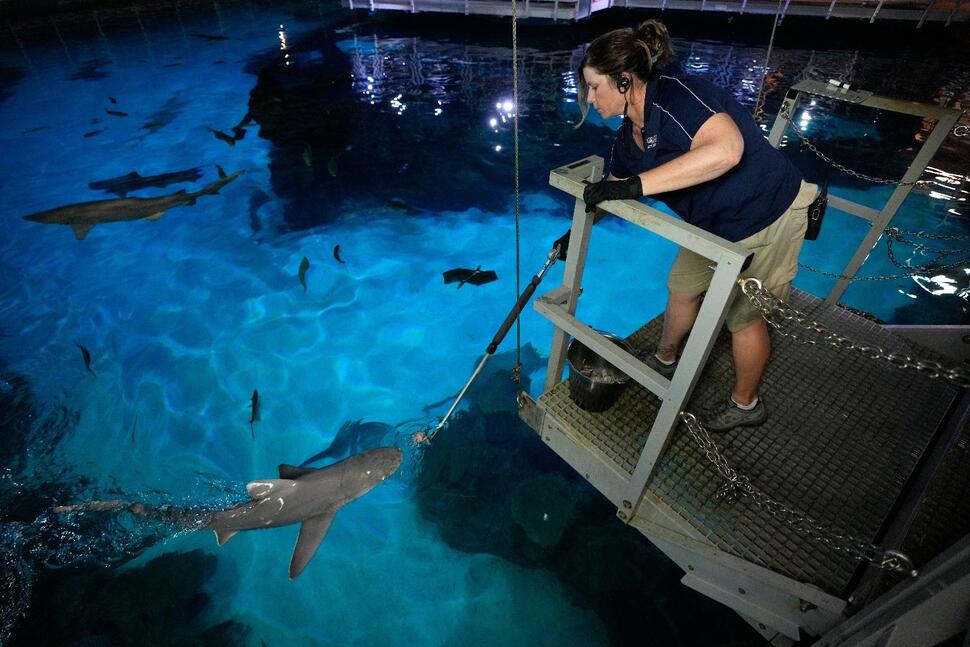
LAS VEGAS (AP) — When Becky O’Brien dangles herring over a tank of over a dozen swimming sharks, it only takes seconds for a zebra shark to snatch the fish from her tongs.
The lead aquarist said she always knew she wanted to work with marine life; she just didn’t think she’d be a shark dietitian at a 1.3 million gallon tank and Las Vegas casino. O’Brien’s team feeds 15 species of sharks three times a week at the Shark Reef Aquarium at the Mandalay Bay Resort, where they tend to over 3,400 animals.
“They eat, I would say, better than the tourists on the Strip,” O’Brien said, referring to the gourmet restaurants in Las Vegas’ biggest tourism hub.
The aquarium is a major tourist attraction that has drawn over 21 million visitors to the resort and casino since it first opened in 2000, according to Mandalay Bay.
Las Vegas sharks eat high-end seafood
Sharks’ diets consist of proteins and lipids in order to maintain their fatty livers, which allow them to move up and down in the water, said Samantha Leigh, a professor at California State University, Dominguez Hills, who focuses on marine animal nutritional physiology.
In the wild, sharks eat a diverse mix of prey across the food web, ranging from microscopic zooplankton to seals and even other sharks, Leigh said. In captivity, many sharks are fed restaurant-quality seafood, she said.
The sharks at Mandalay Bay are fed a mix of mackerel, herring, blue runner and sardines in an effort to give them a varied diet like they’d have in the wild, O’Brien said. Some of the fish are wild-caught, while others come from sustainable fisheries, she said.
In one week the aquarium goes through over 300 pounds (136 kilograms) of fish, O’Brien said.
The fish are stuffed with vitamins, and they need to be hidden in the food to ensure the animals won’t spit them out — the staff’s version of giving a dog its medicine covered in peanut butter, O’Brien said.
Also like dogs, the sharks are trained to be rewarded with food for specific behaviors. The zebra sharks touch a target in order to receive food, and animals learn to go to specific areas of the tank for their meals.
Why sharks might turn down food
Lunchtime provides a chance for the staff to examine the animals. They can tell a lot about the sharks’ conditions based on how they’re eating. If they turn down food, they may have an illness, or they may be interested in mating, O’Brien said.
Sharks are ravenous before breeding season, but many of the male sharks will eat little during the season, which runs from March to June.
“Once you get to work with these guys on a daily basis, you do learn little nuances of how each one feeds a little bit differently,” O’Brien said. “Each species is a little bit different.”
The zebra sharks are one of the aquarium’s endangered species whose population has declined drastically due to fishing and coral reef habitat loss. The aquarium partners with other organizations across the globe to transport zebra shark eggs to Indonesia for rewilding to restore wild populations.
O’Brien hopes people watching the feedings will raise future generations to “care about the ocean and then hopefully protect it, to love it as much as we do,” she said.
Taking care of older sharks
Many of the aquarium’s sharks are living well beyond the years they would in the wild, said Jack Jewell, the aquarium’s general curator.
Jewell pointed out an old sand tiger shark that was moving slowly. He estimated the shark is between 33 and 36 years old — around 10 years older than their typical max age in the wild.
As they get older, sharks have a harder time catching prey, Jewell said. He compared staff’s work at the resort to food delivery drivers who bring meals to people’s doorsteps.
On a recent day, visitors watched the sharks, sea turtles and lookdown fish — silver fish cleverly named for where they look while they swim — meander around the decorative ship wreck in the 1.3 million gallon tank.
The bow mouth guitarfish, known for their bow-shaped mouths designed to crush crustaceans, swam up a vertical platform at the surface of the tank and plucked a fish from aquarist Lukas Seoane’s tongs. One of the guitarfish, a bossy female, ate over 4 pounds (1.8 kilograms) of fish in one feeding, while a young male guitarfish waited his turn.
“Every time I’m done feeding these guys, I think I want to go out and get some sushi,” Seoane said. “If it’s good enough for them, it’s good enough for me.”
Copyright 2026 The Associated Press. All rights reserved. This material may not be published, broadcast, rewritten or redistributed.
Photos You Should See – March 2026

