


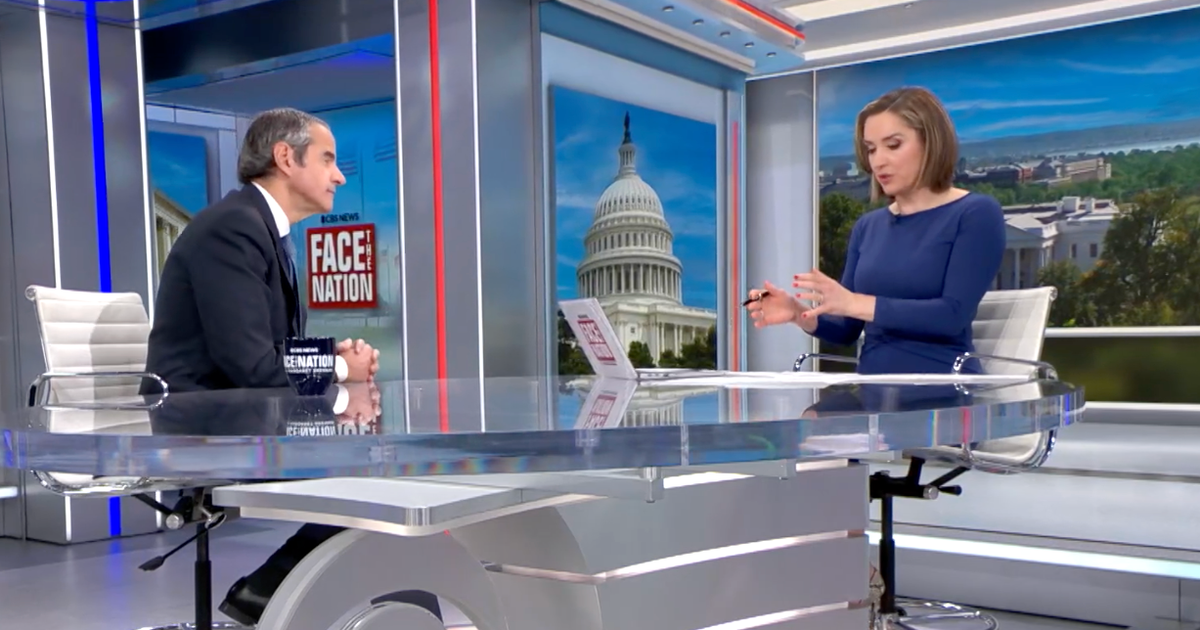
The following is the full transcript of the interview with International Atomic Energy Agency Director-General Rafael Grossi, a portion of which will air on “Face the Nation with Margaret Brennan” on March 22, 2026.
MARGARET BRENNAN: And we’re joined now by the Director General of the IAEA, Rafael Grossi. It’s good to have you here.
DIRECTOR GENERAL RAFAEL MARIANO GROSSI: Thank you. It’s good to be here.
MARGARET BRENNAN: These are some very serious times, particularly for you and your portfolio. Can you explain to our audience, can Iran’s nuclear ambitions be destroyed through military action only?
DIRECTOR GENERAL GROSSI: Well, of course, there has already been a lot of damage done. Last year, the 12 Day War was, in that sense, quite effective. If I can use that, that word, that kind of word. In terms of the physical distraction at three of the major facilities- or more compounds, I should say, because you have many buildings that have been- Fordow, Natanz and Isfahan, we have been covering, covering that. This time around, I think the focus of the campaign does not seem to be specifically the nuclear facilities, although there have been some hits in Natanz and Isfahan and also at another place near Parchin, which used to be a facility more related to the weaponization efforts, but back in the early 2000’s. So, there has been some, but I would say they have been relatively marginal when you consider the overall nature of the military campaign so far. So, going back to your question, there has been a lot of impact on the program. One cannot deny that this has really rolled back the program considerably, although, you know, I’m very skeptical about these metrics, days, minutes, months, because everything is relative. But my impression is that once the military effort comes to an end, we will still inherit a number of major issues that have been at the center of all of this. One, most notably, the inventory of enriched uranium at 60%, which is very close to the degree you need to make a bomb, that is going to still be where it is, largely–
MARGARET BRENNAN: –Under the rubble.
DIRECTOR GENERAL GROSSI: –Under the rubble, and in some cases no rubble. And some- somewhere under. And also, importantly, some facilities, infrastructure, equipment, which have most probably survived some of the attacks, even- they could be damaged, seriously damaged, but that is something that we will only be able to ascertain once our inspectors go back. So–
MARGARET BRENNAN: Let’s talk about that. What I heard you say there is, Iran had that nuclear weapons program that in 2003, according to U.S. intelligence, was halted. But as you know, there’s this debate over whether Iran’s nuclear program actually did have a weapons ambition. You were never quite able to say yes or no.
DIRECTOR GENERAL GROSSI: Well, because we are- we are not analysts or people having opinions. We are the IAEA. So whenever we say something, it has to be based on actual inspection. But, we were as precise as we could be in terms of characterizing what we were seeing. And one important conclusion of that was, and I think I have- I have repeated that in view of the conflicting narratives that are out there, especially here in the United States, they have it, they don’t have it, what- and in particular, people tend to like part of a sentence I pronounce and not the other, or forget the two. And the thing is, and continues to be one, yes, like you say, yes, we haven’t seen a systematic program like the Ahmad plan, with offices people reporting to people, and an array of places where you are doing stuff. But there were many, many concerning things, many unanswered questions, and especially since 2019, 2020 when I became- more or less, when I became director general, where yes, in 2015 in 2016 when the JCPOA, the previous agreement, you remember–
MARGARET BRENNAN: The Obama-era nuclear accord–
DIRECTOR GENERAL GROSSI: Exactly. When that started to be applied, Iran was complying with a number of things, but we started seeing new stuff. We started seeing and getting new elements that gave rise to concerns, and we were talking about them with Iran. You’ve seen me many times go to Tehran, sign declarations and see commitments on their part. And then it came a point, very important point, when I said, you know, in view of this, I have to say that I’m no longer able, I’m no longer able to say that everything is in order–
MARGARET BRENNAN: Because you were finding uranium in places it wasn’t supposed to be because they weren’t allowing you unfettered access. You couldn’t say clearly, one way or the other.
DIRECTOR GENERAL GROSSI: Exactly that.
MARGARET BRENNAN: Let’s come back to that. I- according to what you did know and did- were able to declare in these IAEA reports, Iran had uranium enriched up to 60%, weapons-grade is 90 as I understand it.
DIRECTOR GENERAL GROSSI: Yeah.
MARGARET BRENNAN: And if that material remains now in Iran after combat ends, will it still have nuclear capabilities if it has the enriched material and the centrifuges?
DIRECTOR GENERAL GROSSI: Well, you remember, and for this, I would quote, or partially refer to things that have been said in Iran by Iranians. You remember very important officials saying, we have all the elements of the puzzle. You remember that. So, of course, and not said by a journalist or a newspaper, important people that had been working in the program. So when this is said, we were telling them, this is unhelpful, or at least you should explain what is- what is meant by that. The- it’s a vast program, all right, and so albeit the physical distraction that has been operated, acted upon these facilities, there’s a lot going on. And don’t forget something, Margaret. When we talk about centrifuges, when we talk about this kind of facilities, this is an activity that can be relatively, I wouldn’t say easily, but it is very possible to reconstruct this effort is metallurgy, is a sophisticated washing machine. If I can put it like that, you have rudders. You have rudders, bellows, but it’s about metal, the ability to curve metal in a certain way, the ability to weld it in a certain way, the ability to have it spin at great speed, membranes. It’s nothing- I mean, and you cannot unlearn what you’ve learned.
MARGARET BRENNAN: Right, you can’t bomb away the knowledge. So that capability will exist after combat–
DIRECTOR GENERAL GROSSI: –Exactly, and it was very sophisticated. Let’s not forget, again, referring back to JCPOA. JCPOA was based, or predicated upon a very primitive type of centrifuge. Now Iran has the most sophisticated, fast and efficient machine that exists, and they know how to make them, they know. And on top of that, there might- there may be places out there which are not nuclear places. So, I mean, could be a workshop, dozens of workshops that exist. And they- this capability exists. This is why, what I say is that we still need to find a framework, an agreed framework, that is going to be providing us with the necessary [sic] visibility and sense of a clear idea of where they are, where they want to go.
MARGARET BRENNAN: Because this war will not destroy Iran’s nuclear ambitions–
DIRECTOR GENERAL GROSSI: –any war–
MARGARET BRENNAN: –and capabilities.
DIRECTOR GENERAL GROSSI: I would say any war–
MARGARET BRENNAN: –Any war.
DIRECTOR GENERAL GROSSI: –unless it was nuclear war and you go for destruction in an unfathomable way, which we hope, of course, will not- never be the case.
MARGARET BRENNAN: Well, talk to me about the options that we know are being discussed by the United States right now. Including President Trump and Israel have talked about the potential of sending special forces in to secure some of this enriched material. You have been to Isfahan, you have seen some of the underground facilities. How difficult would it be to move these cylinders that are there full of chemicals?
DIRECTOR GENERAL GROSSI: Listen, of course, I’m not, I’m not a military expert, and I don’t know what kind of abilities there could be out there, and I have no doubt that, you know, looking at the efficiency of military operations that the United States has been performing this year, in particular from the beginning of the year, perhaps there are ways that they can do that, and I will not enter into- into that assessment. But I have to say that we’re talking about cylinders containing gas of highly contaminated uranium hexafluoride at 60%, so it’s very difficult to handle. So much so that, for example, in terms, of this negotiation, we might perhaps discuss that a little bit, that did not bear fruit. One of the things that we were discussing was downblending it because of its difficulty in terms of handling in the scenario, for example, of a ship out of the material, exfiltrating the material. So it is very difficult. Then, of course, I guess there will be a number of decoys, a number of distracting cylinders, materials over there, which would make it very difficult. I’m not saying it’s impossible. I know that here there are incredible military capacities to do that, but it would be very challenging operation for sure.
MARGARET BRENNAN: For special- for a military operation to be carried out. After combat ends, Iran’s foreign minister on this program last week told us their nuclear material is under the rubble and they’d be willing to deal with your agency. Just like they were negotiating before the U.S. started bombing. Have you talked to the White House about this idea that your inspectors can go in and gather that material and take it out?
DIRECTOR GENERAL GROSSI: We are considering these options, of course. Our relationship with Iran is a treaty-based obligation, because even in the context of this war and the situation that we are in, Iran is a signatory to the Treaty on the Non-Proliferation of Nuclear Weapons, so they have a contractual obligation to allow our inspectors in. Of course, there’s common sense. Nothing can happen while bombs are falling. But yes, I’ve been having important conversations here at the White House, and also with Iran. There are some contacts, and we hope to be able to reestablish that line.
MARGARET BRENNAN: Do you think you can revive parts of that deal that were being put together before the bombing began, where Iran would downblend? I mean, Oman’s Foreign Minister on this program said that Iran had agreed to zero stockpiling, that they had agreed to send that material out and to dilute it down, downblend it.
DIRECTOR GENERAL GROSSI: Yes.
MARGARET BRENNAN: Was there really the possibility of a deal? Because it was just hours before the bombing began that he told us peace was possible.
DIRECTOR GENERAL GROSSI: While, while there’s a negotiation, there’s always a possibility of an agreement. We cannot deny that.
MARGARET BRENNAN: But you believed Iran truly was offering an option?
DIRECTOR GENERAL GROSSI: There was a discussion, but there was no agreement.
MARGARET BRENNAN: There was no agreement that Friday that the bombing began. The Omani foreign minister said he needed another 90 days. Would a real deal have been possible?
DIRECTOR GENERAL GROSSI: Well- maybe, I think- I praise his efforts. I respect him enormously. I think he was really trying very, very hard, and we had long discussions. He invited me in, of course, together with the two belligerents today. So we were having very frank and very deep discussions. So one cannot deny the nobility of the effort of someone who’s trying to prevent a war, and I applaud that as a diplomat and as a citizen. But there was no agreement at that point. So much so- remember this, you remember that we had agreed to have a technical meeting on the Monday after the weekend where the operation started. That should tell you that there were very significant, if not disagreements, there was no alignment on what we- what many of the things that were discussed that really meant. And this is why I offered and I said, well, let’s- the technical level piece, send me your people to Vienna. We will go through this and see what this or that may- may mean.
MARGARET BRENNAN: You wanted to keep talking to avoid military action?
DIRECTOR GENERAL GROSSI: Well, I felt that that was my obligation. I was invited to provide my technical support.
MARGARET BRENNAN: Well, let’s talk about that. Because, you know, Iran disputes that they have a weapons program now, but they do have a nuclear program, including a research reactor in Tehran for medical isotopes. President Trump told reporters that this was “a complete and false pretense to hide the fact that they were stockpiling there.” He meant nuclear fuel. The IAEA monitors that location. Is that what Iran was doing, secretly stockpiling material?
DIRECTOR GENERAL GROSSI: Let’s try to clarify, unpack that a little bit, because there’s also a lot of confusion that I see in characterizing, what the- what the Tehran Research Reactor is, what is happening there. The relevant point for and in terms of this negotiation and what could have happened is that this research reactor, and in general research reactors, require for their fuel a level of enrichment which is 20%.
MARGARET BRENNAN: Which was permitted under existing agreements.
DIRECTOR GENERAL GROSSI: Yes, but- yeah, it’s permitted in general. But the thing is that we were in the middle of a negotiation which was proceeding from the assumption that there wouldn’t be any enrichment.
MARGARET BRENNAN: Zero enrichment?
DIRECTOR GENERAL GROSSI: Zero or something very, very limited. So when you, when you talk about 20%, you are exceeding that amount. Forget about if there was stockpile or not. The concept, and this is what I would like your audience to grasp, that the idea that if you go for an agreement that presupposes that you can have 20%, this is three or four times more what the JCPOA was permitting. You remember, the level of enrichment agreed in the JCPOA was 3.6. In general, enrichment–
MARGARET BRENNAN: But there were allowments for these medical- I should just clarify. I said President Trump. I meant President Trump’s officials, his representatives said that. But for you, you- you did have questions about this Tehran Research Reactor. I’m bringing it up because these Trump officials keep pointing to the IAEA as providing information that made them say, wait a second, Iran’s not being honest. Is that what you were telling the U.S.?
DIRECTOR GENERAL GROSSI: Not about- we don’t discuss honesty or dishonesty. What we discuss is technical capabilities, and what technical capabilities may allow you to do or not. Intentions are legitimately discussed at the national level, and I won’t get into that discussion because every country and the United States and the President of the United States has every right to believe that they were going to do something or that they have an intention. My job is a different job, it is to explain, on the basis of the technologies that are there, what can happen and what is the impact vis a vis the negotiation you’re trying to get. And 20% is a lot of enrichment.
MARGARET BRENNAN: So then, was it correct for those Trump officials to say that the agency, your agency, provided the U.S. information that Iran never once used that material to make even a single medicine, that everything that was being done there was a cover for what could be a nuclear program?
DIRECTOR GENERAL GROSSI: Well, there you’re putting words that relate to intentions. And I don’t get into the cover or something like this. What I can say is that this is a reactor that potentially could be used for radio isotope production. There was very, very limited. We were inspecting this facility. We are inspecting it, actually. So there was limited use. Of course, Iran has every right to say, no, we are going to have a big program for radio isotope you know, this is what is used to detect and sometimes cure cancer. So it’s a [unintelligible].
MARGARET BRENNAN: But the IAEA is the UN, is this supposed to be just calling balls and strikes, as we say here, just calling it as they see it?
DIRECTOR GENERAL GROSSI: Yeah.
MARGARET BRENNAN: As you saw it, Iran might have been cheating?
DIRECTOR GENERAL GROSSI: I think, again, to come to the judgment, we have to have certainties. What we- and I go back to what we were discussing at the beginning of the conversation, Margaret. There were many unanswered questions, many unanswered questions, many concerning facts. And what we were asking Iran is, give us the clarity that we need. If you say that you have a fatwa that prohibits the country to develop nuclear weapons, well, let us check. If you don’t have anything to hide, and this is, by the way, what we tell everybody in the IAEA, let’s say, operation, you don’t have anything to hide? Show us.
MARGARET BRENNAN: Right, and you want, you want that access now. U.S.- the U.S. Director of National Intelligence told Congress yesterday that Iran’s enrichment program was obliterated, that the U.S. has seen no efforts to try to rebuild their enrichment capability. Do you agree with that assessment? Do you have any indication that the new Supreme Leader would want a weapons program?
DIRECTOR GENERAL GROSSI: Well, I don’t disagree with that. We don’t see major activity, which is logical, because there is a- there is a military campaign ongoing, whatever- you’re not going to start, you know, bringing cranes and workers–
MARGARET BRENNAN: –but they weren’t doing it in the lead up to the war, either, according to the Secretary of State.
DIRECTOR GENERAL GROSSI: Maybe. By the way, what we have is satellite imagery, all right? So at least the IAEA, maybe others have other technical means or personal means to check what is happening. As far as we are concerned, we haven’t seen activity. But as I was saying, a lot still has survived. They have the capabilities, they have the knowledge, they have the industrial ability to do that. This is why we need to go back to a negotiating table. It’s going to be needed.
MARGARET BRENNAN: And the U.S. has bombed twice in nine months during the course of diplomacy. Who has the credibility to lead negotiations now? Do you think it needs to be a regional conversation?
DIRECTOR GENERAL GROSSI: I don’t think a regional conversation would be- anything can happen, and the IAEA will help. But this is about a national program on a highly sensitive national security issue, like a nuclear program. So, I don’t see how a regional conference or conversation could be more effective than what is needed. We need the United States, of course, and Iran at the table. The IEA can help, maybe, I don’t know. The Omani effort could be revived, I don’t know, that is not my discussion, which is a political discussion. But I don’t think anybody would disagree, even here in Washington, that- that for a durable, long-standing solution, we will have to see each other again around the table.
MARGARET BRENNAN: And Iran has reached out to you? Their foreign minister has said he’s interested in a negotiation?
DIRECTOR GENERAL GROSSI: It’s- I wouldn’t say that, it would be unfair to him. But there are contacts.
MARGARET BRENNAN: Let me just ask you about one other thing. You said about half the nuclear material was around Isfahan.
DIRECTOR GENERAL GROSSI: Well, it’s a little bit more. There is- but the majority of the material is there. And this is no secret, because I’ve seen a lot of hype about it. This has been in our reports. The vast majority is there. There is some in Natanz as well, and some other parts.
MARGARET BRENNAN: There is focus on these other undeclared facilities President Trump has brought up. There’s a facility called Pickaxe Mountain, for example, that comes up. Are you concerned about those others?
DIRECTOR GENERAL GROSSI: Well we should have- we should visit those. They were not operational. So this is why we hadn’t. You may remember that on the- on the eve of the June 2025 campaign, Iran announced that they had a new enrichment facility in Isfahan.
MARGARET BRENNAN: Yes.
DIRECTOR GENERAL GROSSI: On the same day, I issued a request for an urgent inspection, which was granted, and the inspectors were there, and the morning where the- or the, you know, late night when the attacks happened. So we never got to see the place. We will have to go there eventually.
MARGARET BRENNAN: But just- final thought here. Do you think President Trump supports what I heard you say, which is that a military campaign cannot destroy Iran’s nuclear program, and that the only way to understand what they’re really doing is to be on the ground inspecting it, and that can’t be done by the United States military fully either?
DIRECTOR GENERAL GROSSI: Well, I think- I don’t know what he- whether he would endorse this or not, but he has said also that, of course, diplomacy is the preferred option. I think that is encouraging, and we have had a very constructive conversation in the past, and now. So–
MARGARET BRENNAN: Have you spoken to him?
DIRECTOR GENERAL GROSSI: Not to the president, no. I hadn’t had the honor. But I was talking to people that I have been talking in the past. And we continue- we continue this- this effort. I think the essence of this is that in the bleakest hour, we should never lose hope.
MARGARET BRENNAN: Director Grossi, thank you for your time.
DIRECTOR GENERAL GROSSI: Thank you very much.
MARGARET BRENNAN: And we’ll be right back.