


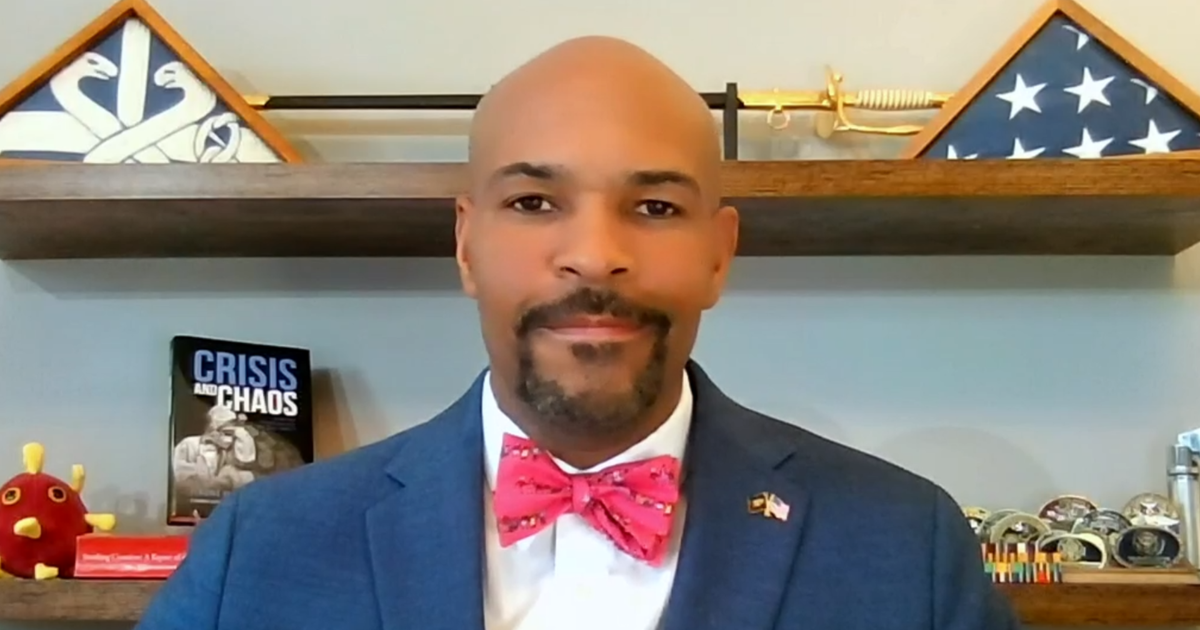
The following is the transcript of the interview with Jerome Adams, surgeon general in the first Trump administration, that aired on “Face the Nation with Margaret Brennan” on March 29, 2026.
MARGARET BRENNAN: Welcome back to Face the Nation. We turn now to former U.S. Surgeon General Dr. Jerome Adams, who joins us this morning from Indianapolis. Good morning to you, Doctor.
FORMER U.S. SURGEON GENERAL DR. JEROME ADAMS: Thanks for having me, Margaret. And I’d like to start by saying that the most important thing for your viewers to understand is that America’s most pressing health threat today isn’t opioids or obesity, it’s mistrust. Seventy percent of Americans say they support childhood vaccines and school mandates. Yet a similar majority say they do not trust health information from Robert Kennedy and say they would not trust Surgeon General nominee Casey Means. So a failure to acknowledge this plummeting trust, or worse, if we’re seeing to accelerate it, is going to hurt Americans. And actually, Margaret, according to Republican pollster Fabrizio Ward, it’s going to hurt Republicans in November elections.
MARGARET BRENNAN: Well, that’s not where I was going with the question. But yes, I’ve seen some of that polling. And it says that the MAHA health guidance resonates more with voters than the vaccine skepticism. So Republicans seem to be signaling what would be more resonant with the majority of voters. But in terms of the policy at this moment in time, you were President Trump’s surgeon general during his first term. There are now more than 1,500 confirmed measle cases in the U.S. since January, according to the CDC. There is this spike out in Utah. Why can’t the existing health infrastructure stop this?
DR. ADAMS: Well, that’s a great question. And you have to start off by understanding that almost 20,000 people have been cut from HHS. And so normally, we have measles cases every year. We had about 250 in 2024. We had about 2,000 last year. As you mentioned, we’re at 1,500 already this year. But normally, we’re able to control those outbreaks because of the CDC, because of public health infrastructure in funding. All of that has been cut. And now instead of one case turning into two or three and being stopped, it’s turning into 20, and 50 and 100 cases. And we’re also seeing falling vaccination rates, a broad group of states are falling below that 95% threshold for herd immunity for measles. Utah, Colorado, Florida, Georgia, Kentucky, all below that 95% threshold. And the further we get below that, the more these outbreaks explode.
MARGARET BRENNAN: Well, you mentioned the memo. This was a pollster who continues to consult for the president and for Republicans, Tony Fabrizio. In the memo, he writes, policies related to vaccines and vaccine safety need to be addressed carefully and with nuance. That’s because overall, a slim majority of voters are not convinced there are negative health impacts from vaccines. He was speaking about how MAHA and MAGA need to continue to work together for the benefit of the Republican Party. But by saying there’s a slim majority who are unconvinced, he’s making it sound like your party really is struggling with this, frankly.
DR. ADAMS: Well, they absolutely are. And I understand why parents are frustrated with the health care system. It is not working for people. And we’ve always, as physicians, been taught to respect patient autonomy. But the difference here is you’re seeing a health secretary and an infrastructure that is actively sowing distrust in vaccines and in the healthcare system. I believe we can do both. I believe we can respect patients’ autonomy. We need to make sure we’re facilitating those conversations between patients and their doctors or their pharmacists or nurses, while at the same time telling people what we know to be true. And that is that childhood vaccines like measles, mumps, rubella, are safe, they’re effective, and they’re the most important public health achievement of our lifetimes. We’re not going to make America healthier if we go backwards on vaccines.
MARGARET BRENNAN: So the chair of the health committee, Senator Bill Cassidy, who’s also a physician, asked Casey Means, she is the doctor you referenced, who is the choice of the Trump administration to be the next surgeon general. He asked her whether she would recommend a mother vaccinate her child against measles. Here’s the part of the exchange from her confirmation hearing.
[SOUND ON TAPE BEGINS]
SEN. BILL CASSIDY (R-LA): You’re the nation’s doctor. Would you encourage her to have her child vaccinated?
DR. CASEY MEANS: I’m not an individual’s doctor and every individual needs to talk to their doctor before putting a medication in their body. I absolutely am supportive of the measles vaccine and I do believe vaccines save lives and are an important part of the public health strategy.
[SOUND ON TAPE ENDS]
MARGARET BRENNAN: So the doctor did say she is supporter- supportive of the measles vaccine. Why does that stop short of what you would want to hear from someone in that role?
DR. ADAMS: Well, number one, I watched the hearing. This was after much pressing and equivocating, number one. And she said she’s not an individualist doctor. That is correct. But you’re applying to be the nation’s doctor. For me, this isn’t personal or political, number one, and I’ve talked to you about this, it’s about her not having the basic qualifications to do the job. She does not have an active medical license and would be the first surgeon general ever to be in the role to not have an active medical license. But beyond that, to the point you brought up, in the midst of a massive measles outbreak, America needs a surgeon general who can clearly stand behind vaccines. When I came in, we had the opioid epidemic and an overdose crisis. Imagine if I had said, you know, as surgeon general, it’s not my place to tell people to take naloxone, the opioid overdose reversal agent, they should talk to their doctor about it. That would not be acceptable in that circumstance, and it’s not acceptable to have a surgeon general who equivocates on vaccines, much less one who can’t actually practice medicine and meet the qualifications to be a physician in the court.
MARGARET BRENNAN: Well, the doctor apparently has an inactive medical license that she says she voluntarily placed on inactive status. And I want to talk about this because it seems a feature, not a bug, right? Because the HHS secretary has described Dr. Means as being perfect for this job. He says the surgeon general is a symbol of moral authority who stands against the financial and institutional gravities that corporatize medicine. He said she was a great student and surgical resident, but she left traditional medicine because patients weren’t getting better, and that’s why she should be the disruptor in this moment. So when you say there’s distrust, how do you respond to those who say disruption is the purpose of this selection?
DR. ADAMS: Well, again, number one, a recent Axios poll came out, and that poll showed that 68% of people who were questioned said they would not trust health advice from a Surgeon General Casey Means. So you’re not going to restore trust if preemptively the public is telling you we’re not trusting the person you’re putting forward. And again, I don’t want to underplay this. Every physician, every nurse, every pharmacist and the Public Health Service Corps has to maintain an active license. I had to fire people for not having an active medical license. So this is not about disruption. Casey Means can be a part of this administration. She can advise the White House. She can advise Secretary Kennedy, as her brother does. But that does not mean she’s qualified to be surgeon general of the United States after dropping out of her residency and not having an active license.
MARGARET BRENMAM: Yeah, and just a note, there is also no Senate-confirmed CDC director currently amid the crisis. Let me ask you about social media as well, because there were these big cases this past week. A New Mexico jury found that Meta platforms violated consumer protection laws by misleading users about the safety of Facebook, of Instagram, and of WhatsApp. Out in California, there was another lawsuit linking Meta to a young woman’s depression. As a doctor, are you convinced that social media has a direct link to health?
DR. ADAMS: As a doctor and as a parent, I’m convinced of these facts. I have three teenage kids. We know, based on Surgeon General Murthy’s report, that there is increasing and very valid evidence out there showing links between social media use, particularly at a younger age, and increasing anxiety, increasing depression, less sleep, which actually leads to mental health problems and also obesity. And so we need to, as a society, understand the harms that are coming from social media, similarly to the harms that surgeon generals have pointed out before coming from cigarettes. We also need to, similar to cigarettes, point out the fact that these substances, meaning social media platforms, are incredibly addictive. And we’re hearing again in these lawsuits that they were specifically designed to addict children, again, the way cigarette manufacturers tried to addict children back in the day.
So, I’m happy that we’re having a conversation about this. The policy is going to be hard, but Australia has already done it. They’ve banned social media for people under 16. You have 25 states, I believe, that are to the point where they’re discussing or have legislation keeping social media and phones out of schools. And we need to to really understand the harm that’s occurring to our children because of this unfettered access to screen time and social media.
MARGARET BRENNAN: Before I let you go, Secretary Kennedy spoke to the Conservative Political Action Conference yesterday. He said he’s worried about cellphones and recommends parents don’t let their kids sleep with phones beside the bed. Would you agree with that recommendation?
DR. ADAMS: Yes. Actually, AAP, the American Academy of Pediatrics, the Health Department of California, all say that we should not allow cellphones in children’s bedrooms. It keeps them up at night and subjects them to bullying constantly. And yes, it is a good practice. And I agree with the secretary on this. I want to find common ground with the secretary. This is one place where we agree we should not be exposing young people to cellphones and social media, particularly in their bedrooms at night.
MARGARET BRENNAN: All right, Doctor, thank you for your insights today. We’ll be right back.