


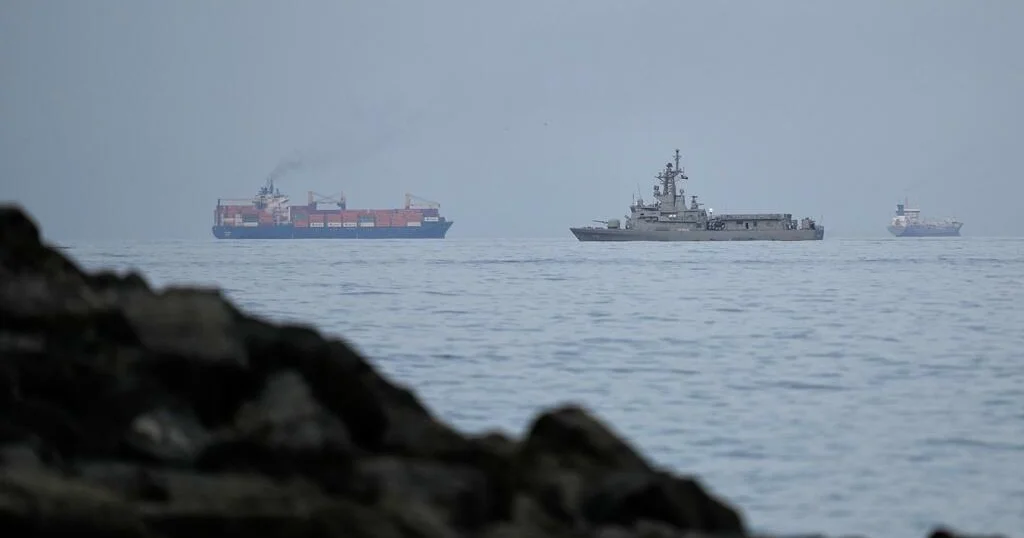
With oil markets paralyzed by the war between the U.S. and Iranthe Trump administration is weighing a military operation to escort ships through a vital maritime chokepoint — a massive undertaking that experts say could already be in the preparatory stages.
Since the U.S. and Israel’s war with Iran began two weeks ago, more than a dozen attacks have been reported against oil tankers and other cargo ships in the Persian Gulf and the Arabian Sea. Iranian officials have openly threatened ships that pass through the Strait of Hormuz, a waterway that connects the Persian Gulf with the world’s oceans.
Fearing attacks, oil tankers have all but stopped transiting the Strait of Hormuz, which carries around 20% of global oil — with mostly Iranian and Chinese ships making it through. And with nowhere to send their supply, some major Arab oil exporters have cut production. Over the last two weeks, oil prices have jumped around 40% amid worries about a supply crunch.
The disruption has led President Trump to consider offering naval escorts to ships passing through the Strait of Hormuz, in the hopes that military protection could clear up the gridlock.
“When the time comes, the U.S. Navy and its partners will escort tankers through the Strait if needed,” the president told reporters Monday. “I hope it’s not going to be needed, but if it’s needed, we’ll escort them right through.”
But administration officials have suggested they aren’t prepared to start carrying out naval escorts just yet. Energy Secretary Christopher Wright said this week “it’ll happen relatively soon, but it can’t happen now,” and pointed to the end of the month as a possible timeline.
Treasury Secretary Scott Bessent said escorts will begin “as soon as it is militarily possible.”
Military experts tell CBS News that any effort to shepherd oil tankers through the Strait — past potential Iranian mines, missiles, drones and explosive-laden “kamikaze” boats — will require preparations to cut back Iran’s ability to strike at targets at sea. After that, it could involve U.S. ships, jets and surveillance capabilities. But the operation would not be risk-free.
What needs to happen for escorts to start?
CBS News military analyst Aaron MacLean described any possible mission to escort oil tankers as a two-phase operation: First, the U.S. needs to “prepare the battlefield by reducing the stockpiles that Iran has of anything that can kill ships,” and then in a second phase, it could start carrying out escorts.
That first phase might already be underway, said MacLean, a Marine Corps veteran, former U.S. Naval Academy faculty member and former foreign policy adviser to GOP Sen. Tom Cotton of Arkansas.
Over the last two weeks, U.S. Central Command says it has struck around 6,000 Iranian targets, including anti-ship missile sites, drone manufacturing facilities and mine-laying ships.
Slashing Iran’s military stockpiles — including its missiles, drones, mines and boats — is important before ships are escorted, MacLean said, because “you want the amount of incoming [fire] to be manageable enough that you can reliably intercept it when it happens.”
“They could do it today, but the earlier you go, the riskier it is,” MacLean explained. “If you put U.S. Navy ships in close proximity of the Iranian coastline right now, it’s going to get real sporty real quick, and the risk is very high.”
Seth Jones, president of the defense and security department at the Center for Strategic and International Studies, told CBS News the U.S. military is likely preparing for escorts in the Strait of Hormuz by “degrading the Iranian capabilities to lay mines and strike targets.”
“I suspect the U.S. Navy is not going to want to enter that Strait unless it’s pretty confident that the threats have been degraded, largely by the airstrikes,” he said.
Asked when escorts could begin, Wright suggested on CNBC earlier this week that the Trump administration is still in the preparatory phase.
“We’re simply not ready. All of our military assets right now are focused on destroying Iran’s offensive capabilities and the manufacturing industry that supplies their offensive capabilities,” the energy secretary said.
How would escorting ships work?
The right time to start carrying out escorts in the Strait of Hormuz is a judgment call that U.S. Central Command would need to make, MacLean said.
“You can’t wait indefinitely because you’ve got to get that thing open,” he said. “So at some point they’re going to determine that they’re comfortable with the risk, and then they’re going to execute the convoy ops.”
He said an escort operation could involve the Navy setting up staging areas where commercial ships are guarded at either end of the contested area — which may be constrained to just the Strait of Hormuz, or could stretch further into the Persian Gulf.
“And then, like a mother duck with her little baby ducks, a U.S. Navy ship, or a ship from a partner navy, is going to escort several ships through at a time,” he said.
Those ships are likely to be supported by air cover and surveillance, added MacLean. And Jones said the mission could involve mine-sweeping capabilities, airstrikes on Iranian threats on the coasts and a nearby quick reaction force that can deal with attacks.
The first few ships to pass through might be targeted, said MacLean.
“We know the Iranians are going to shoot. We’re looking to see where they shoot from, and then we hit them once they reveal themselves,” he said.
Bessent said in an interview earlier this week that the escort operation could involve not just the U.S. Navy, but also an “international coalition.” According to MacLean, potential participants may include developed countries like France, where President Emmanuel Macron has said the country’s navy is considering a “purely defensive” mission to escort ships.
Bedirhan Demirel/Anadolu via Getty Images 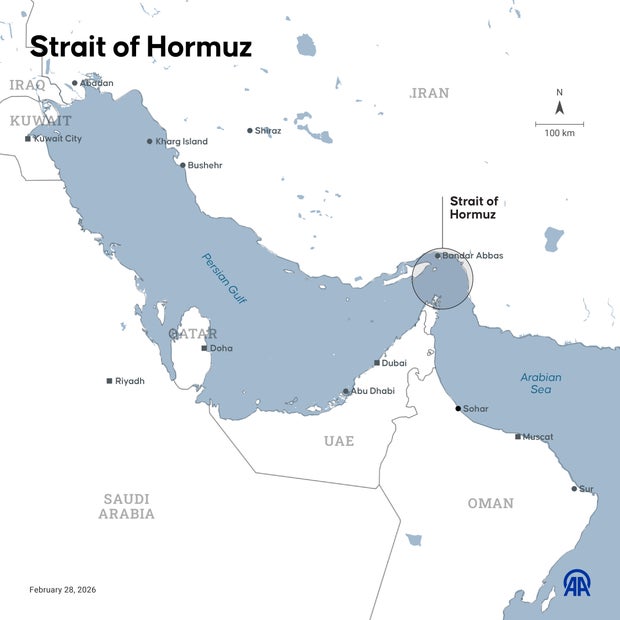

What threats could Iran pose to ships, exactly?
Just 21 miles wide at its narrowest point, the Strait of Hormuz has long been viewed as a potential chokepoint that Iran could seek to close off during a war.
If the U.S. Navy and its partners try to escort commercial vessels past Iran, “they’re 100% going to be shooting at the ships,” MacLean said.
The potential threats to shipping traffic currently in Iran’s arsenal include naval mines, anti-ship cruise missiles, drones, fast-attack boats operated by Iran’s Revolutionary Guards and remote-controlled explosive boats, military and national security experts say.
Earlier this week, U.S. officials told CBS News that Iran appeared to be signaling it could lay mines in the Strait. The size of Iran’s naval mine stockpile is not publicly known, but estimates over the years have ranged from around 2,000 to 6,000.
Top Trump administration officials have said the Strait does not appear to be mined right now. Defense Secretary Pete Hegseth told reporters Friday there is currently no evidence of Iran laying mines, and Bessent pointed out earlier this week that a small number of ships are still traveling through the Strait, suggesting it isn’t impassable due to mines.
“The only thing prohibiting transit in the Straits right now is Iran shooting at shipping,” Hegseth said Friday. “It is open for transit, should Iran not do that.”
Jones told CBS News that Iran doesn’t have many large mine-laying ships — and the U.S. military says it has struck about 30 Iranian minelayers over the last two weeks. But Iran does have potentially hundreds of smaller boats that can lay a few mines at a time, and destroying all of them would be extremely difficult, according to Jones.
Some experts caution that Iran could still pose a serious risk to shipping. Michael Eisenstadt, director of the Washington Institute for Near East Policy’s military and security studies program, says he’s skeptical that an operation to escort oil tankers will work.
Eisenstadt noted that it isn’t clear how many Iranian missiles and drones have survived the last two weeks of U.S. and Israeli strikes, but Iran’s remaining stockpiles could be hidden deep in tunnels — meaning Iran could still target ships. He also said that a prior escort operation in the 1980s involved dozens of U.S. vessels, and if the one being considered by the Trump administration is at a similar scale, it could tie up a significant portion of the Navy’s fleet.
“All you need is half a dozen drones to hit ships,” Eisenstadt told CBS News, “and then tanker owners are going to say ‘forget it, thanks guys, nice try.'”
Has it happened before?
This wouldn’t be the first time the U.S. has ferried ships through the Strait of Hormuz.
In 1987, near the end of the Iran-Iraq War, the U.S. Navy began escorting Kuwaiti tankers through the Persian Gulf and Strait of Hormuz to protect against Iranian mines and missiles.
“It was a big deal,” said MacLean, describing an operation that involved dozens of U.S. ships.
At one point in 1988, the USS Samuel B. Roberts struck an Iranian mine, causing significant damage and leading then-President Ronald Reagan to launch strikes against Iranian targets. Months later, the U.S. shot down an Iranian passenger plane that it mistook for a fighter jet, killing 290 people in what a U.S. report called a “tragic and regrettable accident.”
That war ended with a ceasefire between Iraq and Iran.
If the U.S. decides to carry out another escort operation some 38 years later, MacLean said the mission could end in similar fashion — either due to a ceasefire or because Iran gives up.
“You basically keep going until there’s some kind of inflection point,” he said.