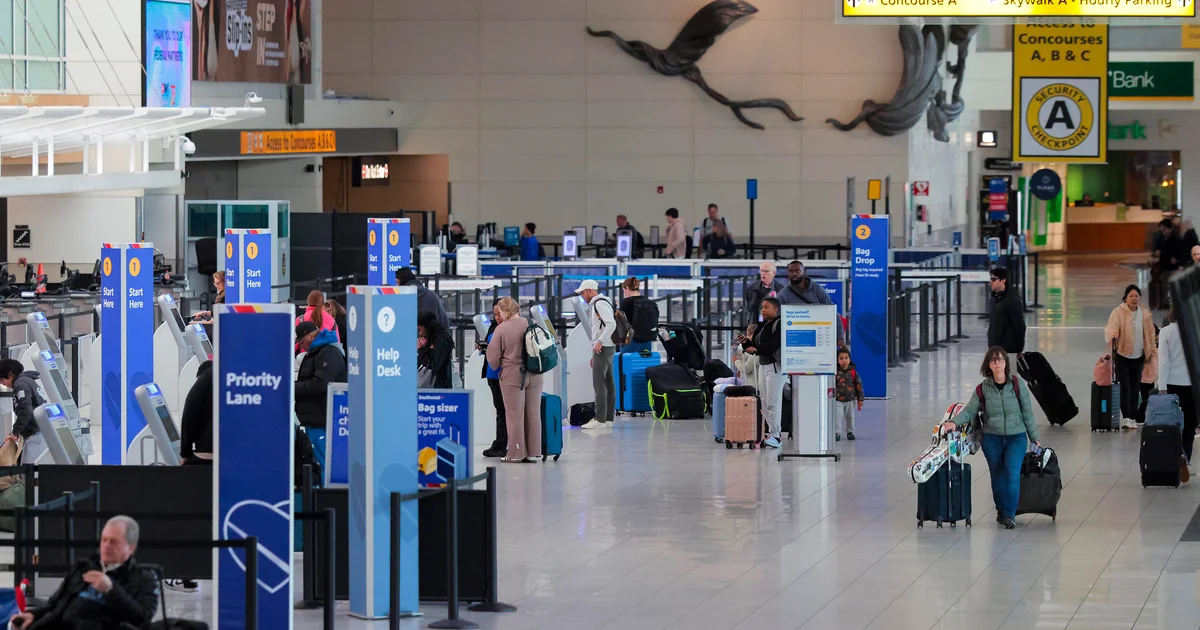
The shortage of TSA officers is still slowing security lines at major airports, where staffing shortages are more severe than the national average, but wait times seemed to be stabilizing Monday. TSA officers were calling out absent at elevated rates Sunday, even as there were signs that part of their back pay over the 45-day partial shutdown was beginning to reach their bank accounts.
Although Congress has failed to reach a deal to fund the Department of Homeland Security and lawmakers have left town Friday for a two-week recess, President Trump signed an executive order directing the DHS secretary to pay TSA workers during the shutdown.
Nationwide, the call-out rate stood at 10.6%, or 3,101 officers Sunday, down from a peak of 12.4% on March 27. Even so, the figure remains well above typical levels, which generally fall in the low single digits — around 2% — underscoring continued strain on airport screening operations.
Baltimore/Washington International Airport reported a 38.5% call-out rate, while Houston’s George Bush Intercontinental had a 36.4% rate and the city’s William P. Hobby Airport had a 34.1% absence rate. New Orleans and Atlanta each topped 33%, while major Northeast hubs including JFK, LaGuardia and Philadelphia airports all reported rates near or above 20%.
Immigration and Customs Enforcement agents were sent to assist TSA at BWI Airport and other airports over the weekend, and White House border czar Tom Homan told CBS News “Face the Nation with Margaret Brennan” that officers would be in place until the airports “feel like they’re 100%.” On Monday, all of BWI’s checkpoints were open.
“Now that I received the deposit, the cars are all gassed up and I’m ready to go to. I’ll be, I’ll be at my checkpoint tomorrow,” TSA officer and union official Pasqual Contreras told CBS News Monday. Last week, he ran out of gas money to make the two-hour round trip daily commute to Phoenix Sky Harbor Airport.
“It pays the rent. it pays March, but as we can all see, we’re in April already. So it doesn’t go far,” Contreras said. “It’s enough to — maybe not continue staying in the red — but not by much.”
CBS News obtained a notice sent to TSA workers indicating that they have received pay for 160 hours, covering the period from Feb. 22 to March 21. They’re still missing pay for Feb. 14-21, and it’s also not yet clear whether they’ve been paid for overtime hours worked during the shutdown. After last fall’s government shutdown, it took several pay periods to sort out missed pay issues.
DHS officials said some paychecks began to be deposited in workers’ accounts as early as Monday, with other workers expected to receive payments Tuesday. The department’s goal is to have most workers paid by close of business Tuesday, with an outside deadline of Wednesday, April 1, when a number of bills tend to be due.
The staggered timing reflects banking practices, rather than differences in payroll. DHS transmitted payments on the same schedule, but some financial institutions release funds as soon as they receive notice of an incoming deposit, while others wait until the official settlement date.
The payments follow weeks of disruption during the partial DHS shutdown, which left roughly 50,000 TSA officers working without pay and contributed to widespread airport delays, high absenteeism and staffing shortages. The financial strain forced more than 510 TSA officers to quit.
The president’s executive order only covers pay for TSA workers. ICE agents have continued to be paid because Congress provided funding for them in last year’s One Big Beautiful Bill Act, but tens of thousands of DHS workers are continuing to work without pay, among them, Coast Guard, FEMA and Cybersecurity and Infrastructure Security Agency employees.
CBS News has asked DHS for additional details on which appropriations or funding mechanisms are being used to cover the payments, as well as how long they can keep this up.
Julia Griggs contributed to this report.