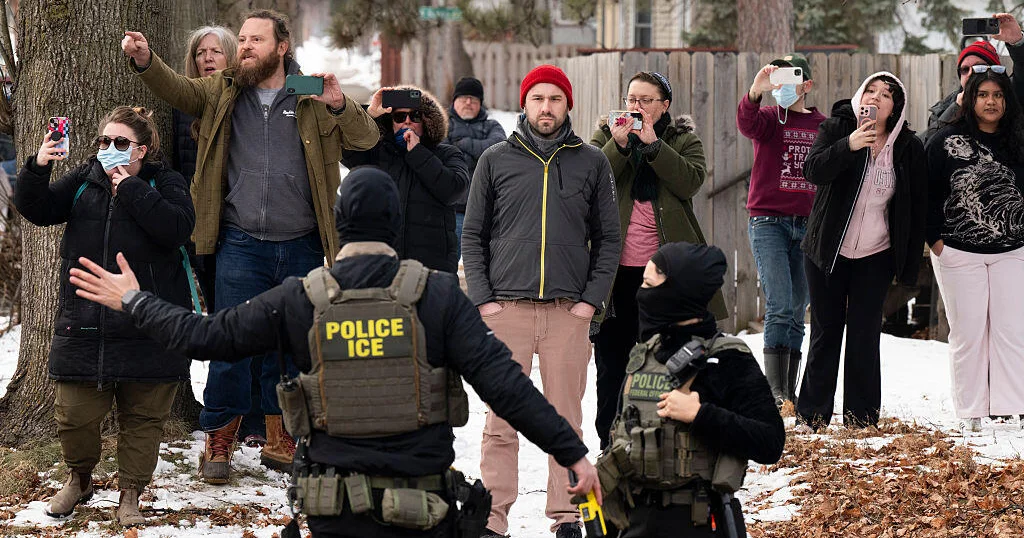
From missed doctor’s appointments to lost wages, Minneapolis and St. Paul residents faced widespread disruptions to their daily lives when the White House deployed thousands of federal immigration agents to their cities, a University of San Diego survey released this week found.
Survey respondents reported missing work and skipping scheduled medical appointments during the immigration crackdown, also known as Operation Metro Surge, in which more than 4,000 federal agents were deployed to the Twin Cities between December and mid-February. Some also said they kept children home from school.
Some reported they were physically assaulted by U.S. Immigration and Customs Enforcement agents, and the majority said they now have less trust in law enforcement in general, the survey found.
Missing work, school and appointments
More than 35% of those surveyed in Minneapolis and about 20% of those surveyed in St. Paul reported missing work during the operation, most often because their workplace closed or they were concerned for their safety.
Those who reported missing work included service workers, physicians and nurses. The study estimated that there was a combined $243.8 million in lost wages in Minneapolis and St. Paul during Metro Surge.
More than 53% of parents with children in K-12 schools surveyed in Minneapolis said they kept their children home from school at some point during the operation, along with approximately 45% of parents in St. Paul.
Among those who had scheduled medical appointments during the crackdown, 29% of Minneapolis respondents said they missed at least one appointment, compared to 20% of St. Paul residents. Some who otherwise would have gone to urgent care or the hospital for an unexpected medical condition instead opted to stay home.
“We are beginning to learn more about how Trump-style, large-scale immigration enforcement is impacting communities,” said Tom Wong, the study’s author and director of the university’s U.S. Immigration Policy Center.
Wong surveyed 728 Minneapolis residents and 662 St. Paul residents between Feb. 17 and March 6. The two cities have a combined population of about 736,000, according to the latest American Community Survey. He weighted the responses to ensure they represented the broader population.
Less trust in law enforcement
In addition to reporting decreased trust in law enforcement, nearly half of survey respondents in both cities said they were less likely to seek help from law enforcement in the future as a result of the operation. Nearly a third in Minneapolis and more than a quarter in St. Paul said they were less likely to obey commands from law enforcement now.
About 28% of Minneapolis residents and 19% of St. Paul residents surveyed said they interacted directly with ICE or Border Patrol agents during the operation, the survey found. Many of those individuals reported being questioned about their race, ethnicity, national origin or whether they spoke English.
In Minneapolis, about 46% of respondents who had at least one interaction with federal immigration enforcement said agents did not believe they were lawful residents even after they showed identification, compared to about 20% of respondents in St. Paul.
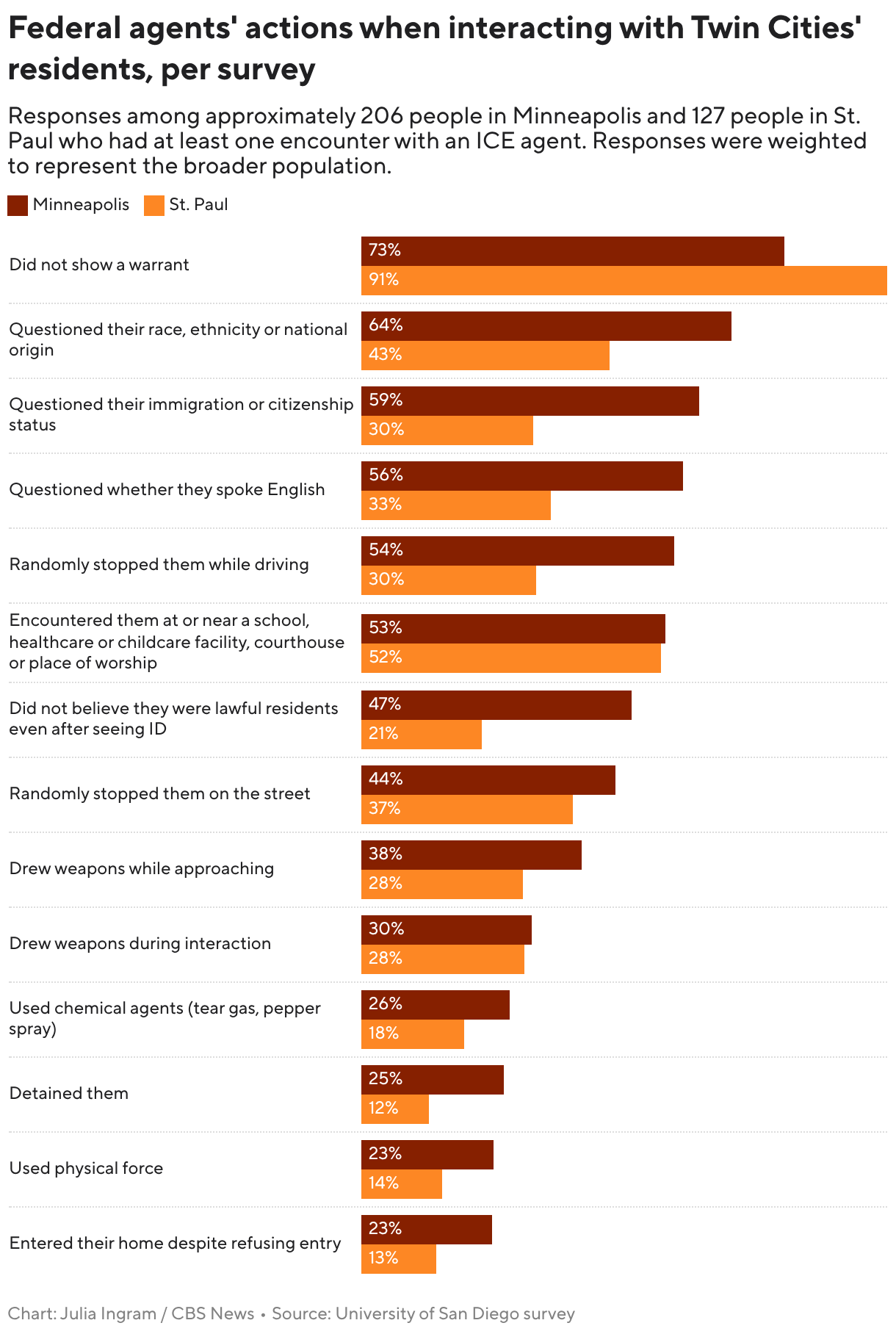
A little more than half of the survey respondents who interacted with ICE agents in both cities said those encounters happened at or near a school, health care facility, child care facility, courthouse or place of worship – places that have been protected from immigration enforcement under previous administrations.
In Minneapolis, about 23% of survey respondents who interacted with ICE reported being physically assaulted, and about 25% said that agents used pepper spray, tear gas or another chemical agent against them. For St. Paul respondents, approximately 14% said they were physically assaulted and 17% said agents used chemical agents against them.
Operation Metro Surge, and the January shooting deaths of Renee Good and Alex Pretti in south Minneapolis by federal agents, sparked widespread protests in the Twin Cities, which federal agents often used chemical agents to disperse.
People of color were roughly twice as likely to be questioned or assaulted by ICE agents, Wong told CBS News of the survey’s findings. The available survey results don’t break down by ethnicity, but will be detailed in a forthcoming study, he said.
“A lot of other states and cities are kind of just waiting to see if they’re going to be the next target,” he said. “I think that if this happens again in the way that it happened in Minnesota, a lot of communities are going to have to brace for a lot of change.”