Washington — The head of the United Nations nuclear watchdog agency said Thursday that “a lot has survived” of Iran’s nuclear capabilities and military operations alone cannot destroy them.
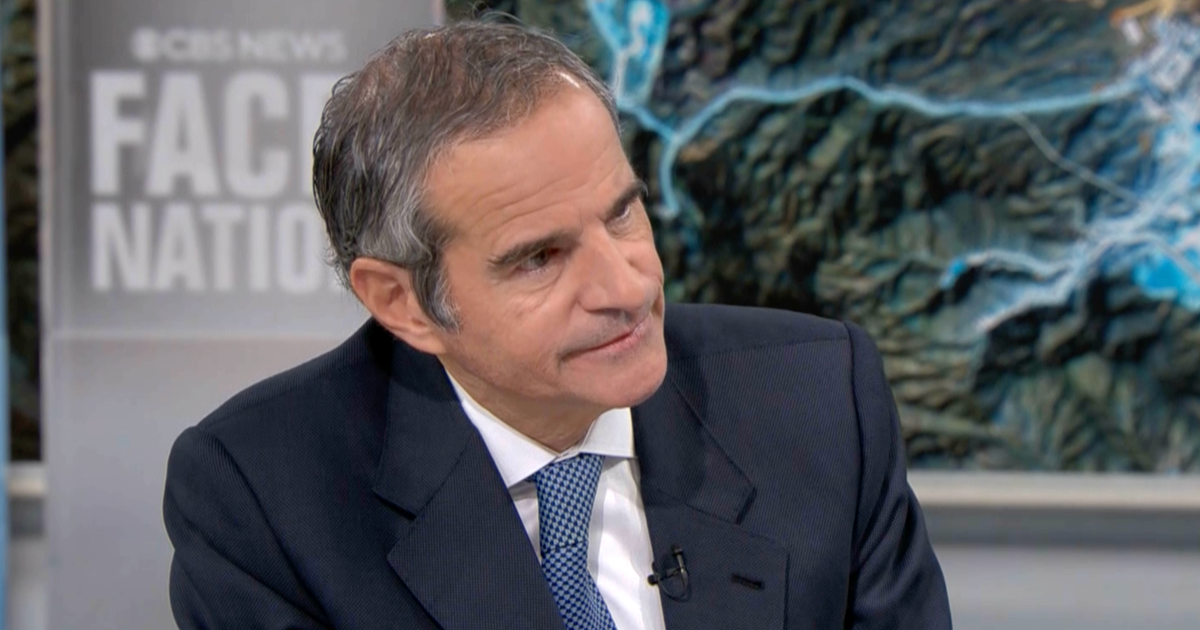
In an interview with “Face the Nation with Margaret Brennan,” Rafael Grossi, director general of the International Atomic Energy Agency, said there had already been damage done to Iran’s nuclear sites, and said last year’s strikes on three nuclear facilities were “quite effective.”
“There has been a lot of impact on the program. One cannot deny that this has really rolled back the program considerably, although, you know, I’m very skeptical about these metrics, days, minutes, months, because everything is relative,” Grossi said. “But my impression is that once the military effort comes to an end, we will still inherit a number of major issues that have been at the center of all of this.”
Grossi said one of those issues is Iran’s inventory of uranium at 60% enrichment, as well as facilities, infrastructure and equipment, which could be damaged.
Iran had rapidly increased its stockpile of highly enriched uranium in recent years. As of mid-June 2025, before U.S. strikes on nuclear facilities, Iran had enriched roughly 972 pounds, or more than 440 kilograms, of uranium up to 60% purity, according to estimates from the IAEA.
President Trump has said an objective of the ongoing war with Iran is to prevent the country from developing a nuclear weapon. While the Defense Department has prepared several options for the president regarding next steps in the conflict, Mr. Trump has not made up his mind on whether he would send U.S. forces into Iran and seize its nuclear material.
But Grossi said removing cylinders with the material would be difficult.
“I’m not saying it’s impossible. I know that here there are incredible military capacities to do that, but it would be very challenging operation for sure,” he said.
Grossi said the IAEA did not see “major activity” by Iran to rebuild its enrichment capacity before the U.S. and Israeli started its strikes, but said “a lot has still survived.”
“They have the capabilities, they have the knowledge, they have the industrial ability to do that,” he said.
Grossi said the extensive program underscores the need for diplomacy to deal with Iran’s nuclear program after combat operations.
“It’s going to be needed,” he said of talks.
In the weeks and hours leading up to the second round of U.S. strikes in nine months, special envoys Steve Witkoff and Jared Kushner, Mr. Trump’s son-in-law, were engaged in indirect talks with Iranian negotiators over a potential nuclear deal in the days before Operation Epic Fury. U.S. and Israeli strikes nearly three weeks ago, which resulted in the death of Iranian Supreme Leader Ayatollah Ali Khamenei.
Defense Secretary Pete Hegseth said earlier Thursday that the U.S. has struck more than 7,000 targets across Iran as part of Operation Epic Fury, and previewed that the day would bring the “largest strike package yet, just like yesterday was.”
Mr. Trump has said that one of the objectives of the ongoing operation is to keep Iran from developing a nuclear weapon, though he has also touted strikes last year on three Iranian nuclear facilities that he said “obliterated” the sites.
Director of National Intelligence Tulsi Gabbard, meanwhile, told the Senate on Wednesday that the intelligence community assessed that Iran’s nuclear program was “obliterated” last year in the strikes dubbed Operation Midnight Hammer. In written testimony to senators, Gabbard said “there has been no efforts since then to try to rebuild their enrichment capability. The entrances to the underground facilities that were bombed have been buried and shuttered with cement.”