


Uganda on Wednesday ordered the closure of its border with Congo, where suspected cases of a rare type of Ebola are surgingand as cases have been confirmed at home after Ugandan health workers were exposed to the disease from Congolese patients.
The measure, which goes against the guidance by the World Health Organization, underscores growing fears of contagion in East Africa from Bundibugyo, a rare type of the Ebola virus that is behind this outbreak and that has no approved medicines or vaccines.
According to numbers compiled by the U.S. Centers for Disease Control and Prevention and the WHO, there were 121 confirmed Ebola cases in Congo and 17 confirmed deaths, with at least 1,077 additional suspected cases of the virus and 246 suspected deaths from the disease.
In Uganda, there were seven confirmed cases, including one death from the virus, the CDC and WHO said.
Like Congo, Uganda has faced Ebola outbreaks in the past. A local Ugandan task force made the decision on the border closure. The Ugandan health workers were exposed to the virus by Congolese patients who had crossed the border before the outbreak was declared in eastern Congo on May 15.
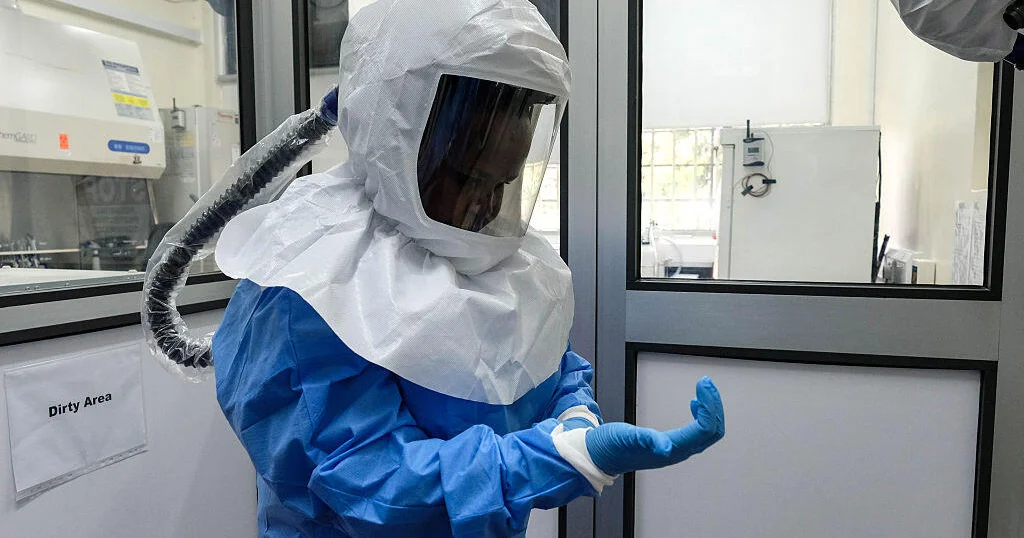
Hajarah Nalwadda / Getty Images 

Border crossings will be authorized only in emergency cases, including for the outbreak response, cargo or security reasons, Dr. Diana Atwine of the Ugandan Ministry of Health, told journalists. Anyone entering from Congo under emergency circumstances will be taken into mandatory isolation for 21 days.
Tracing and isolating Ebola contacts is seen as key to stopping the spread of the disease, which usually manifests as hemorrhagic fever. The virus is spread through close contact with sick or deceased patients’ bodily fluids. Experts say healthcare workers and family members caring for patients face the highest risk.
On Wednesday, Congolese authorities said that the first person who recovered from the Bundibugyo virus has been released home from a treatment center in Rwampara, one of the towns in eastern Congo at the heart of the outbreak.
WHO has discouraged border closures with Congo while acknowledging that neighboring countries are at high risk of contagion. The U.N. health agency has declared this outbreak a public health emergency of international concern.
Closures “push the movement of people and goods to informal border crossings that are not monitored, thus increasing the chances of the spread of disease,” the agency said.
The Uganda-Congo border is several hundred miles long and crossed by numerous footpaths beyond formal border posts. Many people come and go in the course of a day to visit families or to trade.
Congolese health authorities are struggling to contain the outbreak, which WHO says is outpacing them. The rare type of Ebola was confirmed weeks late as tests were carried out for a more common type. Challenges also include the threat from armed groups in eastern Congo, a large number of displaced people and poor infrastructure.
WHO’s Director-General Tedros Adhanom Ghebreyesus called on Wednesday for a ceasefire in eastern Congo to allow safe access for responders and others, saying on social media that “attacks on health facilities make tracking cases and their contacts nearly impossible.”
Meanwhile, the U.S. is working to set up a facility in Kenya for Americans who were exposed to Ebola or infected with the deadly illness, multiple CDC officials confirmed to CBS News on Wednesday.
A U.S. doctor who contracted Ebola while working with a missionary group in Congo was previously airlifted to Germany for treatment earlier this month. Six other Americans have been transported to Germany and the Czech Republic for monitoring.
All American citizens who have recently been in Congo, Uganda or South Sudan must enter the U.S. through one of only three U.S. airports — Houston Bush International, Washington Dulles International or Hartsfield-Jackson Atlanta International — to undergo mandatory enhanced screenings. John F. Kennedy International Airport in New York will be added to the list of approved airports Thursday, U.S. Customs and Border Protection announced.
Houston’s airport said it expects to average up to 50 screened passengers per day.
U.S. green card holders and foreign nationals who have recently been in one or more of those three countries are currently barred from entering the U.S., according to CDC guidelines.
“We cannot and will not allow any cases of Ebola to enter the United States,” Secretary of State Marco Rubio told reporters Wednesday during President Trump’s Cabinet meeting at the White House.