


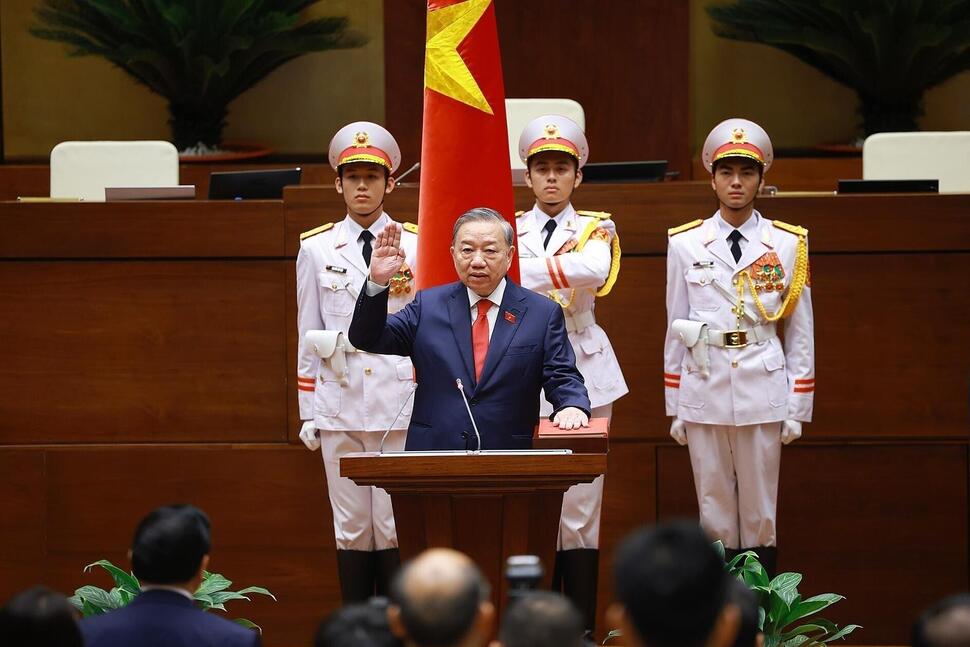
HANOI, Vietnam (AP) — Vietnam unanimously elected Communist Party General Secretary To Lam as president for a five-year term, consolidating his control over both the party and the state.
The move departs from Vietnam’s tradition of shared leadership, in which the jobs have typically been held by different people, and echoes power structures in China under Xi Jinping and neighboring Laos.
It has been widely expected since Lam’s reelection as Communist Party head in January, when observers noted that his consolidation of party authority positioned him to assume the presidency as well.
After being sworn in, the 69-year-old told the National Assembly that his top priority was to maintain peace and stability, which were the foundation for fast and sustainable growth. “We aim to improve people’s livelihoods so all can share the benefits of development,” he said.
The concentration of power was significant since it meant that Lam had a “stronger mandate and far more political room to push through his agenda than any leaders” since the 1980s, when Hanoi launched reforms to shed a state-run economy in favor of a market-oriented one open to foreigners, said Nguyen Khac Giang, of Singapore’s ISEAS–Yusof Ishak Institute research center.
“The opportunity is obvious. Faster decision-making, greater policy coherence, and a better chance of pushing difficult reforms at a pivotal moment. But the risk is that concentration of power can move faster than institutional reform,” he said.
Lam’s rise to the top caps the ascent of a career policeman who advanced from Vietnam’s security services to the top of the political system. This was aided by a sweeping anti-corruption campaign launched by his predecessor, which he oversaw as head of the Ministry of Public Security.
As party chief, Lam has led Vietnam’s biggest bureaucratic overhaul since the 1980s, cutting jobs, merging ministries, redrawing provincial boundaries and advancing major infrastructure projects.
He has focused on economic performance and private-sector growth, aiming to move Vietnam beyond the labor- and export-driven model that has helped lift millions from poverty and build a manufacturing-based middle class. The country is targeting 10% or higher annual economic growth over each of the next five years.
But challenges remain, especially the immediate task of turning this ambitious vision into reality with the world economy upended by the energy shock from the war in Iran. Vietnam’s economy expanded at an annualized rate of 7.8% in the first three months of the year, up from 7.1% last year but below the 9.1% target and slower than in late 2025.
Giang said that Lam also faces political hurdles for reform buy-in and the challenge of maintaining Vietnam’s pragmatic approach to foreign policy.
“It has benefited from a careful balancing strategy in foreign policy, but maintaining that position will become harder in a more turbulent world,” he said.
The Associated Press’ climate and environmental coverage receives financial support from multiple private foundations. AP is solely responsible for all content. Find AP’s standards for working with philanthropies, a list of supporters and funded coverage areas at AP.org.
Copyright 2026 The Associated Press. All rights reserved. This material may not be published, broadcast, rewritten or redistributed.
Photos You Should See – April 2026

