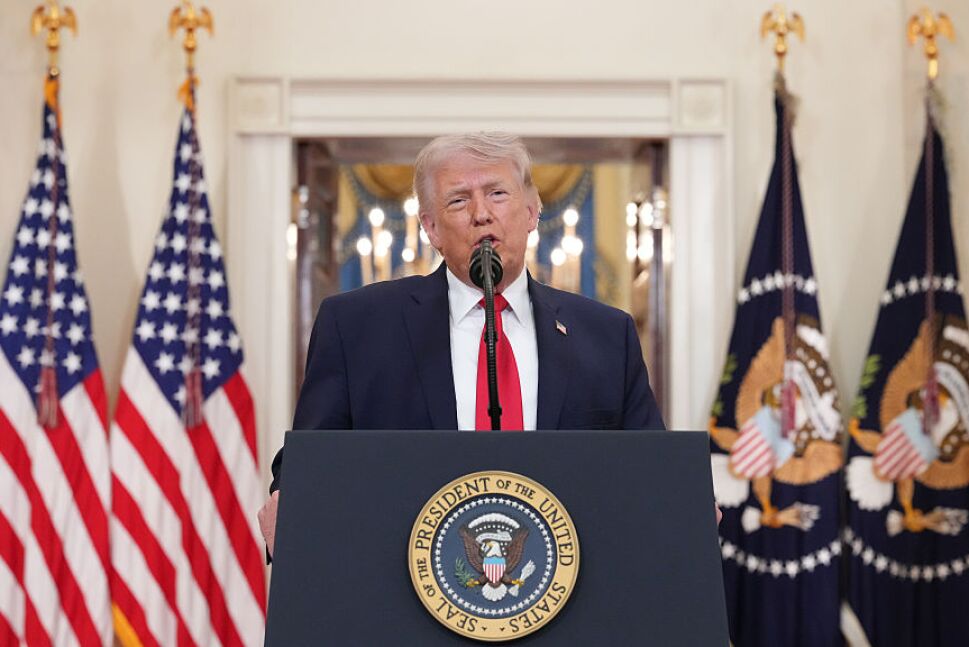
President Donald Trump delivered an address to the nation last night about the war in Iran after four weeks of mostly communicating about the conflict via short phone interviews, social media posts and brief public Q&As at events focused on other issues.
Here’s what I was listening for:
- What’s his thinking about the Strait of Hormuz, the narrow, Iran-controlled waterway through which 20% of globally traded oil must pass?
- Where are we on Iran’s nuclear activities?
- Is he inclined to send ground troops?
- Is there a timetable for the conflict?
While he addressed each of these topics, Trump was somewhat short on specifics. Here is what I think I heard:

Sign Up for U.S. News Decision Points
Your trusted source for breaking down the latest news from Washington and beyond, delivered weekdays.
By clicking “Sign Up”, you will receive the latest updates, including emails, from U.S. News & World Report and our trusted partners and sponsors, and you agree to our Terms and Conditions & Privacy Policy.
Dire Strait of Hormuz
Why start here? It’s the most immediate impact for nearly all Americans. The reason you’re paying so much more at the gas station is that Iran has successfully throttled Gulf oil exports that normally traverse the strait. And it’s not just oil – America gets fertilizer for farms and helium for high-tech products through Hormuz.
In his address, Trump had two basic messages: 1) It’s up to other countries to open the strait, which 2) will open anyway once the fighting stops.
“We will be helpful, but they should take the lead in protecting the oil that they so desperately depend on,” he said. “Go to the strait and just take it, protect it, use it for yourselves. Iran has been essentially decimated. The hard part is done. So it should be easy, and in any event, when this conflict is over, the strait will open up naturally. It will just open up naturally.”
‘Nuclear Dust’
The American rationale for striking Iran turns on preventing that country from developing nuclear weapons, a capability Tehran has always denied seeking even as it built atomic facilities designed to elude detection and resist bombardment.
Trump ordered strikes on suspected Iranian nuclear sites in June 2025.
“We totally obliterated those nuclear sites,” he said Wednesday. “The regime then sought to rebuild their nuclear program at a totally different location, making clear they had no intention of abandoning their pursuit of nuclear weapons.”
Other senior U.S. officials, notably Secretary of State Marco Rubio, have argued the U.S. needed to strike to destroy Iran’s missile and drone arsenal – with which Tehran aimed to have a “shield” deterring attacks on its nuclear program.
Ground Troops?
The United States now has thousands of troops in the region in a potential prelude to an invasion to secure Iran’s nuclear fuel. On Wednesday, Trump appeared to play down the need for putting American boots on the ground – a risky proposition that could lead to more American casualties.
“The nuclear sites that we obliterated with the B-2 bombers have been hit so hard that it would take months to get near the nuclear dust,” said Trump, who didn’t directly address ground forces in his remarks. “We have it under intense satellite surveillance and control. If we see them make a move, even a move for it, we’ll hit them with missiles very hard again.”
Photos: Trump Behind the Scenes

A Timetable?
That sounds like an open-ended commitment. It’s sometimes (glibly) called “mowing the grass” – striking targets but assuming the threat will return regularly. So what’s Trump’s notional timetable for the conflict?
The president has regularly talked about a four- to six-week duration for the operation, which began five weeks ago. Three weeks ago, he said the war was “very complete, pretty much.”
That ambiguity was on display Wednesday, as Trump declared Iran “has been eviscerated and essentially is really no longer a threat” – but he also braced Americans for more fighting.
“We are on track to complete all of America’s military objectives shortly, very shortly, we are going to hit them extremely hard,” he said. “Over the next two to three weeks, we’re going to bring them back to the Stone Ages, where they belong.”
So the stage is set for declaring victory of sorts, while committing to long-term policing of Iran’s nuclear ambitions.