


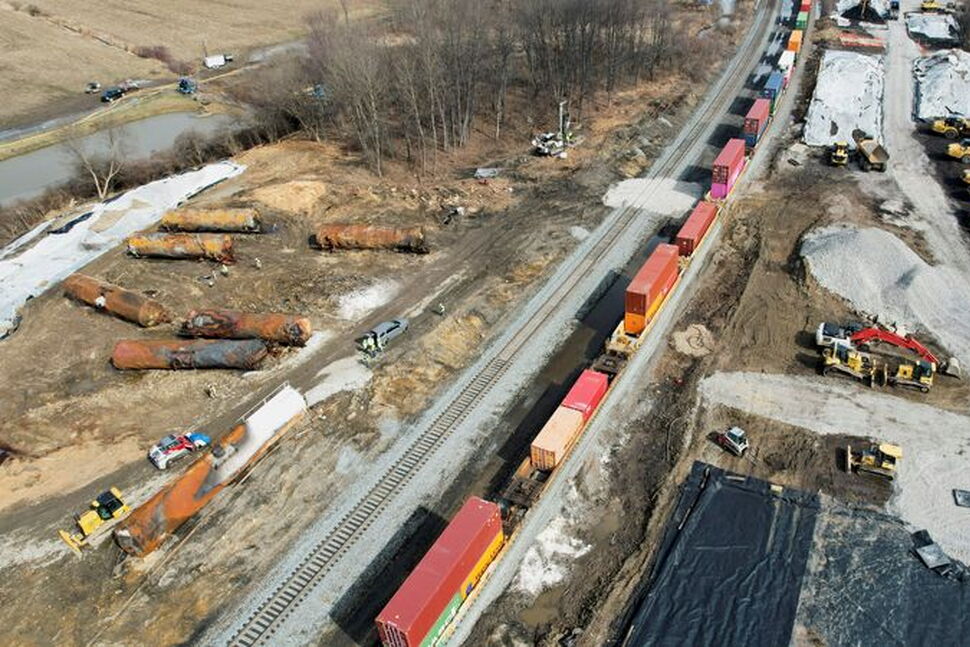
WASHINGTON, May 21 (Reuters) – The White House on Thursday urged lawmakers to pass long-stalled rail safety legislation after the 2023 derailment of a Norfolk Southern-operated train in Ohio that caught fire and released over a million gallons of hazardous materials and pollutants.
Despite support from President Donald Trump and many Democrats, the bill’s fate is in doubt and faces significant opposition from railroads and many Republicans in Congress.
The U.S. House Transportation and Infrastructure Committee is debating a five-year $580 billion highway bill on Thursday and is considering adding a rail safety bill that would boost safety procedures for trains carrying hazardous materials and toughen rules on railcar wheel bearings.
Representative Troy Nehls, a Texas Republican, said the bill was necessary because the derailment “exposed serious weaknesses in the freight rail industry safety practices, particularly when it comes to transporting hazardous materials.”
Representative Sam Graves, the Republican chair of the committee, said the bill would add billions over 10 years to the cost of shipping by rail. “It’s going to ripple across the entire supply chain,” Graves said.
The 2023 derailment was triggered by a catastrophic mechanical failure of an overheated railcar wheel bearing. Norfolk Southern in 2024 agreed to a Justice Department settlement worth $310 million, including agreeing to install additional devices to detect overheated wheel bearings early enough to prevent derailments.
National Transportation Safety Board chair Jennifer Homendy said many safety recommendations made after the 2023 derailment in East Palestine, Ohio, remain unaddressed over three years later.
“People living in the community of East Palestine and all Americans deserve no less than a comprehensive approach that addresses critical rail safety issues,” Homendy said.
The legislation would require enhanced safety procedures for trains carrying hazardous materials, as well as require wayside defect detectors, a minimum of two-person crews and increased fines for wrongdoing.
The Association of American Railroads, which represents major rail companies, criticized the bill saying it has “increasingly become a vehicle for longstanding labor and operational mandates that would raise costs throughout the supply chain while doing little to measurably improve safety outcomes.”
(Reporting by David Shepardson; Editing by Chizu Nomiyama and Nick Zieminski)
Copyright 2026 Thomson Reuters.