


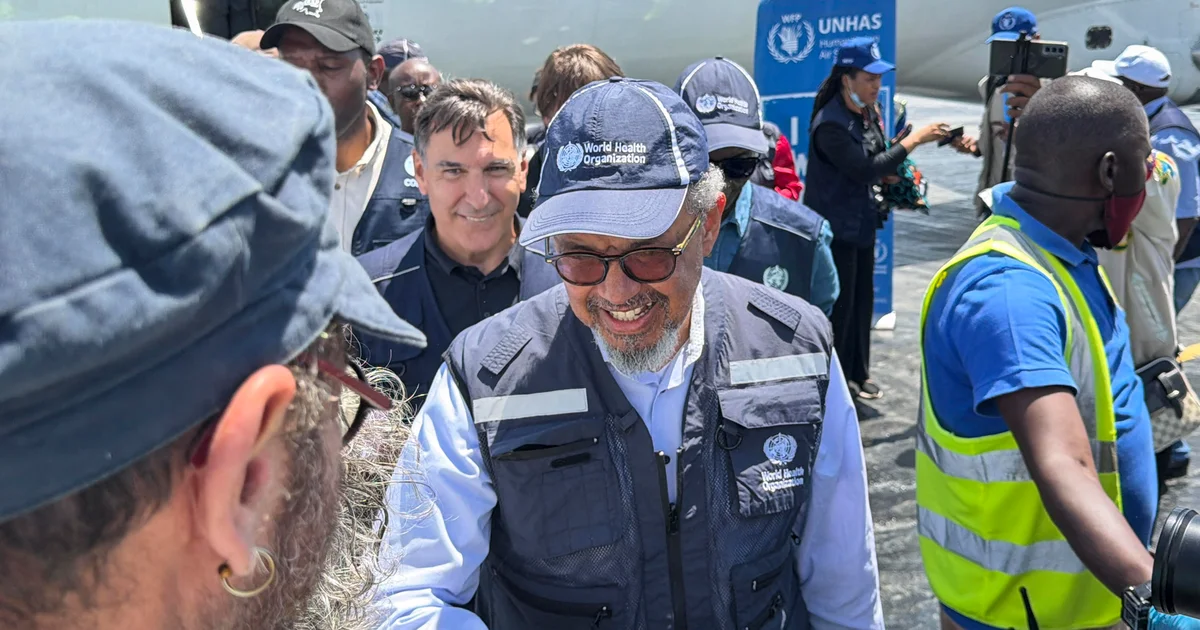
The head of the World Health Organization on Saturday visited eastern Congo’s Bunia, a city at the heart of an outbreak of a rare type of Ebola, where the virus is spreading faster than the response despite better-organized health facilities and new aid arrivals.
Tedros Adhanom Ghebreyesus is expected to visit a treatment center and meet local authorities, health workers and affected families in Bunia.
“The best way to address this is to provide all the necessary support to fight the disease at its epicenter and to continue offering every assistance needed,” the WHO’s director-general told reporters late Friday.
The health organization said latest official figures showed 906 suspected cases and 223 suspected deaths. The number could be three to four times higher than what is being reported, “CBS Saturday Morning” reported.
Neighboring Uganda has confirmed nine cases and one death, the Ugandan ministry of health said Friday.
GLODY MURHABAZI/ AFP via Getty Images 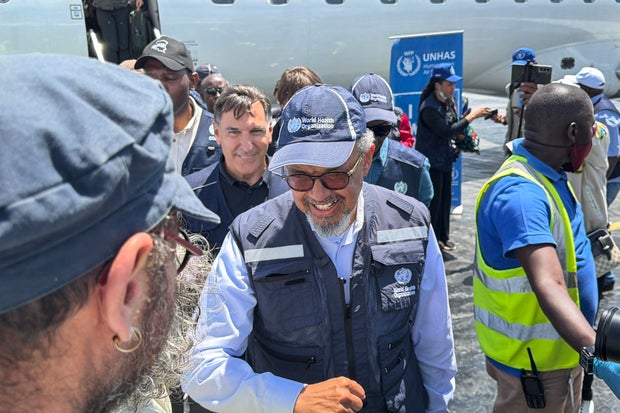

Current Ebola strain has no approved treatment or vaccine
The Bundibugyo virusthe current kind of Ebola, has no approved treatment or vaccine.
“This is a difficult situation, and we recognize that. But the Democratic Republic of Congo has faced the Ebola virus many times before. We are confident that it can once again bring this outbreak under control,” Tedros said after meeting with Congo’s Prime Minister Judith Suminwa Tuluka on Friday.
Last week, the WHO upgraded its risk assessment to “very high” at the national level. Tedros said the outbreak is “spreading rapidly.”
Medical aid donated by the European Union arrived in Ituri, the heart of Congo’s Ebola outbreak, on Thursday. More shipments are expected in the coming days. The U.S. announced $80 million in additional aid on the same day, bringing its total commitment to more than $112 million.
Response efforts don’t match pace of outbreak
Response efforts at Bunia’s Rwampara and General hospitals appear more organized, with additional staff, protective gear and medical supplies, though patients continue arriving around the clock, a reporter from The Associated Press observed on Friday.
The response has not kept pace with one of the fastest-spreading outbreaks on record, Doctors Without Borders, or MSF, warned on Saturday.
“Never before has an Ebola outbreak recorded so many cases so soon after its declaration,” Dr. Alan Gonzalez, MSF’s deputy director of operations, said in a statement. “Nobody knows the true scale and severity of this outbreak.”
Gonzalez called for an immediate expansion of testing, faster deployment of aid workers and sustained access for medical supplies.
The dangers faced by health workers have been heightened by anger among residents over the stringent medical protocols for handling the victims’ bodies, which clash with local burial rites. Residents have launched at least three attacks against health centers.
Attacks in Ituri by the Allied Democratic Forces, a rebel group allied with the Islamic State group, and a coalition of ethnic militias have also hindered the response.
The illness also has been reported in the Congolese provinces of North Kivu and South Kivu, south of Ituri, where the Rwanda-backed M23 rebel group controls many key cities, including Goma and Bukavu. The rebels have reported two cases.
Border closures “not effective” in preventing spread, WHO says
Uganda and Rwanda have closed their borders with Congo. Border closures and travel bans are “not effective at all” in preventing the spread of the outbreak, Tedros said on Friday.
“Closing borders, as some countries have done, only discourages transparency. The Democratic Republic of Congo is reporting the situation openly and transparently,” he said, urging countries to reconsider these measures.
U.S. Secretary of State Marco Rubio said Wednesday that no Ebola patients will be allowed into the U.S., and banned entry for non-U.S. passport holders who had recently visited Congo, Uganda or South Sudan.
Airports in the United States, including JFK in New York, Washington-Dulles International Airport, Hartsfield-Jackson Atlanta International Airport and George Bush Intercontinental Airport are conducting enhanced health screenings. CDC officials will evaluate travelers showing symptoms and they could be transported to a hospital for further treatment.
On Friday, a Kenyan High Court judge temporarily blocked a Trump administration attempt to set up an Ebola quarantine facility on an air base in the East African country.