


Previous large initial public offerings suggest SpaceX investors could be in for a bumpy ride after Elon Musk’s rocket company goes public on Friday.
Companies staging major IPOs often see their share price surge over the first several days or weeks of trading, but then return to earth. Such stocks routinely fall below their offering price after a year.
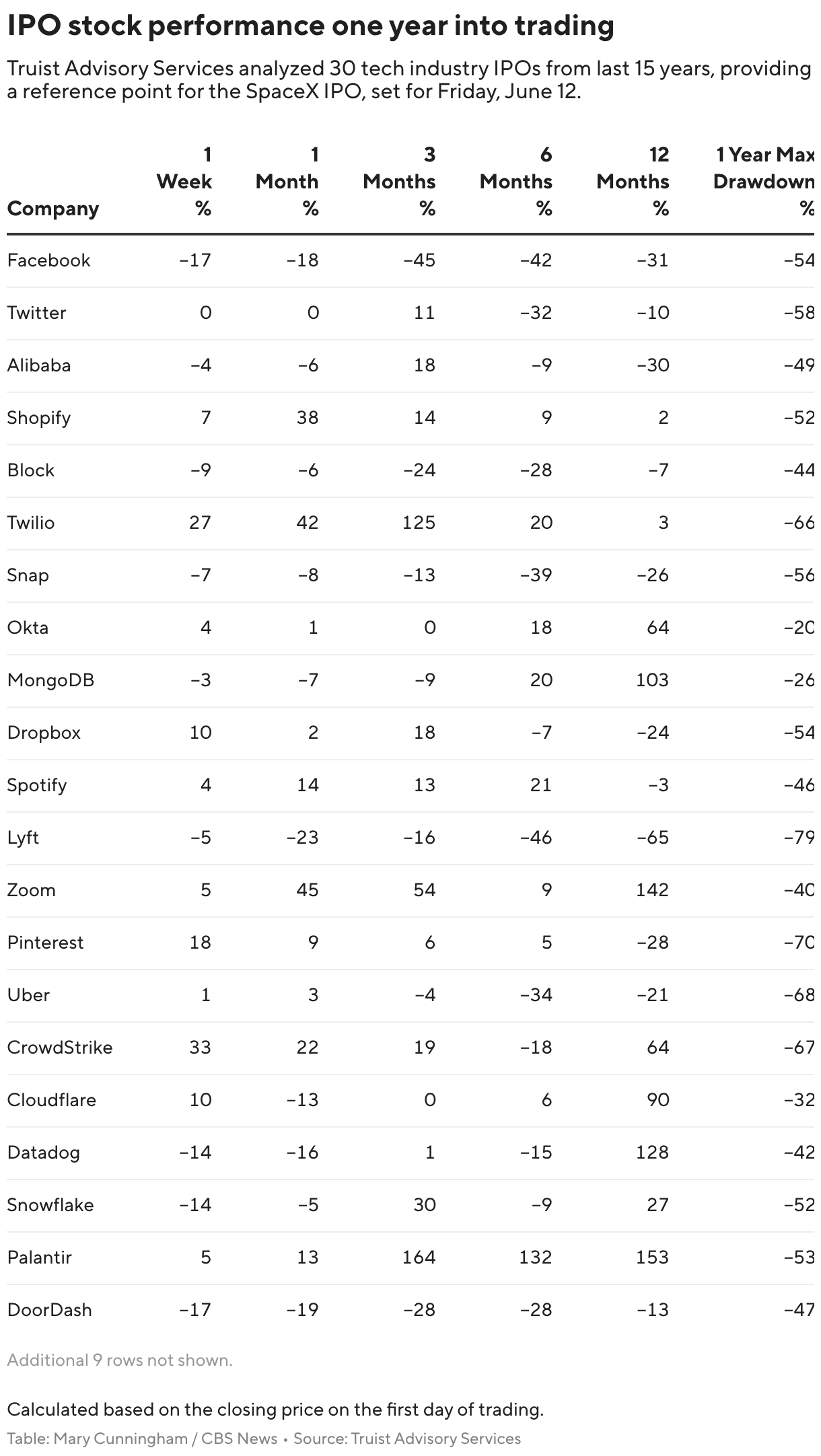
“Historically, major IPOs have tended to have a good deal of volatility over the first 12 months,” said Sam Grelck, an equity strategy analyst at Truist Advisory Services, a unit of Truist Financial. “Even those that have performed well in many cases have tended to have pretty significant drawdowns at some point.”
To be sure, there are exceptions. For example, shares of online video company Zoom Communications soared after their 2019 market debut and remained 142% to the good after the offering, according to Truist data.
Over the longer term, IPOs are a crapshoot. A Truist analysis of 30 sizable technology IPOs over the past 15 years found that the companies had an average maximum loss of 55% in their first year of trading. More than half of those offerings posted negative returns a year after their debut.
“The near term — so one week, one month, three months — is stronger,” Grelck said. “As you get to longer horizons, those drawdowns and the negative returns start to come in a little bit more.”

Separate data from Jay Ritter, an IPO expert and professor at the University of Florida’s Warrington College of Business, also underscores the inherent risk in public offerings. The average three-year market-adjusted return for investors who bought shares at a company’s closing price on its first day of trading is -21%, Ritter found in research spanning more than 9,200 IPOs from 1980 to 2024.
SpaceX priced its stock at $135 and expects to raise $75 billion, making it the largest-ever IPO. After the offering, the company is projected to be valued at $1.77 trillion.
By comparison, that would make it larger than Musk’s electric car maker, Tesla, which has a market value of $1.5 trillion; Meta Platforms ($1.4 trillion); and Warren Buffett’s Berkshire Hathaway ($1.04 trillion).
“IPOs go up 19% [on average] on the first day of trading from the offer price, so in this deal that would correspond to about $30 a share,” Ritter told CBS News. “The return is going to be much better if your purchase price was at $135 than $165.”
“Investors buying in are only going to make a decent return if the company grows its revenue enormously and becomes very highly profitable,” he added. “This could happen, but it’s not guaranteed to happen.”
What does this mean for SpaceX shareholders?
While past IPOs offer reasons for caution, SpaceX won’t necessarily follow the same trajectory, Grelck noted.
“We don’t know exactly how it’s going to trade. There are exceptions to the high-volatility, potential negative returns,” he said. “Maybe SpaceX will perform very well and not have a major drawdown.”
One factor that could drive volatility in SpaceX shares is the many ordinary investors expected to pile into the stock, he added. SpaceX is allocating 30% of the IPO shares to retail investors, far above the typical 5% to 10% allocation.
Such investors might be more inclined to dump their shares if the company’s growth falters, rather than ride out the storm, Grelck said.
Exposure through indexes
SpaceX’s performance will also affect people who don’t directly own its shares, as the stock is slated to be included in major index funds. That means millions of Americans will become shareholders in SpaceX through their 401(k) and other retirement plans, which commonly invest in index funds.
For example, the Nasdaq-100 index recently changed its rules for newly traded companies, paving the way for SpaceX to be added to the index within 15 trading days of its public listing. That could affect people who own shares of the popular QQQ exchange-traded fund, which tracks the index.
The Russell indices also changed their fast-entry rules, allowing SpaceX stock to be included within five trading days of the IPO.
“There’s a lot of money tracking that index, so as SpaceX enters, I think there’s a real possibility that there’s a systematic buying that could support shares, at least to some extent,” Grelck said.