


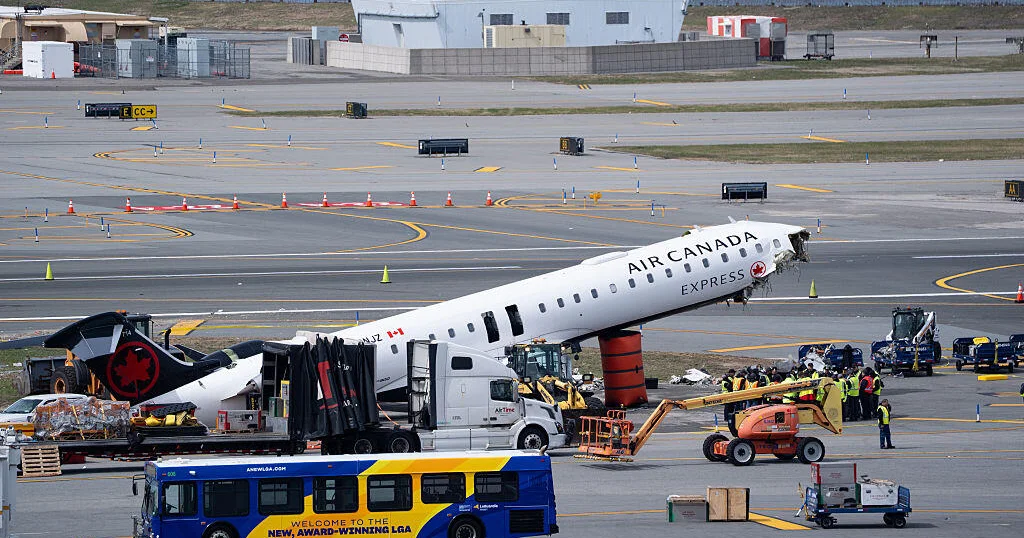
All but four of the passengers injured in Sunday’s deadly collision between an Air Canada plane and a fire truck have been released from the hospital, the airline said Wednesday, as crews began moving the mangled aircraft off the runway at New York’s LaGuardia Airport.
A spokesperson for the Port Authority of New York and New Jersey said in a statement provided to CBS News that it was working to have the runway reopened by “no later than Friday morning.”
“With the removal of the plane and truck, we are reviewing the condition of the runway to ensure it meets FAA regulations and can be re-opened safely,” the spokesperson said, adding that the truck was moved to a “secure location as evidence” in the National Transportation Safety Board’s investigation into the crash.
In its own statement earlier Wednesday, Air Canada said that the plane’s debris had been released by authorities. It said its crews would “move the aircraft as soon as it is safe, to a secured hangar.”
Air Canada added that it was cooperating with the NTSB’s investigation.
Since Monday, much of the wreckage had remained on the tarmac, blocking access to one of LaGuardia’s two runways at one of the country’s busiest airports.
Just before 5 p.m. Eastern Time on Wednesday, airport workers began towing the remnants away. Two big tow trucks working in tandem also righted the badly damaged fire truck, which had been laying on its side since the crash.
Lokman Vural Elibol/Anadolu via Getty Images 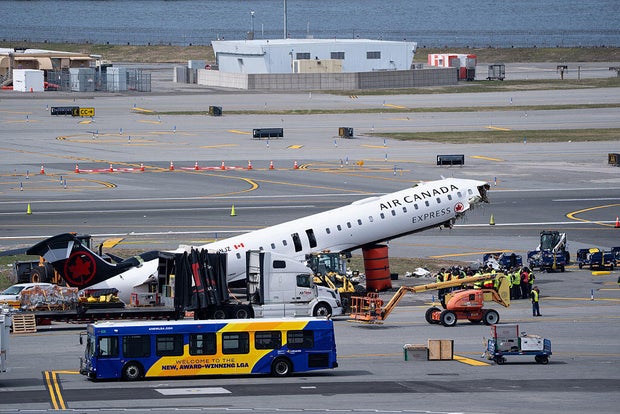

The jet’s tail end was lifted onto a large dolly, which was then towed via long tethers by two vehicles driving side by side. Earlier in the day, much of the wreckage of the nose, which was obliterated in the collision, was cut away by work crews. As it was towed, the middle of the plane was supported by its own landing gear, which appeared to be intact.
The crash killed two pilots. Roughly 40 people were treated at area hospitals for a range of injuries, some serious. Further details on the four people who remained hospitalized were not immediately available.
The plane, which originated in Montreal, was carrying 76 people, including the crew, when it slammed into the fire truck that had driven out onto the runway. Seconds before the collision, an air traffic controller had cleared the truck to cross the runway.
After the collision, many onboard managed to escape the damaged aircraft, including a flight attendant who survived after being thrown onto the tarmac while still strapped in her seat.
The two pilots have been identified as Capt. Antoine Forest and First Officer Mackenzie Gunther. At least one passenger, Clément Lelièvre, credited their “incredible reflexes” in saving his life and those of others, noting they braked extremely hard just as the plane touched down.
The two Port Authority Police Department firefighters in the truck survived.
In an interview with CNN Wednesday, NTSB Chair Jennifer Homendy said that the air traffic controller who was directing traffic during the crash was interviewed by NTSB investigators late Tuesday night. Homendy also said that interviews were conducted Wednesday with the other controller who was in the tower at the time, as well as the controller in charge, the air traffic manager and the operation supervisor.
She told CNN that the workload faced by the two controllers who were on shift at the time of the collision was “concerning.”
“In this case, we saw that there was a pretty heavy workload for these two controllers, where you had an emergency going on, you had several flights that they had to attend to, so it was a high workload for them,” Homendy said.
A CBS News review of dozens of reports going back to 2000 found that pilots have complained about controller miscommunication and close calls with ground vehicles at LaGuardia Airport for years. A review of the Federal Aviation Administration’s official database of runway incursions identified at least 132 incidents since 2000, including 17 involving maintenance, snow and other support vehicles being on runways when they should not have been.