


For generations, young Americans have heard the same message: Go to college, get a job. But lately, young people are finding the job market to be terrible. Meghan Obetz of Philadelphia said, “It feels like once you graduate, you know, you’re expecting things to just fall into place, and sometimes that’s just really not the case.”
It definitely hasn’t been the case for Obetz, or for Olivia Bennett in New York, Michael Sundheim in Minneapolis, and Daniel Fischer in Anchorage. They’ve recently graduated, but trying to find a job has been slow and frustrating, despite sending in hundreds of applications.
“You know your résumé is getting thrown into a pile, and AI is basically sorting it through,” said Obetz.
Fischer said, “The last position that I interviewed for had 300 applicants.”
CBS News 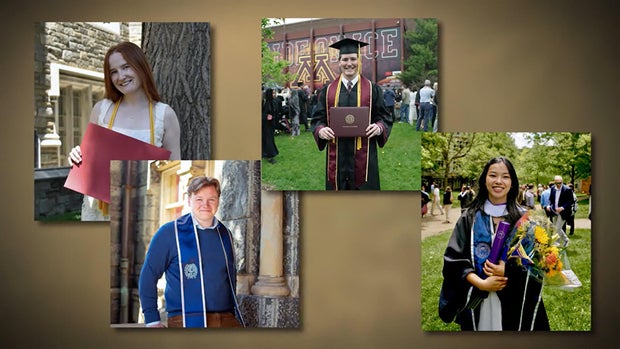

“And you’re not even hearing back,” said Bennett. “You can’t even get a rejection. You just submit into some kind of void.”
Sundheim said, “It gets to a point where you definitely feel defeated.”
Fischer says, as far as he can tell, no humans have been involved in the process: “It’s plausible to me that this is some kind of elaborate psychological experiment that’s being done on me and my classmates, to see, you know, how many applications they can get us to submit before we lose our minds!”
“Measures of uncertainty”
They’re not imagining it. The unemployment rate among young people is about twice as high as the national average; and 40% of college grads who are working have taken jobs that don’t require a college degree, like temporary or part-time gigs.
“People who are trying to look for jobs for the very first time are having a really difficult time of it, the hardest time that they’ve had in years,” said Laura Veldkamp, an economics professor at Columbia Business School.
Is it true that artificial intelligence has taken all these jobs? “There’s a little bit of truth to that,” Veldkamp said. “The research that’s done on this suggests that AI has actually increased the unemployment rate by about 0.1 of a percent. So, that’s one in 1,000. But it’s definitely not the whole story of what’s going on with unemployment.”
CBS News 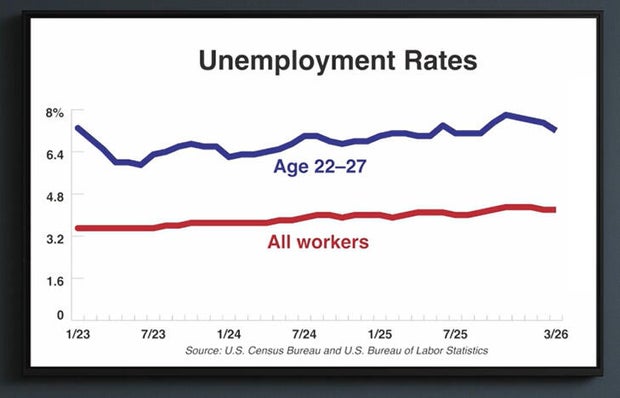

The real story, she says, is a weak economy: “Measures of uncertainty are at all-time highs recently. And when people are uncertain, they often freeze. So, this is a deer-in-the-headlights moment for U.S. employers, where they’re uncertain, partly about AI; they don’t know how it’s going to affect their businesses and how it’s going to affect their hiring needs. But they’re also uncertain about tariffs that have been on again, off again, higher, lower.
“The third thing that’s creating uncertainty is a lot of fluctuation in fuel prices,” Veldkamp said. “They’ve almost doubled in the last few months. And when its price moves around a lot, it creates a lot of uncertainty for the cost of doing business.”
So, why is it affecting young people and entry level jobs in particular? According to Veldkamp, “If you’re really uncertain about what to do and you freeze, that means, ‘I don’t want to do something new, like go look for a new person who may or may not work out.’ And so, that tends to be young people.”
And to make matters worse, Veldkamp said, “Wages are lower because there’s so much demand from potential workers.”
So, not only is it harder to find a job, but if you manage to find one, it’s likely to be paying less? “I’m sorry to say, yes,” Veldkamp replied.
“Play the long game”
There are certain industries that offer some green shoots of hope for job growth, says Laura Fuentes, who runs human resources for Hilton, which employs 500,000 people. She points out that some fields – including healthcare, energy, AI and hospitality – are hungry for new workers. “Those with the right hustle, the right mindset are piercing through, and we’re able to find them,” she said.
Fuentes acknowledges that first-time job-seekers are having difficulty with the huge volume of applications being met with little or no response: “I do feel for students; I’m a mom of two kids, they’ve witnessed that. So, play the long game. Be patient and persevere.
“And I’d say open up your aperture,” she added. “A lot of kids come out with this, like, ‘I wanna be X when I graduate.’ That first job, it’s not your identity, and it’s not your destination. It’s a launching pad, right?”
Are you saying, Don’t be so picky? “A little bit!” Fuentes laughed. “Loosen up about the exact job title, the exact pay, the exact thing you will be doing.”
The perils of “one-click apply”
Ironically, part of the problem might be websites designed to make finding a job easierlike Linkedin, ZipRecruiter and Indeed. They’ve come up with the “one-click apply” button. This kind of feature lets you blast out your résumé to hundreds of listings. As a result, each job opening may get thousands of applications, lowering everyone’s chances of getting through; and employers often wind up using AI to evaluate the tsunami of applications.
Laura Fuentes suggests a better way: “As our recruiters lovingly say, ‘Don’t spray and pray,'” she said. “Find a couple of entry points beyond your recruiter, and beyond the online application. Even as a student, your network is likely far broader than you imagine. Your professors, the people you babysat for, friends of the family. Keep at it. All you need is that one yes to get in the door.”
And sure enough, studies have shown that most jobs are filled through personal connections.
All of the recent graduates we met said they’ve heard the advice: “Forget the job sites, go through a networking channel, someone you know.”
“But in order to know somebody, you have to know somebody,” Daniel Fischer laughed. “And you don’t always, right?”
“And even if you do have a connection, you’re not guaranteed anything, which is incredibly disappointing,” said Olivia Bennett.
After months of searching, Bennett and Michael Sundheim finally landed jobs through people they’d met, not through job sites. Bennett accepted a job outside her chosen field. “I went to college for international relations, and specifically U.S.-China policy,” she said. “I now work in digital marketing in event production. So, kind of different.”
Meghan Obetz is still looking for a job in music or marketing. Daniel Fischer is still hunting for something in law or political advocacy.
Fortunately, the dry spell may be easing. According to Fuentes, “This month’s job report suggests that we’ve turned the corner, and we’re starting to see more jobs posted, more entry-level jobs posted that young people would be highly qualified for. We don’t stay frozen forever. Eventually, even amidst all the uncertainty, life must go on. Business must proceed. And we’re going to need more workers to make that happen.”
For recent grads like Fischer, a turnaround can’t come too soon: “I mean, it doesn’t matter to me if it’s the economy [to blame] or not, right? Like, it is deeply personal. Like, I really would like to not live with my parents anymore. Because I need to start my life! I need to, like, have a career!”
For more info:
Story produced by Gabriel Falcon. Editor: Carol Ross.
See more: