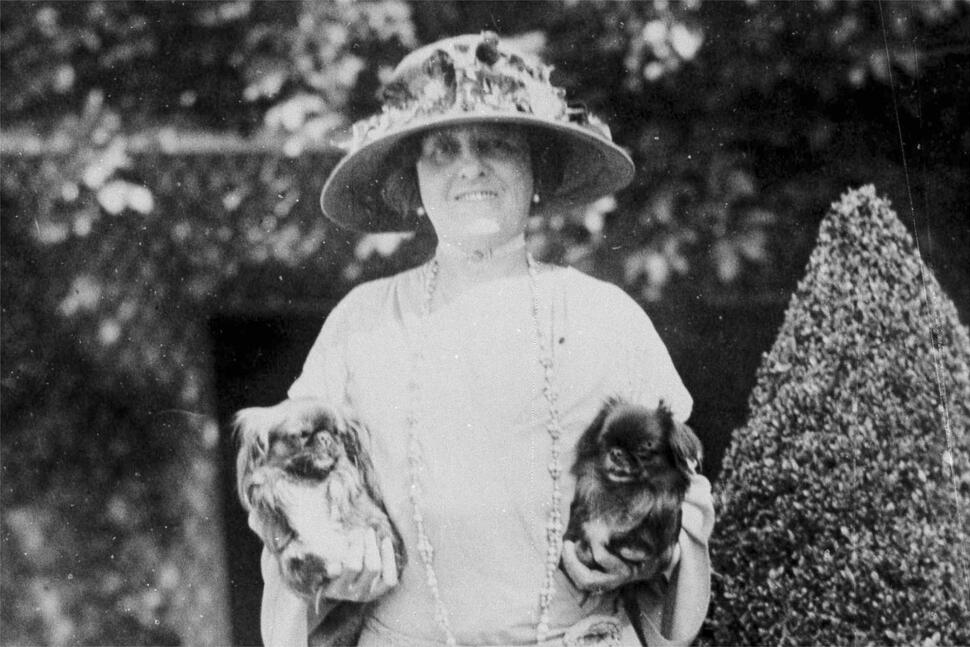
NEW YORK (AP) — When World War I broke out in 1914, Edith Wharton’s initial response was less as a storyteller in search of material than as a citizen and intrepid witness.
The Pulitzer Prize-winning author of “The House of Mirth,” “The Custom of the Country” and other probing stories of New York society was living in Paris at the time and soon set out to help those imperiled by the clash between Allied and German forces. She set up a workroom for seamstresses and others who had lost their jobs, established hostels that aided thousands of refugees and even reported from the trenches for a series of dispatches that ran in the American periodical Scribner’s Magazine.
But Wharton eventually — and inevitably — channeled her observations and experiences into fiction. She worked on a novel published after the war, “A Son at the Front,” and attempted a story about an affluent couple in the French countryside who decide that the war is going well enough that they can resume the social gatherings of the past. “The Men Who Saved the World” — unfinished and never before published — appears Friday in the new issue of The Strand Magazine, which has released rare works by Mark Twain, Ernest Hemingway and many others.
“The boom of guns can be heard in the distance. A few young soldiers sit among the guests. And the hostess wants to know whether they might have dancing,” Strand Managing Editor Andrew Gulli writes in a brief introduction. “Wharton asks a question that is as relevant today as it was over a century ago: what is the cost of refusing to see the horrors beyond the softly curtained windows — and who pays it?”
Wharton had long scrutinized the rich from the inside. Born into a wealthy New York City family in 1862, she knew firsthand the manners and codes and traditions that she picked apart in her best known work. In “The Men Who Saved the World,” believed to be written in 1918, she shifts the narrative from the New York drawing rooms of her early fiction to a French chateau within miles of a battlefield.
The author had a deep affinity for France and French culture, which she regarded as “one of the greatest cultures in the world, perhaps the greatest culture,” Wharton scholar Julie Olin-Ammentorp wrote in an email, adding that she was unsure why the author never finished “The Men Who Saved the World.” The German attack stirred Wharton’s conscience, and her imagination.
“The Men Who Saved the World” dramatizes the separation between civilian and military life, and what happens when they merge. It’s told through the perspective of a young American nurse, Milly Arden, a guest at the home of Fred and Madge Upshall, who are preparing a dinner party in the same setting where they had once permitted an army surgeon to perform amputations. Arden finds herself seated next to a war hero, Capt. Sherman Wake, regarded by Mrs. Upshall as one of the “real people.” Capt. Wake proves eager to discuss the “catastrophic horror and waste” he has seen nearby.
“You hear the guns pretty distinctly here,” Wake tells Arden. “They must make the windows rattle when everything’s quiet, don’t they?”
“Yes, they do,” she responded, looking out on an orchid “which the cannonade had displaced just before dinner.”
Copyright 2026 The Associated Press. All rights reserved. This material may not be published, broadcast, rewritten or redistributed.
Photos You Should See – April 2026
