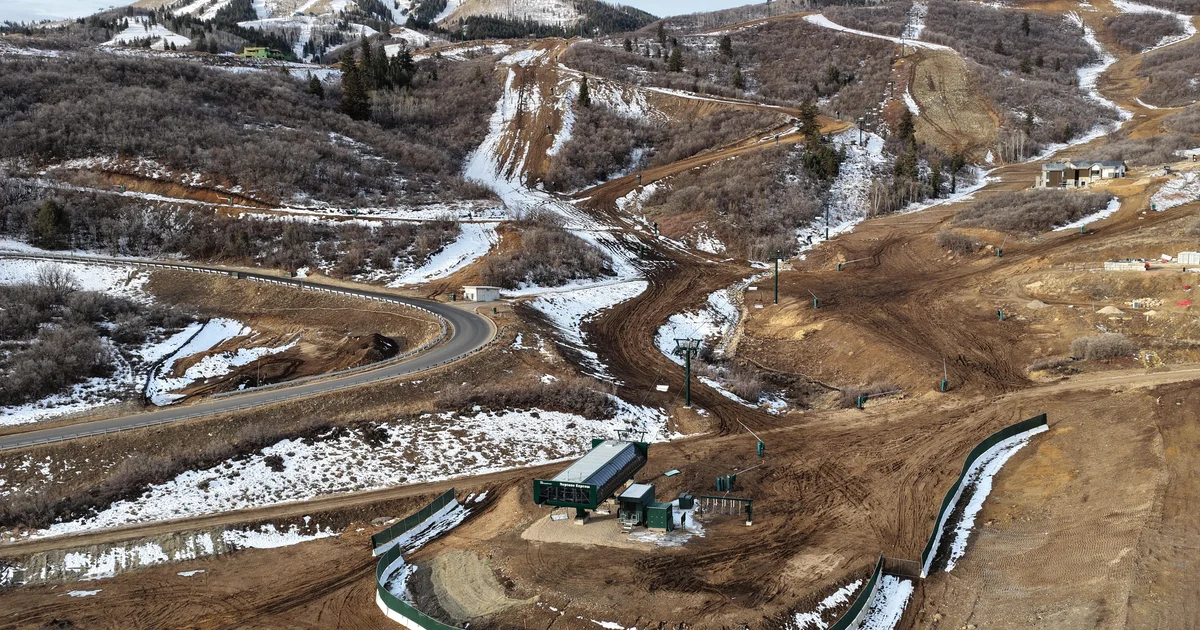
At ski resorts across the West this winter, viral images showed chairlifts idling over brown terrain in places normally renowned for
their frosty appeal. Iconic mountain towns like Aspen, Colorado, and Park City, Utah, were seen with shockingly bare slopes,
as the region endured a historic snow drought that experts warn could bring water shortages and wildfires in the months ahead.
“It’s been a long time since it’s been this bad,” said Russ Schumacher, Colorado’s state climatologist and the director of the Colorado Climate Center, a research initiative at Colorado State University that tracks extreme weather.
He said Colorado hasn’t experienced such a severe snow drought in more than 40 years. Neither has Utah, said Jon Meyer, that state’s climatologist, and newly released federal drought data show similar conditions in New Mexico and Arizona. All four states are contending with record-low snowpack, which is the accumulation of mountain snow that fortifies rivers, reservoirs and drinking water systems once it melts.
In mid-January, NASA released imagery that showed sparse snow cover on the Rocky Mountains and Cascades — the lowest extent recorded for that date since satellite monitoring began in 2001. That trend was consistent through much of the winter, with western snow-cover lagging far behind historical averages on most days, according to the National Snow and Ice Data Center.
Mario Tama/Getty Images 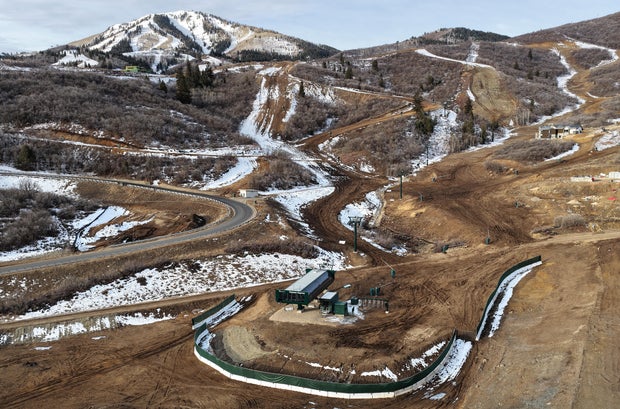
A snow drought of this magnitude has the power to disrupt fundamental aspects of life in the West, where the population relies on snowpack for roughly 75% of its water supply, multiple experts told CBS News. Because the amount of snow that falls in winter determines what’s available in spring, summer and beyond, they said the repercussions of it will likely be felt for at least the rest of the year.
In addition to increasing the risk of water shortages for states already strapped for those resources, low snowpack can make wildfire-prone land even more vulnerable.
“When people ask what they should be concerned about coming into the spring or summer months, I say: water supply, water supply, water supply, and fire concerns,” said Jason Gerlich, a regional drought information coordinator at the National Integrated Drought Information System, or NIDIS.
Water shortage concerns
Precipitation totals were near normal this winter across the West. But it’s the scarcity of snow, specifically, that alarms researchers.
Every state and major river basin in the West is currently experiencing a snow drought, according to an NIDIS report written by Gerlich and other researchers. The drought worsened from February into March, the report said, and was expected to deepen after an unseasonably early heat wave.
The consequences are already being felt across the Colorado River Basin, a critical watershed that supports roughly 40 million people and has been strained for decades. The amount of water stored in its snowpack has reached a record low, according to NIDIS. That threatens Lake Mead and Lake Powell, the basin’s largest reservoirs, and could stretch vital lifelines for farmlands in some of the driest parts of Arizona, California and Nevada that have no other dependable water sources.
Federal forecasts show that by the end of the year, Lake Powell’s water levels could fall so low they won’t be able to spin turbines at the nearby Glen Canyon Dam. Those turbines generate electricity to power homes, businesses and irrigation systems across the region. The reservoir is currently about 25% full.
Jim West/UCG/Universal Images Group via Getty Images 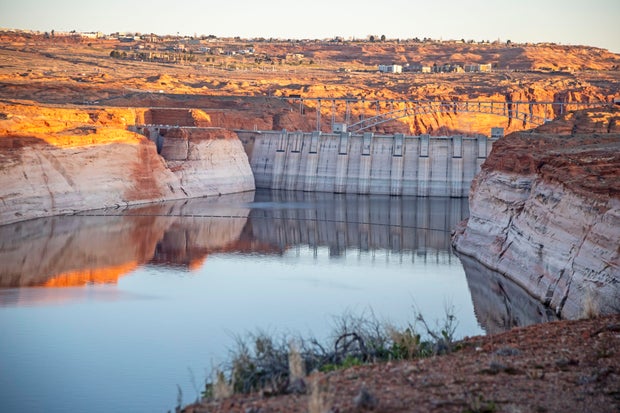
Broader water supply forecasts suggest shortages could be imminent and potentially widespread.
The latest outlooks from the Colorado River Basin Forecast Center are well below average, while forecasts for California and Nevada say most monitored locations in those states will have less than 50% of their normal water supplies for most of the spring and summer, with few exceeding 70%, because of weak snowmelt.
Some Nevada communities that rely on reservoirs could see supplies shrink to a fraction of normal — as low as 9% in some areas. The impacts may be particularly acute for the state’s rural ranchers. Some of them don’t have access to reservoir water and depend directly on mountain runoff to irrigate their land, said Jeff Anderson, a water supply specialist for Nevada at the U.S. Department of Agriculture.
Utah is also expected to receive less than half of its average seasonal water supply, said Meyer, the state’s climatologist, with some central regions projected to see as little as 20%. While its reservoirs are designed to mitigate those swings — storing water in wet years to use in dry ones — persistent drought has compromised that backup plan, too.
“If we have a pretty bad spring and summer, where we don’t get a lot of precipitation, it’s hot and dry, we have a lot of evaporative demand, we could see a lot of our small and intermediate reservoirs beginning to reach levels where they can’t sustain the outflows that they need for normal operations,” he said.
Wildfire risks
The same forces constraining western water supplies could also set the stage for the West’s wildfire season, which has lengthened over the last few decades with rising temperatures and intensifying drought.
Snowpack typically acts as a seasonal buffer against fire, keeping land cool and moist into spring, said Gerlich. When it disappears early, soil and vegetation are exposed sooner to heat and sun, allowing them to dry out more quickly.
“That could increase the risk of an earlier wildfire season,” he said.
The National Interagency Fire Center also warned that the potential for significant fires would be higher than normal for parts of the Southwest later in the spring, in part due to snowpack.
An early start does not guarantee a severe wildfire season, Gerlich said. But the conditions now taking shape increasingly resemble those that in recent years have fueled some of the region’s most destructive blazes.
Record warmth and climate change
The current snow drought is rooted in a combination of factors, including unusual warmth due to climate change, experts said.
Conditions across the West this winter were exceedingly and in some cases dramatically warmaccording to various weather and climate offices in the region. That caused precipitation to materialize as rain, Gerlich said, since “it’s just too warm” for snowfall.
Seven states currently experiencing snow drought, including Colorado, Nevada, Oregon, Utah and Wyoming, are coming off of their warmest winters since record-keeping began in 1895, with Arizona and New Mexico breaking their previous records by more than 2 degrees Fahrenheit, according to the NIDIS report. Meanwhile, California, Idaho and Montana saw their second-warmest winters, and Washington had its fourth-warmest.
“That warmth is on track with the climate change signal that we’ve been seeing,” said Daniel McEvoy, a researcher at the Western Regional Climate Center who co-authored the NIDIS report with Gerlich. “And the thing that’s most attributable right now to climate change is our warming temperatures. There’s a lot of evidence to support that.”
The warmth has accelerated snowmelt and triggered premature mountain runoff, a particularly prevalent issue in California as mid-March temperatures reach triple digits in some areas. David Rizzardo, an engineer and hydrology manager at the California Department of Water Resources, said Sierra Nevada snowpack is about 50% of what it should be for this time of year.
What stands out most to him is how quickly the remaining snow is disappearing.
By April 1, when snowpack currently peaks, California’s could fall to roughly half of where it stands now, according to Rizzardo. He said the unprecedented melting rate this year exemplifies how climate change is reshaping water systems.
“The rapid snow melt is definitely something that we’re trying to put context to, because it’s at a rate we really haven’t seen much of before,” Rizzardo said. “It’s unfortunately evident that some of the warnings about a warming climate are showing up now and becoming true.”