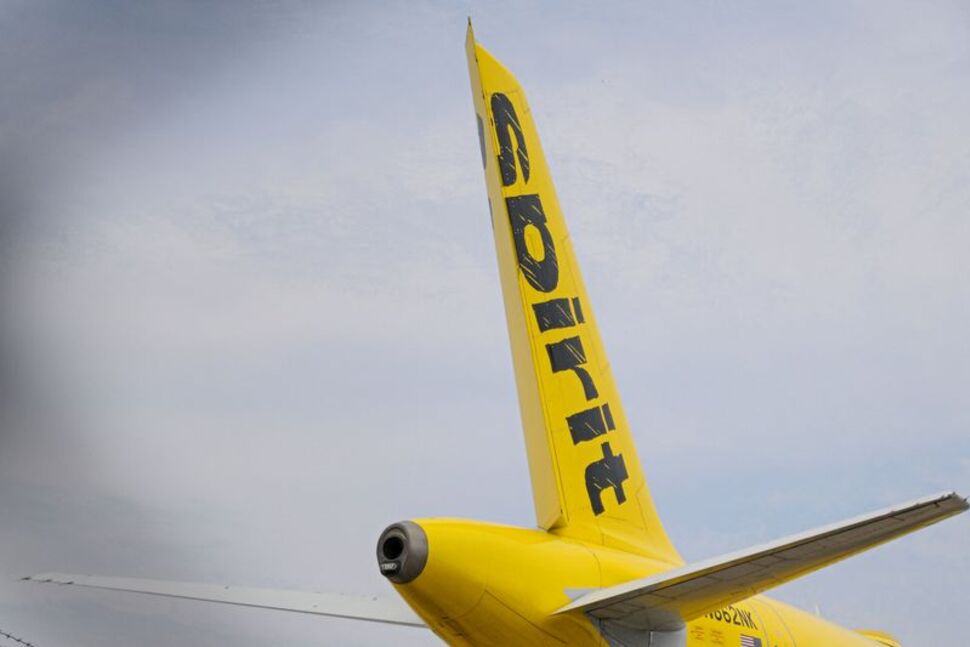
CHICAGO, May 11 (Reuters) – The collapse of Spirit Airlines, one of the industry’s fiercest discounters, has given U.S. budget carriers more room to lift fares, but its exit does little to fix the long-running strain on the cheap-flight model.
The Florida-based airline ceased operations on May 2 after creditors failed to agree on a $500 million government bailout. Now, rivals including JetBlue Airways and Frontier Airlines are targeting its markets while they contend with the same surging fuel costs that doomed Spirit.
The challenges that existed for discounters before Spirit ceased operations will not disappear, experts said. The post-pandemic spike in wages, rising aircraft lease costs and maintenance bills have eroded the advantages that defined the low-cost airline industry.
With a customer base of price-sensitive travelers, discounters have a limited ability to pass on higher costs without hurting demand.
“I expect Spirit’s liquidation to be a modest benefit to its low-cost competitors,” said Joe Rohlena, senior director at Fitch Ratings. “But I don’t expect it to be sufficient on its own to overcome other hurdles that the discounters are facing.”
Frontier has reported adjusted per-share losses in eight of the past 13 quarters, while JetBlue has not posted a full-year profit since 2019. Both stocks have lost about three-quarters of their value in the last five years.
Big U.S. airlines such as Delta Air Lines and United Airlines remained profitable in 2025, helped by higher-income travelers.
Frontier’s adjusted earnings before interest and taxes margin plunged from 9.3% in 2019 to negative 12.1% in 2025, while JetBlue’s declined from about 10.0% to negative 3.7%, according to an analysis from TD Cowen. Delta’s EBIT margin fell from 19% to 10%.
ALL SPIRIT SEATS WON’T BE REPLACED
Spirit’s exit is unlikely to trigger a wholesale rebuilding of capacity, executives said, as discounters have been shrinking networks. Carriers instead are likely to cherry-pick Spirit routes to replace seats.
Frontier said the industry has filled about half of Spirit’s earlier May capacity reductions, with Frontier accounting for roughly 40% of that restored capacity. It expects Spirit’s exit to lift revenue per seat by 3% to 5%.
CEO Jimmy Dempsey, in a statement, noted the company’s record adjusted revenue in its most recent quarter, saying it is in a good position to replace lost capacity and emerge “structurally stronger.”
JetBlue is expanding in Spirit’s former Fort Lauderdale stronghold and enticing eligible Spirit flyers with loyalty matches. It expects 130 daily departures by the summer, more than 75% above its 2025 levels.
JetBlue did not respond to a request for comment.
Not all low-cost carriers have suffered. Las Vegas-based Allegiant Air posted a 14.9% adjusted operating margin in the quarter compared with negative margins for JetBlue and Frontier, due to its focus on lesser-served leisure routes with little competition.
HIGH FUEL COSTS HIT PROFITS
Ultimately, low-cost carriers have little room for error if fuel costs remain high. But pricing power is limited, said Andrew Levy, CEO of Houston-based budget carrier Avelo Airlines, making it “a little harder for companies like mine.”
His airline’s fuel bill rose from about $2.56 a gallon in February to roughly $4.71 in April, prompting it to raise base fares by about $20, lift fees and use promotions to sustain demand, he said.
The fuel-price hit could run into tens of millions of dollars for Frontier and well over $100 million for JetBlue this quarter. JetBlue expects to recover only 30% to 40% of higher fuel costs, while Frontier expects to recoup about 35% to 45%.
Frontier paid $268 million for fuel at $2.88 a gallon in the first quarter, and has forecast $4.25 a gallon for the current quarter. Assuming similar consumption, the unrecovered fuel increase would imply a roughly $70 million to $83 million hit to earnings.
Similarly, JetBlue paid $2.96 a gallon in the first quarter, but has forecast a range of $4.13 to $4.28 for the current quarter. Assuming similar consumption, fuel costs would rise from $573 million in the first quarter to a range of $797 million to $826 million.
“The ability to recoup sharply higher fuel prices is the primary consideration at the moment,” said Jarrett Bilous, an analyst at S&P Global.
(Reporting by Rajesh Kumar Singh in Chicago; additional reporting by Doyinsola Oladipo in New York; Editing by Sayantani Ghosh and David Gaffen)
Copyright 2026 Thomson Reuters.