BUENOS AIRES, June 4 (Reuters) – Felipe Mujica is heading into this month’s soccer World Cup feeling less anxious than usual.
Mujica, a 39-year-old architect in Buenos Aires, typically watches World Cup matches yelling and swearing, getting so tense that “frankly, it’s not good to be near me,” he admitted.
But this time around, Argentina is defending its 2022 Qatar title, the pressure is off and he may actually enjoy watching the games, he said.
“We were waiting for 30 years to get another World Cup and after winning it the expectations are lower,” he said. “I don’t want to say it doesn’t matter, as we get closer to the date it matters more, but we have a different kind of calm.”
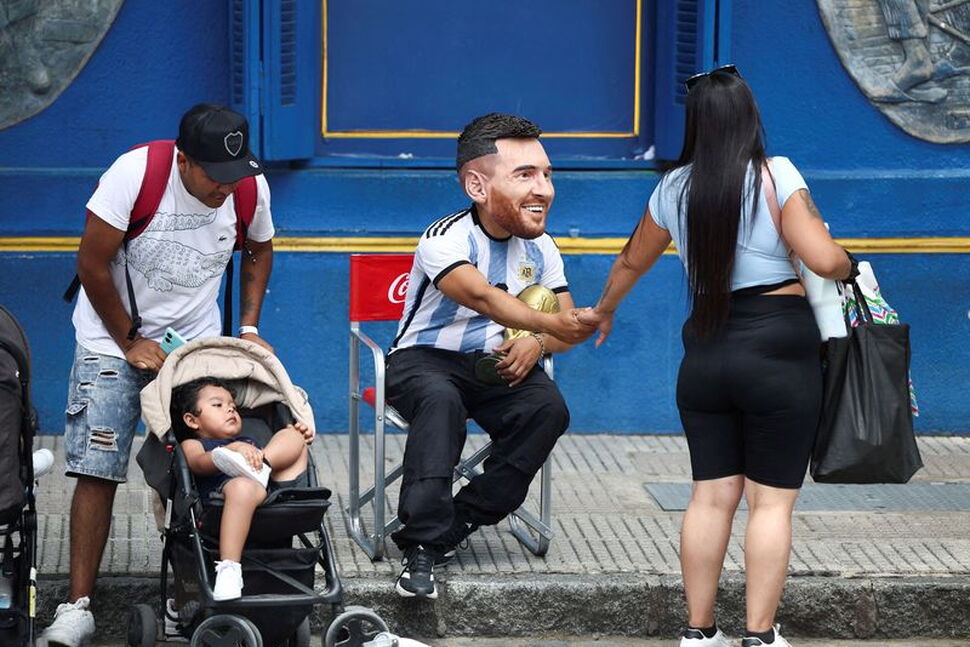
In three-time World Cup winner Argentina, soccer fever is unusually tempered less than two weeks before the 2026 World Cup kicks off in North America. While billboard advertisements featuring Argentine football hero Lionel Messi and the national squad are plastered across Buenos Aires, the temperature is less feverish than in 2022.
Then, “Muchachos, Ahora Nos Volvimos a Ilusionar” (Boys, We Are Now Going to Dream Again), a song that evoked Diego Maradona and Lionel Messi, became the country’s much-sung World Cup anthem.
The pressure was so high then because it was widely seen as Argentina’s last chance to win a World Cup under the leadership of Messi, whose intelligence on the field and dribbling prowess made him the dominant global football player of his generation.
In December 2022, Buenos Aires came to a halt as several million Argentines filled highways, overpasses and the streets in the euphoria that followed Argentina’s victory in Qatar, its first since Maradona led the team in 1986.
“No one expects that to be exceeded,” said Diego Murzi, an Argentine sociologist who studies soccer.
“That World Cup was very intense, and I doubt it will be repeated.”
The feat would be remarkable: if Argentina wins again, it would be only the third country to clinch consecutive World Cups after Italy (1934 and 1938) and Brazil (1958 and 1962).
Bookies generally rank Argentina as the fifth favorite, with a Goldman Sachs model reducing the team’s chances by what the bank called a “winner’s slump” effect, or the tendency of defending champions to underperform at the following World Cup.
“The truth is that it’s very difficult, but well, not impossible, right?” said Argentina’s coach Lionel Scaloni in an interview published on Instagram by CONMEBOL, South American soccer’s governing body.
Advertisers have done their best to convince Argentines that lifting that trophy again is still possible. In a World Cup commercial for popular beer Quilmes, a young man tells his friends at a pizzeria that they are “screwed.” But then Argentine retired basketball star Manu Ginobili turns up to remind them that in the 2004 Athens Olympics he scored a winning basket moments before the final buzzer, sending his team on a run to the gold medal.
At age 38, this will be Messi’s sixth – and almost certainly last – World Cup.
“Here in Argentina we know that it is his last World Cup but it’s something we don’t want to believe,” said Tato Aguilera, a sports journalist in Buenos Aires. “We want to continue that illusion that Messi is immortal and that Messi will keep playing until he’s 55 years old, something that won’t happen.”
As for that tempered atmosphere? That could quickly change once the whistle blows.
“Remember that an Argentine can get fired up in two minutes,” said Aguilera.
(Reporting by Leila Miller, Editing by Rosalba O’Brien)
Copyright 2026 Thomson Reuters.