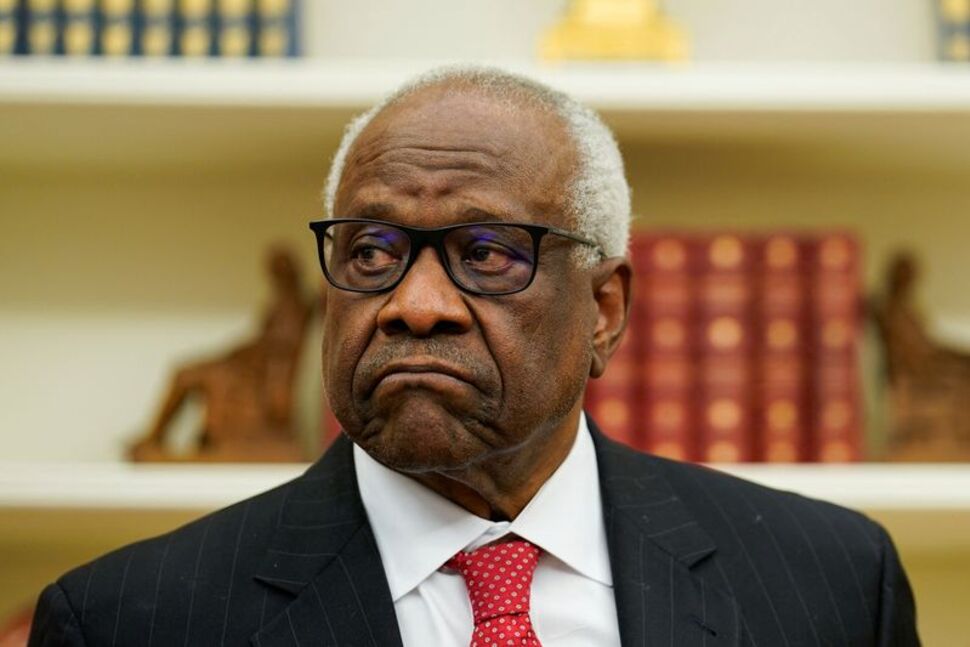
May 3 (Reuters) – Clarence Thomas this week will reach a major milestone on the U.S. Supreme Court, becoming the second-longest-serving justice in American history. Along the way, the stalwart conservative has played an important role in guiding the court on a rightward course, even if he has not gotten everything he has advocated.
Thomas, who is 77, has served since October 1991, having been appointed at age 43 by Republican President George H.W. Bush to replace liberal luminary and civil-rights pioneer Thurgood Marshall on the top U.S. judicial body. Marshall was the first Black member of the court. Thomas, after a contentious Senate confirmation battle, became the second.
Thomas on Monday will overtake Justice Stephen J. Field, who served from 1863 to 1897, for the court’s third-longest tenure, according to the Supreme Court Historical Society. Thomas on Thursday will leapfrog his late former colleague Justice John Paul Stevens, who served from 1975 to 2010, for the second-longest tenure, the society said.
If Thomas remains until May 20, 2028, he would set the court’s longevity record, passing Justice William O. Douglas, who served from 1939 to 1975, the society said.
Thomas has left his mark on the Supreme Court, even as his role has evolved over the years.
“He began his time on the court often in dissent, and he stood his ground,” said Haley Proctor, a University of Notre Dame law professor who previously served as a clerk for Thomas.
“The justice’s influence on the law has been profound,” Proctor said. “And that is a consequence, not only of his many years on the court, but also of his persistence.”
Thomas has helped the court’s 6-3 conservative majority, in place since 2020, to act assertively. On back-to-back days in June 2022, he was the author of a landmark ruling expanding gun rights protected by the U.S. Constitution’s Second Amendment and joined other conservative justices in overturning the 1973 Roe v. Wade decision that had legalized abortion nationwide.
Thomas also has championed an expansive view of religious liberty, opposed gay marriage, fought affirmative action preferences for minorities in university admissions and hiring, supported the death penalty and broad presidential powers, and curbed campaign-finance restrictions.
“Justice Thomas is the most radically conservative justice to serve on the Supreme Court in modern times,” said Erwin Chemerinsky, dean of the University of California, Berkeley School of Law. “I say this because in addition to being conservative he has taken positions that would dramatically change the law that the court never has accepted.”
Chemerinsky noted, among other things, that Thomas favors overturning Supreme Court precedents that have blocked laws against contraceptives and gay sex. Chemerinsky also pointed to the justice’s desire to end key protections for freedom of the press and his criticism of the court’s precedent that required states to provide defense lawyers to criminal defendants who cannot afford to hire one.
“In some areas, he succeeded in changing the law, such as the Second Amendment, overruling Roe v. Wade and ending affirmative action,” Chemerinsky said. “But in most places his calls for a radical change in a conservative direction have not gained support from a majority of the court.”
Thomas and the other conservative justices have let Republican President Donald Trump implement a series of policies impeded by lower courts that faulted their legality. When the court handed Trump a rare setback in February by rejecting his sweeping global tariffs, Thomas was one of three conservative justices who dissented, and the president lavished praise on him.
Ken Masugi, a fellow at the conservative Claremont Institute think tank, said Thomas engenders a sense of loyalty in those who work with him, especially his former law clerks, several of whom have since become federal judges. Before his Supreme Court tenure, Thomas hired Masugi as an advisor at the U.S. Equal Employment Opportunity Commission, or EEOC.
“One notices that his clerks are incredibly loyal to him, even the ones who disagree with him,” Masugi said. “That’s proof of the influence he has on the people within the court.”
Thomas was serving as a federal appellate judge when Bush nominated him to a lifetime job on the Supreme Court. The Senate confirmed Thomas on a 52-48 vote after a confirmation battle during which he was accused of sexual harassment by a law professor named Anita Hill, a former subordinate of his at the EEOC. Thomas denied the allegation.
Future President Joe Biden, a Democrat, was the chairman of the Senate Judiciary Committee during the confirmation hearings that Thomas denounced as “a high-tech lynching for uppity Blacks.” Thomas told the senators: “It is a message that unless you kowtow to an old order … you will be lynched, destroyed, caricatured by a committee of the U.S. Senate rather than hung from a tree.”
Thomas continues to be blunt in public remarks. On April 15 at the University of Texas, Thomas called progressivism a political philosophy that poses an existential threat to the United States and its 18th-century founding principles.
Thomas said progressivism “seeks to replace the basic premises of the Declaration of Independence, and hence our form of government. It holds that our rights and our dignities come not from God, but from government. It requires of the people a subservience and weakness incompatible with a Constitution premised on the transcendent origin of our rights.”
American University law professor Stephen Wermiel said, “I understand that he’s a very gregarious guy and that people at the court like him, but he does often come across as sort of an angry, bitter justice. There are times when you feel like he’s still not over the Anita Hill episode, and still has a kind of simmering anger about that.”
Bush’s other Supreme Court appointee, Justice David Souter, surprised conservatives by evolving into a reliable member of its liberal wing. Thomas, on the other hand, became a darling of conservatives, even if his contributions sometimes were overshadowed by his contemporary conservative Justice Antonin Scalia, who died in 2016.
In 1992, his first full year on the court, Thomas joined a dissent arguing that abortion access should be decided on the state level, and that Roe v. Wade should be overturned. It was the first of many times Thomas showed no reservations about overturning major precedents.
In 1995, Thomas wrote a concurring opinion denouncing affirmative action programs, saying they foster a belief that racial minorities cannot compete without help.
Now, decades later, these positions have been enshrined in Supreme Court precedent.
“If Thomas believes there were bad precedents set in the past, he doesn’t feel any fidelity to them,” said Ralph Rossum, a professor at Claremont McKenna College who wrote a book on Thomas.
And Thomas has abandoned one of his idiosyncrasies. For his first nearly three decades on the court, he rarely posed questions during oral arguments in cases. That changed when the court began hearing arguments by teleconference in 2020 during the COVID pandemic, and he has been a regular questioner since.
WHAT’S IN STORE FOR THOMAS?
Thomas, who turns 78 on June 23, has given no indication of planning to retire. Trump, who would get to make a fourth appointment to the court if any vacancy arises, has said he hopes Thomas and fellow conservative Justice Samuel Alito, 76, stay on the bench.
“It’s hard for me to imagine that becoming the longest-serving justice is not of some importance to him,” Wermiel said.
Thomas in the past has hinted at a lengthy tenure. During a 2019 talk at Pepperdine University in California, Thomas was asked what he might say at his retirement party in 20 years’ time.
“But I’m not retiring,” Thomas told the interviewer, who queried: “Not in 20 years?”
“Not in 30 years?” the interviewer persisted.
(Reporting by Jan Wolfe; Editing by Will Dunham)
Copyright 2026 Thomson Reuters.