By Kentaro Okasaka, Uditha Jayasinghe and Lucy Craymer
TOKYO/COLOMBO/WELLINGTON, March 31 (Reuters) – Indonesia’s leader visited Tokyo this week in Asia’s latest flurry of fuel bartering efforts to offset crippling shortages caused by conflict in the Middle East, a key source of regional energy supplies.
The race for alternatives has hotted up as China, the world’s second largest economy, imposed fuel export bans, while nations such as South Korea and Thailand try to exploit the lifting of U.S. sanctions on Russian energy as a stopgap move.
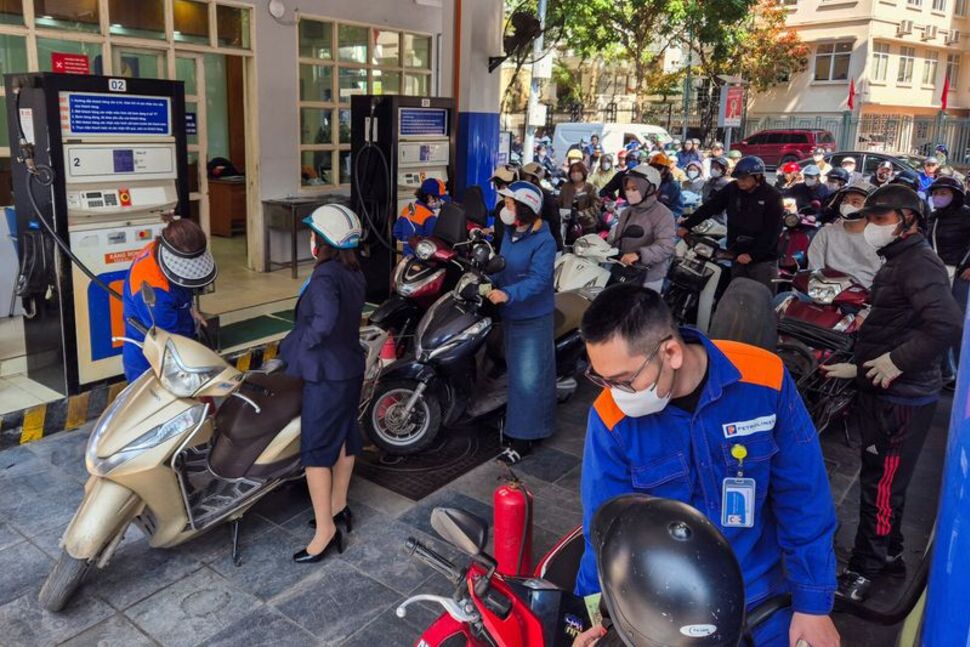
Matters are getting desperate for poorer nations as the Philippines became the first to declare a national energy emergency, Sri Lanka cut its work week to four days and rationed fuel, and Myanmar limited car drivers to alternate days.
Southeast Asia’s biggest economy and the world’s fourth most populous country, Indonesia is also expected to announce curbs in coming days.
“To maintain rational economic relationships is of vital importance,” President Prabowo Subianto told Japanese business leaders in Tokyo after pacts signed on Monday covering long-term oil and gas and geothermal power projects.
“The geopolitical situation in the Middle East gives strategic uncertainty for the security of our energy.”
More immediately, Jakarta could strike a deal to beef up supplies of liquefied natural gas to Tokyo in exchange for liquefied petroleum gas, an essential cooking fuel, Djoko Siswanto, the head of oil and gas regulator SKK Migas, told Reuters on Monday.
While Prabowo and Japan’s Sanae Takaichi agreed to boost ties on energy security at a meeting on Tuesday, neither leader confirmed such a swap agreement.
Japan’s government-backed oil and gas producer Inpex is discussing a similar barter deal with India to swap LPG for naphtha and crude oil, according to an internal Japanese government document seen by Reuters.
Vietnam has also sought Japan’s help for energy supplies, it showed, while the Philippines said on Monday it had received diesel from Tokyo.
Japan’s trade minister stressed the importance of keeping up fuel supplies to Southeast Asian nations where it has supply chains, but declined to comment on specific deals.
Resource-poor Japan relies on the Middle East for about 95% of its oil and 11% of its imports of liquefied natural gas, though its energy stockpiles are among the world’s largest.
Australia’s position as a major energy producer and exporter should give it clout in talks with Asian partners for supplies of jet fuels that could soon run short, energy analysts said.
The government was engaging with major suppliers such as China, Singapore and South Korea, Foreign Minister Penny Wong said this month.
However, China has banned exports of refined fuel, including jet fuel, to safeguard its economy from energy disruption.
That ban, and another by Thailand, have hit Vietnam especially hard, as the neighbours fill more than 60% of its jet fuel needs.
Vietnam’s aviation regulator urged authorities this month to seek additional jet fuel supplies from Brunei, India, Japan and South Korea.
Two-way deals with alternative suppliers should help ease shortages, but a longer war would require concerted efforts, said Hiroshi Hashimoto, senior fellow at Japan’s Institute of Energy Economics.
“If the crisis continues for a prolonged period, Asian countries may need to develop multilateral frameworks to help each other and talk to alternative supply sources.”
RUSSIAN COULD BE UNLIKELY ALTERNATIVE SUPPLIER
Russia could prove to be an unlikely supplier for some Asian countries, after the United States issued a temporary waiver of sanctions for its attack on Ukraine.
For the first time in years, South Korea imported Russian naphtha this week, a feedstock critical for making plastics used in everything from automobiles to electronics, and also seeks to secure crude oil, its energy ministry said.
India has stepped up purchases of oil from Russia, with which Bangladesh, Thailand and Sri Lanka are also in talks.
It could be challenging to finalise arrangements with Russian oil companies before the April 11 expiry of the U.S. sanctions waiver, however, said Janaka Rajakaruna, chairman of Sri Lanka’s state-run Ceylon Petroleum Corp.
Small countries such as New Zealand are keenly aware they could be vulnerable amid a scramble for fuel set to get more frenetic in the next few months.
Prime Minister Christopher Luxon has spoken by telephone in recent weeks with the leaders of Singapore, Malaysia and South Korea, New Zealand’s three largest suppliers of refined products, as well as with the head of the European Commission.
Associate Energy Minister Shane Jones told Reuters he had also contacted big commodity traders, among others, in the effort to shore up fuel supplies.
“Unless you build options, we’re too small to get noticed in a maddening, frenzied search for fuel in another two or three months,” Jones added.
(Reporting by Kentaro Okasaka and John Geddie in Tokyo; Francesco Guarascio in Hanoi; Heejin Kim and Hyunjoo Jin in Seoul; Lucy Craymer in Wellington; Uditha Jayasinghe in Colombo; Ruma Paul in Dhaka; Helen Clark in Perth and the Jakarta bureau; Writing by John Geddie; Editing by Clarence Fernandez)
Copyright 2026 Thomson Reuters.
Photos You Should See – March 2026
