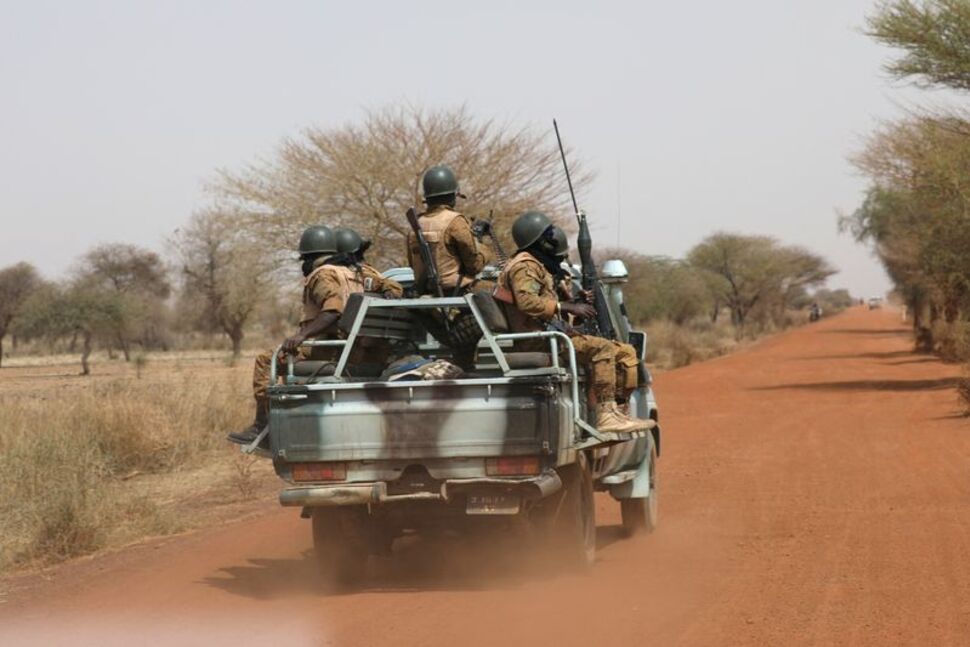
DAKAR, April 2 (Reuters) – Government and allied forces in Burkina Faso have killed more than twice as many civilians as Islamist militants have since 2023, according to a tally of incidents documented in a report published on Thursday by Human Rights Watch.
The pattern is broadly consistent with data shared with Reuters by Armed Conflict Location & Event Data (ACLED), a conflict monitoring group, and also applies to neighbouring Mali.
In that country, which like Burkina Faso is ruled by a military-led government that seized power in a coup, government forces and their partners have been responsible for three to four times as many civilian killings as jihadists over the last two years, according to ACLED’s data.
Violence involving jihadist groups in Burkina Faso, Mali and Niger has surged since 2021, making the Sahel region a global terrorism hotspot.
Widespread deaths of civilians at the hands of government forces could bolster the political legitimacy of militant groups and fuel recruitment, analysts said.
They could also complicate steps by the United States to improve relations with Sahel governments, which expelled French and other Western forces after their respective coups.
Burkina Faso’s security forces and allied militias “appear to be more brutal and violent” than militant groups like the local al Qaeda affiliate, Jama’at Nusrat al-Islam wal-Muslimin (JNIM), said Ilaria Allegrozzi, senior Sahel researcher at Human Rights Watch.
The Burkinabe forces’ behaviour is part of a regional pattern, raising concerns about military indiscipline and its consequences for counterinsurgency efforts, she said.
Spokespeople for the Mali and Burkina Faso governments did not immediately respond to requests for comment from Reuters. The Burkina Faso government and JNIM’s Sharia Committee in Burkina Faso did not respond to requests for comment from HRW.
Mali and Burkina Faso have previously denied allegations of extrajudicial killings, saying instead that their forces had killed “terrorists”.
‘THEY EXTERMINATED EVERYTHING’
Covering the period between January 2023 and August 2025, the HRW report documents 57 incidents in which at least 1,837 civilians were killed. Of those, 33 were committed by government forces and their allies, resulting in 1,255 civilian deaths, according to the report, which details widespread abuses by all parties to the conflict.
The ACLED data shows that in 2025 alone, the Burkinabe military and forces from the pro-government Homeland Defence Volunteers militia killed 523 civilians while JNIM and Islamic State Sahel Province (ISSP), another militant group, killed 339.
In Mali, the military, together with Russian paramilitary groups Wagner and Africa Corps, killed 918 civilians in 2025, while JNIM and ISSP killed 232, according to ACLED.
JNIM could not be reached for comment. Russia’s defence ministry, which runs Wagner and Africa Corps, did not immediately respond to a request for comment.
ACLED sources its data from social media, press reports and statements from governments, armed groups and non-governmental organisations. It says it provides conservative estimates of fatalities. HRW based its report on 450 interviews and verified social media and satellite imagery. It also says the incidents it has documented are not exhaustive.
Because JNIM controls large swathes of territory, security forces are sometimes called on to escort humanitarian or supply convoys in rural areas – but in many cases they kill civilians they encounter along the way, Allegrozzi said.
One resident of eastern Burkina Faso, who asked to remain anonymous for fear of reprisals, told Reuters he was travelling in a civilian convoy under military escort in July 2024, and many of the villages they passed had been abandoned. Then they reached the village of Sakoani, 30 kilometres (19 miles) west of the town of Kantchari.
“When the army arrived in this village and saw that it was populated, they surrounded the entire village and they exterminated everything – every living being,” he told Reuters. “People tried to flee, but if you run, they shoot at you.”
He estimated that he saw at least 100 dead bodies.
EXPANDING USE OF DRONES IN MALI
In Mali, meanwhile, many civilian killings have been carried out by drone strikes, according to ACLED. Drone warfare there has surged since the government began purchasing Turkish-made drones in 2022. Drone or airstrikes on civilians by Mali’s armed forces jumped from four incidents that year to 66 incidents in 2025, resulting in 155 deaths, the ACLED data shows.
In July 2024, government drone strikes killed at least 50 civilians at the Inatiyara artisanal gold mining site in northern Mali, according to ACLED. Three eyewitnesses described the attacks to Reuters.
“We were surprised by the strikes, we were so scared,” said a 30-year-old gold panner from Niger who worked at Inatiyara and asked not to be identified.
“It was pure panic… I’m still reeling from the shock.”
HRW and ACLED also documented grave abuses by JNIM, including the killing of at least 133 civilians in Barsalogho, Burkina Faso, in August 2024 and 19 civilians in Diallassagou, Mali, in May 2024.
The group has nonetheless been able to position itself as a defender of marginalised communities like the Fulani, a widely dispersed pastoralist group whose members are often accused of being affiliated with JNIM, analysts have told Reuters.
“As state responses increasingly rely on retaliation and collective punishment, more civilians find themselves trapped in areas under jihadist control, where JNIM is consolidating its influence through coercion and strategic engagement with local populations,” said Heni Nsaibia, ACLED’s senior analyst for West Africa.
(Reporting by Portia Crowe; Editing by Robbie Corey-Boulet and Daniel Wallis)
Copyright 2026 Thomson Reuters.
Photos You Should See – March 2026
