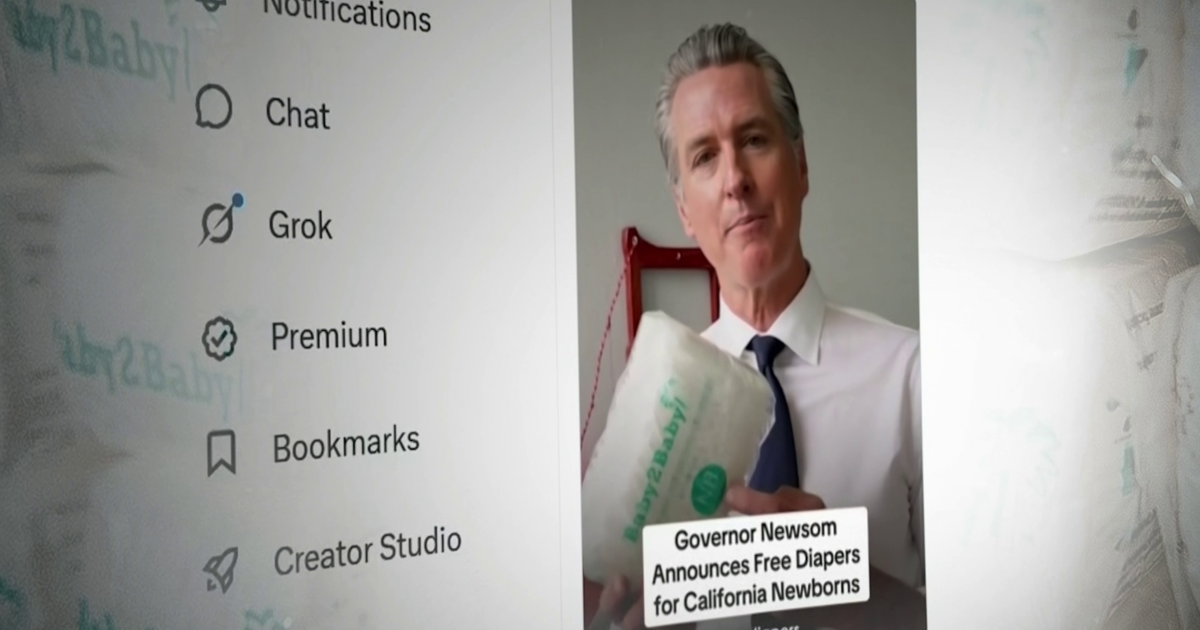
California’s new Golden State Start diaper program is facing backlash after viral social media posts claimed taxpayers were paying as much as 50 cents per diaper through a partnership with Baby2Baby.
The Newsom administration fired back, insisting the actual cost is just 15.5 cents per diaper.
But a CBS News California Investigates review of the state’s own budget documents, Baby2Baby tax filings and social media claims found both sides are leaving out important context.
There are also many claims we can’t yet fact check because, nearly a month after the governor publicly announced the program and touted the competitive selection process, his administration will not release the Baby2Baby state contract or competitive bid records to CBS News California Investigates.
The administration says it needs more time to determine whether the records are disclosable under California’s Public Records Act, pushing the deadline to decide whether to release the records to the first week of June, a full month after the public announcement.
Key fact checks
- Californian’s are currently paying 18.5 cents per diaper under the new program.
- The viral “50 cents per diaper” criticism combines multiple years of proposed spending and divides it by only the first year’s diaper total.
- The Newsom administration’s 15.5-cent fact check ignores state agency costs that add an additional 3 cents per diaper in the first year.
- This is not a gift card or cash-assistance program; parents will leave the hospital with roughly 400 diapers for their newborns.
- Experts caution that stockpiling newborn diapers often leads to waste because babies grow at different rates and can quickly outgrow diapers in the first few weeks.
- So far, officials can’t say how they plan to ensure taxpayer funded diapers given out in bulk will not go to waste.
- The Baby2Baby co-CEOs, widely linked to Gov. Newsom’s wife, make less than $80,000 per year – not the $240,000 widely circulated online.
Online critics repeatedly point to the Baby2Baby co-CEOs’ relationship with First Partner Jennifer Siebel Newsom. The governor also alluded to a longstanding relationship between his administration and Baby2Baby during the program launch.
Baby2Baby was previously awarded $1.5 million in the 2023/24 state budget to distribute diapers in Los Angeles County. However, the state payment is not included on the nonprofit’s public 2024 tax return, which shows a total revenue of more than $70 million.
According to Baby2Baby, the state payment was included along with charitable contributions in a confidential portion of the public tax filing, labeled as “restricted.”

50-cent diaper math isn’t mathing
The viral criticism spreading online started with a social media post by gubernatorial candidate Steve Hilton, who filmed himself inside a Target diaper aisle.
“Gavin Newsom is taking $20 million of your money to send 100,000 babies 400 diapers,” Hilton said in the viral X video. “That works out at 50 cents per diaper.”
Conservative commentators and influencers quickly amplified the claim.
“Allegedly, the diapers for the program, supplied by a nonprofit called Baby2Baby, are estimated to cost 50 cents per diaper,” commentator Isabel Brown said in a separate X post.
Fox News and influencers also questioned the nonprofit’s political connections.
But CBS News California Investigates found the “50 cents per diaper” math relies on an inaccurate calculation. The critics divide the program’s full proposed two-year budget — roughly $20 million — by only the first year’s diaper total: 40 million diapers.
Lawmakers have not approved the full two-year budget for a total 120 million diapers.
So far they have only approved is $7.4 million for 40 million diapers in the first year which means California taxpayers are currently paying 18.5 cents per diaper.
That’s still more than the 16-cent diapers Hilton found at Target, but far less than the 50-cent figure circulating online.
The Real Math:
- FY25/26: Total $7.4 million / 40 million diapers = 18.5 cents per
- FY26/27: Total $12.5 million / 80 million diapers = 15.6 cents per
- Combined: $19.9 million / 120 million diapers = 16.6 cents per diaper delivered to the hospital and sent home with each newborn
The Newsom administration was quick to fact-check Hilton, saying Californians are paying just 15.5 cents per diaper to Baby2Baby, the vendor hired to manufacture and distribute the diapers to participating hospitals.
“The 2025-26 State Budget includes funds for a diaper contract that was awarded to Baby2Baby. The $6.2 million contract Baby2Baby received is designed to cover 25% of California births at 400 diapers per infant, which equates to 15.5 cents per diaper,” the governor’s office told CBS News California Investigates.
That calculation counts only the Baby2Baby $6.2 million contract itself, which includes diaper manufacturing, warehousing, and direct program implementation.
It does not include state staffing, oversight, or future program planning costs. The state has not provided the requested budget breakdowns for the additional $1.2 million in state agency fees.
According to the California Department of Finance Budget Proposal, this is what Californians are paying for:
- Manufacturing: 9.5 cents per diaper
- Warehouse/distribution: 4 cents
- Direct program costs: 2 cents
- State operations: 1.75 cents
- Phase 2 planning/RFI exploration: 1.25 cents
Baby2Baby background
The online backlash also targeted Baby2Baby itself, with some posts falsely claiming executives were making “hundreds of thousands” of dollars from taxpayer money.
“Did I mention that Baby2Baby CEO Norah Weinstein is really good friends with Gavin Newsom’s wife?” conservative commentator Brittany Hughes said in another video, echoing claims that she made $240,000 in 2024.
Public IRS 990 tax filings reviewed through ProPublica Nonprofit Explorer and Charity Navigator show co-CEOs Kelly Sawyer Patricof and Norah Weinstein each reported compensation of roughly $77,566 during the most recent filing period — far below the $240,000 figures circulating online.
There are several operational employees who do make six-figure salaries; however, the total salaries and compensation amount to roughly 10% of the total revenue.
Tax records show the nonprofit generated more than $77 million in revenue in 2024 alone, with approximately 95% coming from charitable contributions.
By comparison, the state’s current $6.2 million diaper contract represents a relatively small portion of the organization’s overall funding and representatives say Baby2Baby will not profit from the state contract.
However, the state has yet to release the Baby2Baby contract, so CBS News California can not independently confirm that.
Questions also remain about the state’s selection process.
Online critics repeatedly point to the longstanding relationship between Baby2Baby leadership and First Partner Jennifer Siebel Newsom.
“Was it really a rigorous process if you’re best friends with the CEO of the company?” commentator Isabel Brown asked in a viral social media post.
Governor Newsom maintains Baby2Baby won the contract through a competitive bidding process. But until the state releases the contract, bid sheets and scoring records, CBS News California Investigates cannot independently verify how the nonprofit was selected or how it scored against competing applicants.
Will free diapers go to waste?
The state says the program is not a gift card or cash-assistance program, as some have claimed online.
Instead, participating hospitals serving high numbers of low-income and Medi-Cal patients will distribute diapers directly to qualifying families immediately after birth, meaning parents will literally leave the hospital with roughly 400 diapers for their newborns.
Program officials told CBS News California Investigates:
- More than 100 hospitals have already expressed interest
- Roughly 60 to 70 hospitals are expected to participate initially
- Hospitals serving the highest-need families will be prioritized.
However, they could not address some practical questions about how the diaper distribution will work.
Parenting and pediatric experts caution that newborns often outgrow diaper sizes within the first few weeks, and stockpiling leads to waste.
Some families could ultimately end up with boxes of diapers that their babies outgrow before they can use them. So far, officials can’t say how they plan to ensure taxpayer funded diapers given out in bulk will not go to waste.
They say hospitals will largely handle those logistics individually.
Meanwhile, diaper insecurity remains a documented issue nationwide.
A Tampa Bay Times / ProPublica diaper investigation found roughly one in three American families struggles to afford diapers and estimated diapering a child can cost families nearly $1,000 annually.
And while the political debate online continues, the biggest unanswered questions may no longer be about diaper math at all — but about transparency, oversight and whether California taxpayers believe the state should be funding free diapers in the first place.