By Ethan Wang and Michel Rose
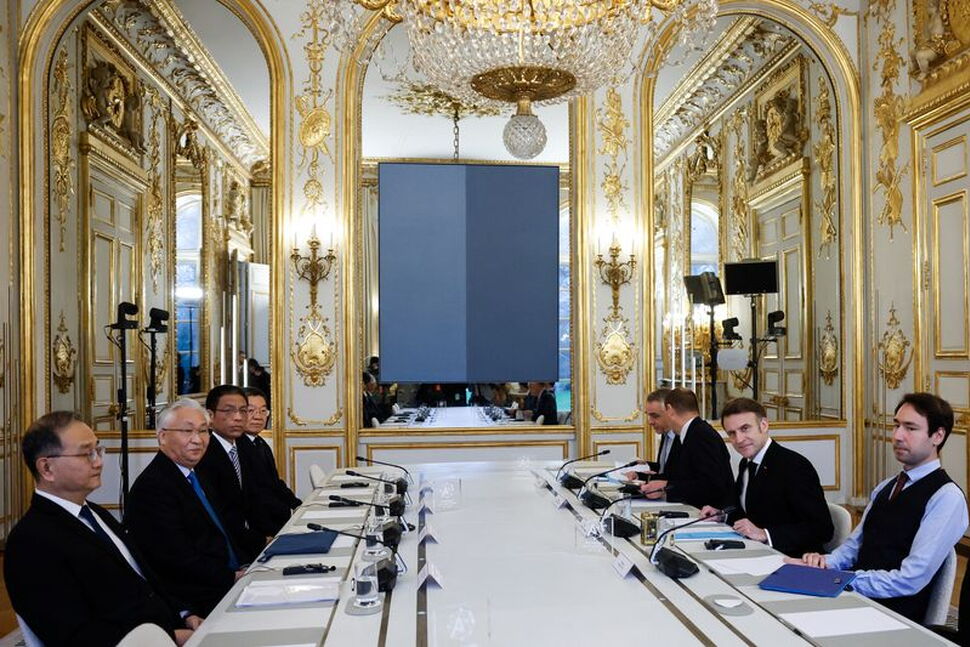
BEIJING/PARIS, June 11 (Reuters) – Chinese Vice Premier Zhang Guoqing will attend a video conference hosted by French President Emmanuel Macron on global economic imbalances on Thursday, days before G7 countries meet in France to discuss how to deal with waves of low-priced Chinese exports entering their markets.
Macron, who is hosting the Group of Seven summit in Evian-les-Bains next week, has sought to engage with Beijing in a last-ditch attempt at a cooperative approach before the European Union decides whether to toughen its trade policy towards China, French officials say.
EU leaders meet immediately after the June 15-17 G7 gathering, with China set to feature prominently on the agenda.
Zhang’s inclusion in the so-called “Global Convergence for Growth” video conference, which was announced by a Chinese foreign ministry spokesperson, is an unusual instance of China engaging with the G7 which comprises France, Britain, Canada, Germany, Italy, Japan and the United States, alongside the EU.
Beijing has long criticised the grouping as illegitimate for discussing world affairs and for being unrepresentative of the world order.
There’s growing alarm in Europe at China’s record trade surplus and move up the value chain, with its exports of electric vehicles, lithium-ion batteries and other high-tech products threatening European manufacturers, in what analysts describe as a “second China shock” following its dominance of low-value industries in the 2000s.
China has defended its industrial policy and rejected allegations of Chinese exporters unfairly benefiting from state subsidies. It says other countries are undermining global trade rules instead by imposing unilateral tariffs.
Since December, the Chinese capital has received leaders from five G7 nations in a flurry of high-level meetings. Macron met Chinese President Xi Jinping in Beijing that month, telling him China should help rebalance economic relations cooperatively, or Europe would have little choice but to adopt more protectionist measures.
However, EU nations remain divided on how to approach China. Germany, Europe’s largest trading economy, has long been reluctant to impose tariffs on one of its main export markets. But as Chinese carmakers compete more directly with German manufacturers, some German lawmakers have begun calling for a tougher stance towards Beijing.
(Reporting by Ethan Wang and Ryan Woo in Beijing and Michel Rose in Paris; Editing by Christopher Cushing and Emelia Sithole-Matarise)
Copyright 2026 Thomson Reuters.
Photos You Should See – June 2026
