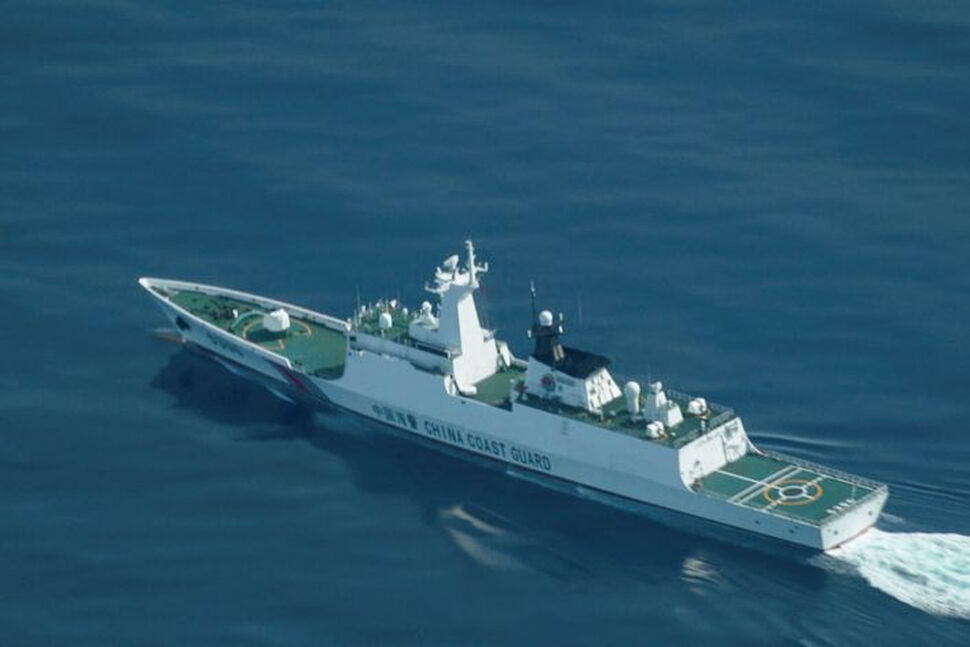
BEIJING, May 31 (Reuters) – China’s military and coast guard said they carried out patrols near Scarborough Shoal in the South China Sea on Sunday, a day after the Philippine defence minister said Manila remained under threat from Beijing despite a recent easing in U.S.-China tensions.
Scarborough Shoal is one of Asia’s most contested maritime features and has become a frequent flashpoint between China and the Philippines over sovereignty and fishing rights.
The People’s Liberation Army’s Southern Theatre Command said in a statement on the WeChat platform that its naval and air units carried out combat readiness patrols in the “territorial sea and airspace” of the atoll and its surrounding areas.
“Such patrols serve as an effective countermeasure to cope with all sorts of rights violation and provocative acts,” the command said.
China’s coast guard said in a separate statement it conducted law enforcement patrols near the Scarborough Shoal, adding that since this month it had dealt with ships engaged in “illegal rights-violation activities in accordance with laws and regulations,” without elaborating.
The Philippine embassy in Beijing did not immediately respond to an emailed request for comment.
The patrols took place as defence ministers, military chiefs and policymakers from the Asia-Pacific region and beyond gathered in Singapore for the Shangri-La Dialogue, Asia’s premier defence forum.
Speaking to Reuters on the sidelines of the summit, Philippine Defence Secretary Gilberto Teodoro said the Philippines remains under “severe threat” from China both territory-wise and politically, despite a recent thaw in U.S.-China tensions following the summit between Presidents Donald Trump and Xi Jinping earlier this month.
“We have no choice but really to be resilient and to stand up against Chinese aggression,” he said.
The Philippines and China have been locked in repeated maritime standoffs in the South China Sea in recent years, at times resulting in collisions between vessels and injuries to personnel.
China claims sovereignty over almost the entire South China Sea via a “nine-dash line” on its maps that cuts into the exclusive economic zones of the Philippines, Brunei, Malaysia, Vietnam and Indonesia.
Disputes over dozens of islands and features have festered for decades. Taiwan’s claims to features in the South China Sea are broadly similar to China’s.
In 2016, the Permanent Court of Arbitration in The Hague ruled that China’s claims were not supported by international law, a decision that Beijing rejects.
(Reporting by Beijing Newsroom; Editing by William Mallard and Sonali Paul)
Copyright 2026 Thomson Reuters.