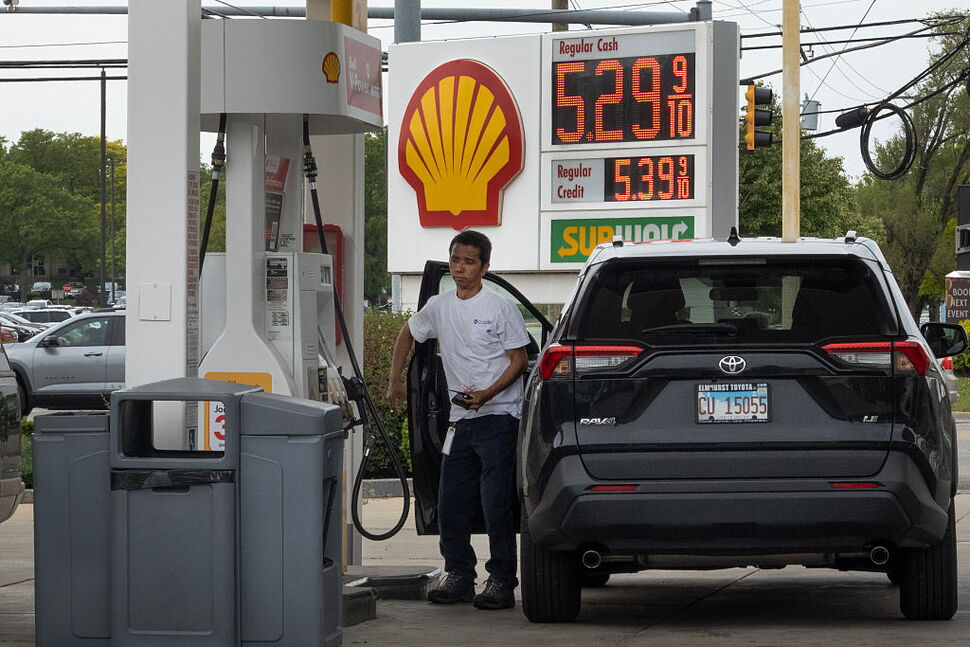
Consumers continue to feel battered by inflation driven by the U.S.-Iran conflict, with overall sentiment falling in May as 57% of consumers saying that high prices were eroding their personal finances, up from 50% last month.
That is the final reading of the University of Michigan’s consumer sentiment index for May, falling for the third straight month as the closure of the Strait of Hormuz pushes the average cost of a gallon of gasoline to $4.55. That’s higher by almost $1.50 a gallon from a year ago as Americans head into the Memorial Day weekend.
Notably, year-ahead inflation expectations inched up to 4.8% from 4.7% in April, and “consumers appear worried that inflation will increase and proliferate beyond fuel prices, even in the long run,” according to a written analysis Friday from survey director Joanne Hsu.
“Lower-income consumers and those without college degrees posted particularly strong sentiment declines; these groups are more sensitive to increases in the cost of gas and other essentials,” Hsu said. “Independents and Republicans saw decreases in sentiment, with both groups reaching their lowest readings of the current presidential administration. Meanwhile, sentiment of Democrats was little changed from last month.”
A separate measure of the economic outlook also released on Friday showed a slight rise of 0.1% in April following a 0.6% decline in March.
The leading indicators index from the Conference Board “increased slightly in April, driven mainly by a rebound in stock prices and an increase in building permits, only for two and more units,” Justyna Zabinska-La Monica, senior manager, business cycle indicators, wrote in a statement. “The leading index rose in two of the past three months, but the gains did not offset the steep fall registered in March. As a result, the LEI’s six- and 12-month growth rates were negative, signaling fragile economic conditions ahead.”
“Strong investment in AI infrastructure, data centers, and energy production likely will have a positive impact on growth and sustain business spending, but may only partially offset weakness on the consumer side. Higher gasoline and energy costs – paired with weak hiring – will likely erode household purchasing power in the months ahead, particularly for lower- and middle-income consumers.” The Conference Board is currently projecting year-over-year growth in gross domestic product of 1.7% in 2026, revised up slightly from the last update of 1.6%.
The U.S. economy wobbled a bit earlier in the year, but GDP rebounded in the second quarter, posting 2% annual growth.
“Economic growth was somewhat sluggish in the prior two quarters, leaving investors to ponder whether we are heading toward a contraction or going through something of a soft patch,” Tony Welch, chief investment officer at SignatureFD, wrote on Friday “But there are still few signs of the kind of broad deterioration that typically shows up before a recession. Corporate profits remain positive, business investment is holding up, and the labor market, while no longer booming, continues to provide support.

Sign Up for U.S. News Decision Points
Your trusted source for breaking down the latest news from Washington and beyond, delivered weekdays.
By clicking “Sign Up”, you will receive the latest updates, including emails, from U.S. News & World Report and our trusted partners and sponsors, and you agree to our Terms and Conditions & Privacy Policy.
For now, we believe the economy appears to have cooled but not cracked.”
Still, the rising prices for necessities such as gasoline, groceries and electricity are fueling poor poll results for President Donald Trump and Republicans in Congress. In particular, Americans would prefer the president focus on inflation over wars in the Middle East and saber-rattling toward Cuba.
A Gallup poll released early Friday found that confidence in the nation’s economy reached a low that tied results from October 2022. Only 16% of Americans consider current economic conditions “excellent” or “good,” the lowest since April 2023, Gallup found. Nearly half say conditions are poor, up from 37% at the beginning of the year.
Asked to consider the economy’s outlook, 76% of Americans said economic conditions are getting worse – the biggest share in the past three years – and just 20% said conditions are improving.
Still, the stock market continues to shake off concerns, with the Dow Jones Industrial Average gaining 2.2% so far this week and futures suggesting a positive opening.
“The American consumer is treading water here and the income tax refunds must be gone already or the money spent on the higher prices seen everywhere in the economy,” Chris Rupkey, chief economist at fwdbonds.comwrote in an email Friday. “The stock market record highs are having no effect whatsoever on cheering consumers up which means most Americans have the money locked up in 401(k) retirement accounts that cannot be drawn on to make life easier now.”
The Week in Cartoons May 18-22
