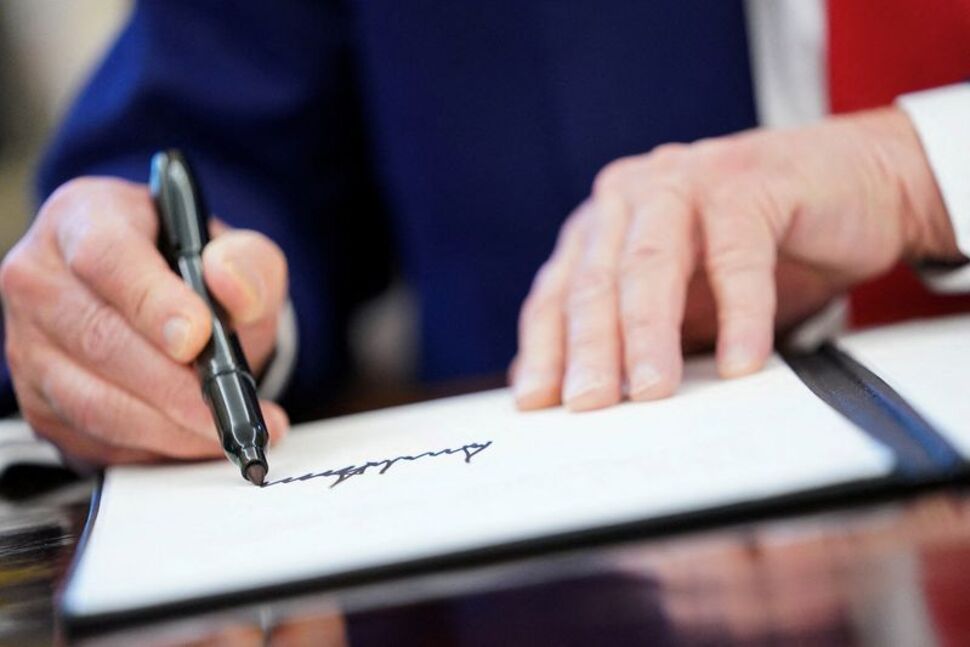
March 28 (Reuters) – When U.S. President Donald Trump’s signature appears on $100 bills in June, it will end 165 years of the U.S. Treasurer signing banknotes and place Trump among a small band of sitting global leaders, most heads of developing economies, whose autographs or images have graced their currencies.
Banknotes around the world often show the signature of a central bank leader, finance minister or other official associated with the printing and issuing of money. Trump’s signature would replace that of the U.S. Treasurer, which has appeared on U.S. currency since 1861. The Treasury secretary’s signature was added about a century ago. It will remain there alongside Trump’s.
Euro notes bear the signature of the European Central Bank president and pounds sterling are signed by the chief cashier of the Bank of England. Soviet roubles for a while took the signature of a finance minister or central banker.
The Treasury Department on Thursday announced the plan to have Trump’s signature on banknotes starting this summer as part of the 250th U.S. anniversary celebration. Previously, Treasury had unveiled plans for a commemorative coin featuring Trump’s likeness to be issued as part of the Semiquincentennial celebration, but an 1866 law forbids paper currency from carrying images of living current or former presidents.
Here are some examples of sitting leaders Trump will join in the banknotes club:
CONGO/ZAIRE – Images of Congolese former dictator Mobutu Sese Seko in leopard hat or military garb appeared on banknotes issued after he changed the name of his country to Zaire in 1971. He ruled until 1997. The government that ousted him punched out his face from banknotes until new ones came out.
UGANDA – Idi Amin Dada (1971-79), an army officer who came to power in a coup, was on Ugandan banknotes during his time. Rival Apollo Milton Obote, who was overthrown by Amin in 1971 but later came back to power in 1980 after Amin’s ousting, also appeared on Ugandan notes.
KENYA – Late President Daniel Arap Moi, who was in office between 1978 and 2002, used to have his portrait on the bank notes. Jomo Kenyatta, Kenya’s first president, had his portrait on notes too. Both the Moi and Kenyatta portraits were gradually phased out after Kenya got a new constitution and notes got redesigned.
INDONESIA – Indonesia’s first two presidents, Sukarno and Suharto, appeared on bank notes during their terms in office. Notes bearing Suharto’s image were withdrawn in 2000, following the authoritarian leader’s 1998 resignation during an Asian financial crisis that prompted civil unrest and resulted in a bailout by the International Monetary Fund.
PHILIPPINES – Numerous bank notes and coins bore the image of former President Ferdinand Marcos Sr during his 1965-1986 presidency, which included nearly a decade under martial law. Philippine peso notes now bear the signature of his son and current President Ferdinand Marcos Jr, but with images of native birds and animals.
TANZANIA – In Tanzania, the first president, Julius Nyerere, who served from independence in 1961 until 1985, had his picture on bank notes while in office, according to central bank records. The first bank notes, which featured Nyerere’s image, were released in 1966 after the central bank was established.
(Reporting by Nuzulack Dausen in Dar es Salaam; David Lawder in Washingotn; Robbie Corey-Boulet in Dakar; Elias Biryabarema in Kampala; Gleb Bryanski in Moscow; George Obulutsa in Nairobi; compiled by Mark John and David Lawder; Editing by David Gregorio)
Copyright 2026 Thomson Reuters.
Photos You Should See – March 2026
