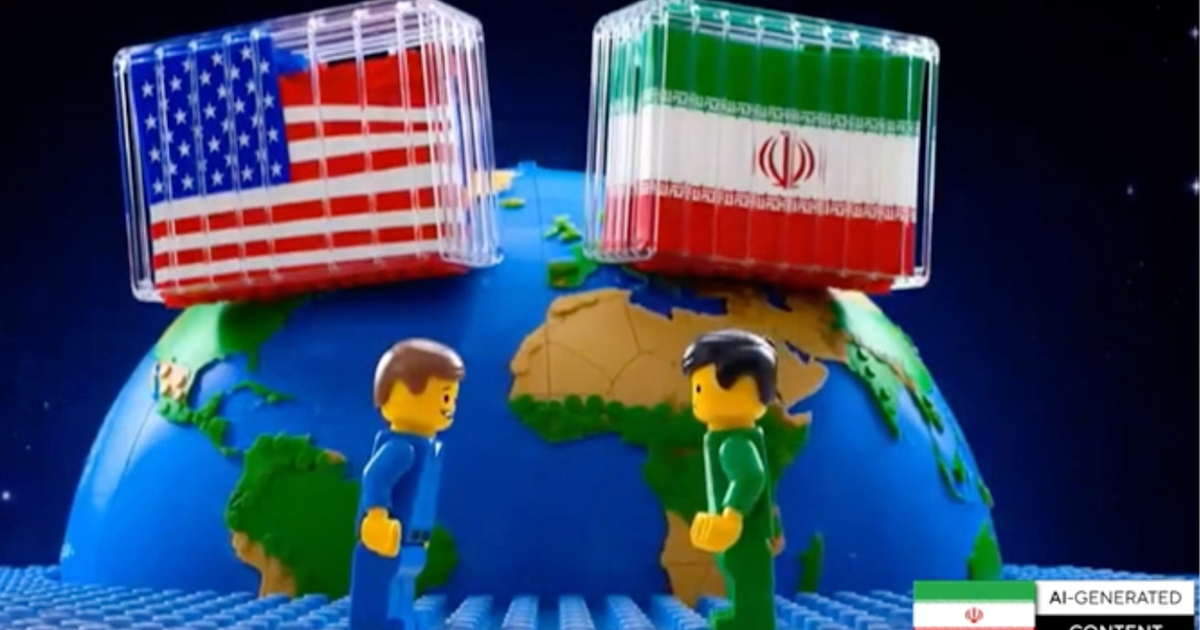
As the war with Iran approaches the three-month mark, another battle is raging far from the front lines. An online propaganda war is currently being waged between the United States and Iran, and global reaction suggests the Iranians are beating the Americans at their own game.
Political satire and propaganda have been used as a weapon of war for decades. In 1940, the German army was invading and seizing one European country after another.
It would take more than slapstick Hollywood comedy to turn the tide, but Charlie Chaplin as an Adolf Hitler look-alike gave the world an insight into the power of mockery.
“The point with all political satire is to mock those in power. It’s to lampoon them because it emasculates them,” said Bret Schafer, who studies foreign propaganda as a senior director of policy and research at the Institute for Strategic Dialogue. “People who are in power, I think, are OK with being criticized. What they’re not OK with is being ridiculed and sort of cut down to size.”
Through the decades, when it came to marketing a product, campaign or vision, no one in the world excelled at it quite like Hollywood and the American advertising industry. And when it comes to American presidents, none has used and orchestrated modern media more effectively than President Trump.
So, it’s something of a mystery that Iran could be outmaneuvering the U.S. in the online propaganda war.
Schafer said his organization conducted a study examining Iranian accounts on the social media platform X in the 50 days after the war began and found there was a thirtyfold increase in the number of views and likes.
For instance, when Mr. Trump posted an image of himself looking Christ-like and tending to an ailing patient, it was the Iranian Embassy in Tajikistan, of all places, that responded. The response amassed more than 24 million views.
“Diplomatic accounts never get that amount of views,” Schafer said, attributing the traction these accounts are receiving to the “style of the content they put out.”
The content isn’t subtle, but people are watching by the millions. Some of the messages in these videos, like on the cost of war, linger.
“This kind of messaging, I think, is going to resonate the most with American audiences,” Schafer said. “If you want to degrade support for the war within the U.S., you point to how much it’s costing. This also requires almost no budget. This is just a guy with AI generation tools. So there’s been a democratization of propaganda. This is kind of outsourced to content creators.”
Some of the most popular videos come from an account called Explosive Media, where Iran’s messages are displayed in Lego format. We spoke with their representative in Tehran through a translator and asked why they were using Legos to convey their messages.
Speaking through a translator, the representative responded, “Lego is a universal language. Every person around the world can understand it without saying anything.”
The videos, as Schafer suggested, are likely produced by artificial intelligence, another example of how the technology can be used in this propaganda battle.
“It’s clickable. It’s shareable. People are not engaging with serious content. They’re not engaging with diplomatic statements,” Schafer said.
Jamie Rubin ran the State Department’s Global Engagement Center, an agency that shuttered after Congress eliminated its funding in 2024. Before the role, Rubin was the chief spokesman and assistant secretary of state for public affairs during the Clinton administration.
“I was involved in an information warfare unit that was designed to combat Russian, Chinese, and to some extent, Iranian disinformation. That unit was wiped out,” Rubin said.
“This is a painful subject, and it’s painful because we haven’t followed the rules, the basic requirements, to build support for a military action,” Rubin said. “It has to start with a good cause, an urgent cause, a cause that people agree with. It has to include allies and then it has to have a trusted messenger, and it pains me to say this, but right now we don’t have any of those qualities in this war with Iran.”
Rubin said the Trump administration has discarded many of the assets that used to support the U.S. government at war.
“The entire description of our policy is now controlled by the White House,” Rubin said. “If you have to go back to the White House to get approval for every sentence, every rebuttal, every response, you’ve lost the game. You’ve lost the war, the information war.”
Early on in the war, the White House released a couple of videos mixing actual footage of the war with scenes from “SpongeBob SquarePants,” the NFL, college football and Hollywood. The videos captured hundreds of millions of views but stopped after the White House was accused of “gamifying the war.”
What’s come since has been any number of presidential contributions on Truth Social. CBS News asked the White House to provide someone to lay out the administration’s case and whether there’s a direct response to Iran’s propaganda.
The White House said in a statement: “Why is CBS News doing propaganda for a terrorist regime? Under President Trump’s leadership, the United States decimated the Iranian regime’s military capabilities in 38 short days and is now strangling what’s left of their dismal economy with one of the most successful naval blockades in history. Iran should be less concerned with winning the meme war and more concerned with making a deal to save their country.”
These days, Iran has zeroed in on the files related to the late convicted sex offender Jeffrey Epstein and the charge that Israel drew America into the war.
Effective propaganda doesn’t require an accusation to be true. Sometimes, the mere suggestion that it might be true is enough.