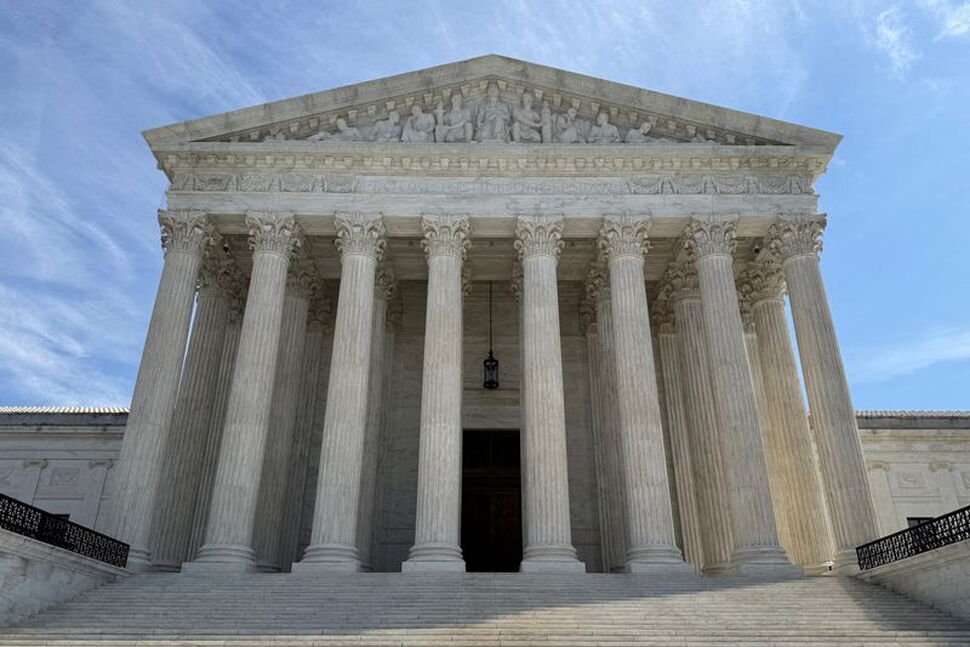
May 31 (Reuters) – The U.S. Supreme Court this year already has given a boost to President Donald Trump and his fellow Republicans in the nationwide battle over redrawing electoral maps. In the coming weeks, it could rule in favor of the Republicans in two more significant cases related to elections ahead of the November elections that will decide control of Congress.
In a case from Mississippi, Republican Party officials are seeking to strike down state laws that allow late-arriving mail ballots to be counted as long as they are postmarked by Election Day. Trump has sought to cast doubt on the security of mail-in ballots, though evidence of voter fraud is rare, and Democratic voters tend to use this mode of voting more than Republicans.
In a separate case involving Trump’s Vice President JD Vance, Republicans are seeking to further chip away at legal limits on money in political campaigns – specifically involving spending coordinated between party organizations and candidates.
They argue such curbs violate the U.S. Constitution’s First Amendment protections against government abridgment of freedom of speech. The court has proven receptive to such an argument, including in its landmark 2010 decision in the case Citizens United v. Federal Election Commission.
Rulings in both cases are expected by around the end of June.
Republicans are defending slim majorities in both the House of Representatives and Senate in the November 3 midterms. If Democrats win control of either chamber, they could impede Trump’s legislative agenda and mount investigations of him and his administration.
VOTING RIGHTS CASE RULING
The Supreme Court has a 6-3 conservative majority. In an April decision powered by the conservative justices in a case from Louisiana, it gutted a key provision of the Voting Rights Act, making it harder to challenge electoral maps as racially discriminatory under the landmark civil rights law.
That decision provided an immediate advantage to Trump’s party ahead of the midterms, though legal experts said the impact of the two forthcoming rulings is harder to gauge.
The Voting Rights Act ruling opened the door for Republican state legislators to dismantle Democratic-held U.S. House districts with large Black or Latino populations across the South, potentially giving Republicans an electoral advantage for years to come. Black and Hispanic voters tend to vote for Democratic candidates.
That decision has been a “boon for Republicans,” said Travis Crum, a Washington University in St. Louis School of Law professor.
Thanks in part to that ruling, Republicans are positioned in November to gain up to a dozen U.S. House seats currently held by Democrats through the process of redistricting – redrawing the boundaries of voting districts.
Working against Republicans in November are Trump’s sagging approval ratings, as measured by public opinion polls, amid the unpopular Iran war and the higher gasoline prices it caused, and the historical trend of a president’s party losing congressional seats in midterms.
Vance and other Republicans appealed a lower court’s ruling that upheld restrictions on the amount of money parties can spend on campaigns with input from candidates they support – called coordinated party expenditures. Vance was running for the U.S. Senate in Ohio in 2022 when he and other challengers sued.
Under the bedrock 1971 law regulating fundraising in U.S. federal elections, spending by a political party to advocate for or against a candidate that is not coordinated with a candidate’s campaign is considered an independent expenditure not subject to amount limits. But it does restrict contributions coordinated between a party and a campaign.
Supporters of these restrictions have said they help prevent corruption. Without them, they said, wealthy donors could curry favor with candidates by routing massive sums to them through political parties, evading limits on how much any individual can donate to a candidate per election cycle.
Conservative election law attorney Dan Backer said striking down limits on coordinated spending would strengthen political parties, which “have a generally moderating impact” on U.S. politics compared to special interest groups.
“The overall political system is benefited by very strong parties,” said Backer, who has represented Republican candidates and right-leaning organizations.
During December arguments in the case, conservative justices appeared sympathetic to the First Amendment argument against these limits.
University of Minnesota political science professor Timothy Johnson said a ruling in favor of the Republicans seems likely, and it could let them capitalize on their fundraising advantage over the Democrats.
Three major Republican committees – the Republican National Committee, the National Republican Congressional Committee and the National Republican Senatorial Committee – ended April with $251 million in cash and no debt. That was about double the roughly $125 million held by their Democratic counterparts, who also carried more than $17 million in debt.
“There certainly is an advantage, monetarily, on the Republican side in terms of the party committees,” Johnson said. “Once that ruling comes down, there could be coordination between those committees and candidates pretty instantaneously.”
Johnson added that some individual Democratic candidates in high-profile races have impressive fundraising hauls that could blunt the impact of a ruling in favor of the Republicans.
The ruling may lead party committees to seek the same discounted rates for television and radio advertisements that candidates have long received, though election law specialists said this would raise an untested legal question.
In the Citizens United ruling, the court cited the First Amendment, invalidating campaign finance limits and letting corporations and other outside groups such as labor unions spend unlimited money on elections.
The Supreme Court’s ruling in the mail-in ballots “grace period” case could lead to stricter voting rules around the country.
Casting ballots by mail has been common among some Republican voters, particularly among rural and older ones. But Trump’s false claims about widespread voter fraud, including allegations involving mailed ballots, after he lost the 2020 election to Democrat Joe Biden, have made the practice less popular among Republicans.
Trump in March signed an executive order aiming to tighten mail-in voting rules, drawing legal challenges involving whether his directive infringed on the constitutional rights of individual states to regulate elections.
In the 2024 U.S. election, 37% of Democratic voters reported casting ballots by mail, compared to 24% of Republicans, according to the MIT Election Lab. In the 2020 election conducted during the COVID pandemic, 60% of Democratic voters and 32% of Republican voters cast mail-in ballots.
The Supreme Court heard arguments in March in Mississippi’s appeal of a lower court’s ruling that deemed its mail-in ballot law illegal in a challenge by the state’s Republican Party. The law permits mail-in ballots to be counted if they are postmarked by, and then received within five business days of, Election Day.
The dispute involved whether federal laws setting the dates for federal elections preempt any state laws that allow ballots to be received after Election Day.
During March arguments in the case, a majority of the justices appeared ready to invalidate Mississippi’s law.
According to the National Conference of State Legislatures, 14 states, plus Guam, Puerto Rico, the Virgin Islands and Washington, D.C., accept and count mailed ballots if they are received after Election Day but postmarked on or before – sometimes only before – Election Day.
Crum said the justices could strike down Mississippi’s law but let it remain in effect for the midterms under a legal concept called the Purcell principle under which courts should strive to avoid changing voting rules too close to an election to avoid voter confusion.
The Democratic National Committee filed a legal brief warning of “disastrous consequences” if the court backs the Republicans in the case.
Striking down Mississippi’s law, it said, and imposing on states an inflexible Election Day deadline for receiving mail-in ballots could disenfranchise millions of voters, “including military voters stationed away from home, overseas citizens, rural voters, elderly and disabled voters, and voters lacking reliable transportation.”
Chris McIsaac, a researcher at the R Street Institute libertarian think tank, viewed requiring mail ballots to arrive by Election Day as reasonable, but said there could be administrative challenges to implementing new rules just months before an election.
“All of the voter communications and information that election offices publish in advance of elections that give the instructions for when ballots are due – that stuff happens pretty far in advance,” McIsaac said. “Some of that would need to be reprinted.”
(Reporting by Jan Wolfe; Editing by Will Dunham)
Copyright 2026 Thomson Reuters.