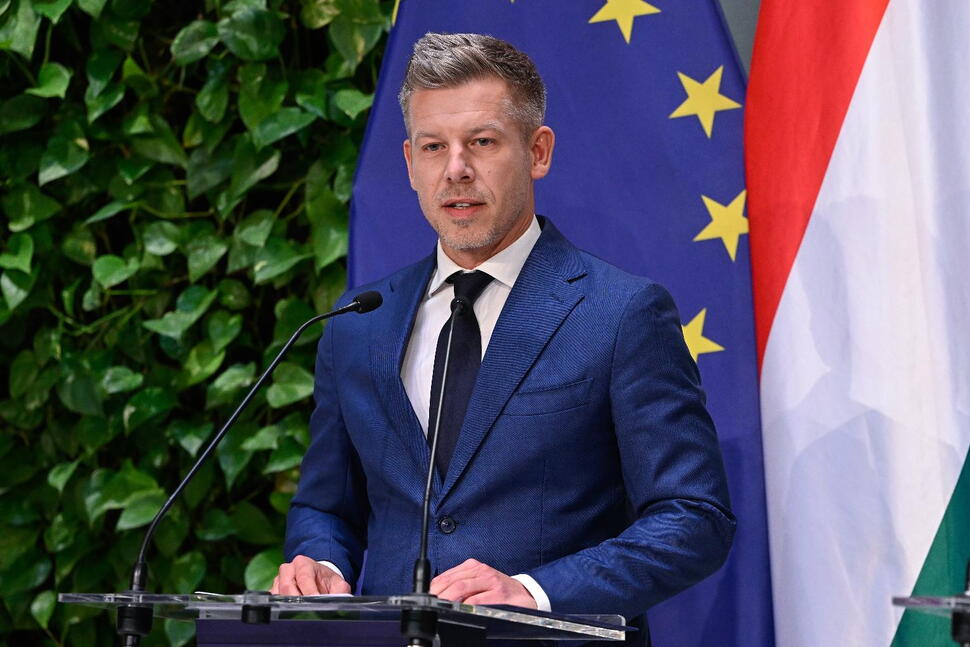
Magyar, whose center-right Tisza party defeated far-right Prime Minister Viktor Orbán and his nationalist-populist Fidesz in an earthquake election last month, has vowed to dismantle the political and economic system his autocratic predecessor spent 16 years building.
That has raised hopes across Europe, and also drawn comparisons to Poland’s 2023 election when Prime Minister Donald Tusk’s center-right coalition defeated the national-conservative Law and Justice party after eight years in power.
Like Magyar, Tusk moved quickly to restore democratic institutions eroded during the previous government, including the judiciary and public media, while seeking accountability for officials accused of abuses of power.
Hungary’s new leader hit the ground running
Magyar is flying to the southern Polish city of Krakow on Tuesday, before proceeding by train to the capital of Warsaw and then on to Gdansk, on the Baltic Sea.
After taking office on May 9, Magyar called openly for many officials appointed by Orbán’s government to step down or be removed by constitutional amendment — a power available to him after Tisza won a two-thirds majority in Parliament.
Magyar has targeted Hungary’s President Tamás Sulyok, a mostly ceremonial role but with some key constitutional powers, as well as the country’s attorney general and the heads of the constitutional and supreme courts — all figures he’s decried as “Orbán’s puppets.”
Andrzej Sadecki, an analyst with the Center for Eastern Studies in Warsaw, told The Associated Press that Magyar’s biggest challenge is that “some key state institutions are still in the hands of people nominated by Fidesz.”
Still, unlike in Poland, “the situation is much easier for Magyar because he has a constitutional majority. This makes it much easier for him to introduce deep changes,” Sadecki said.
While Tusk took power through a coalition government in Poland’s 2023 election, Magyar’s Tisza won 53% of the vote, gaining more votes and seats in Parliament than any other party in Hungary’s post-Communist history.
“It’s not just a change of government, it’s a watershed moment,” Sadecki added.
Magyar’s priorities include dismantling Orbán’s hold on the media
Orbán’s rule was marked by a sprawling media ecosystem, which for years served as a loyal mouthpiece for his Fidesz party while discrediting, defaming and intimidating his opponents.
Fresh from election victory, Magyar slammed public broadcasters under Orbán as “a factory of lies,” and said his government would suspend their news services until “the conditions for objectivity are restored.”
The approach mirrors steps taken by Tusk’s government, which less than a month after taking power revamped evening newscasts on state television. Poland’s new government argued its ownership of public media gave it the authority to replace executives at state outlets.
But the process drew criticism even by some liberal groups, with the Helsinki Foundation for Human Rights in Warsaw saying at the time that “the manner of initiating changes in public media raises serious legal doubts.”
Still, József Péter Martin, executive director of Transparency International Hungary, said the degree to which Hungary’s public media had failed to fulfill its role means that “it should be rebuilt, and it can be done within the framework of the rule of law.”
Magyar goal to establish judicial independence is a tough task
During its years in power, Poland’s Law and Justice party tightened control over the courts by appointing loyalist judges to higher courts and punishing critics with disciplinary action.
It also installed enough sympathetic judges to the Constitutional Tribunal to delay any bills the party deemed unfavorable by referring them for constitutional review. Tusk government efforts to reverse those changes have repeatedly been blocked by two subsequent Law and Justice-sympathetic Polish presidents.
While progress was made in some areas, judicial independence has not been fully restored in Poland, and Magyar’s government could face similar challenges.
Despite Magyar’s calls for him to resign, President Tamás Sulyok — an Orbán ally whose term expires in 2029 — has indicated he does not intend to step down.
Also, the head of Hungary’s Constitutional Court, Péter Polt, widely regarded as a Fidesz loyalist, is to remain in office until 2037.
Though many Hungarian judges and prosecutors faithfully carry out their duties, judicial leadership — including the heads of the constitutional and supreme courts — should be replaced to restore trust and impartiality, said Martin of Transparency International Hungary.
And “not with (Magyar’s) Tisza loyalists, because then we would go from one problem to the other, but with someone who has full integrity and devotion to the Hungarian constitution and to the public interest, and not to the interest of the former autocratic regime,” Martin said.
Holding former officials to account may be difficult
Even without fully restoring judicial independence, Polish prosecutors have opened investigations and pursued cases against former Law and Justice officials they accuse of abusing their positions to benefit their political allies.
In October, Polish prosecutors announced plans to charge former Justice Minister Zbigniew Ziobro with diverting money from a Justice Ministry fund intended for victims of violence and using it for his own personal and political gain.
Many of the nearly 3.4 million Hungarians that voted for Tisza expect the new government to hold Orbán and his political and economic allies accountable.
Magyar has pledged to create the National Asset Recovery and Protection Office, an authority tasked with investigating and seeking to recover public funds allegedly misused during Orbán’s tenure.
According to Martin, restoring the rule of law and judicial independence would be “the initial and most essential step” toward ensuring past abuses will be prosecuted.
Hungary joining the European Public Prosecutor’s Office, something Magyar has promised to do, would be a step in the right direction, he added.
“If all this is done, then I think there is a good chance that the corrupt perpetrators of the former regime, under an independent judiciary, can be held accountable,” he said.
Ciobanu reported from Warsaw, Poland.
Copyright 2026 The Associated Press. All rights reserved. This material may not be published, broadcast, rewritten or redistributed.
Photos You Should See – April 2026
