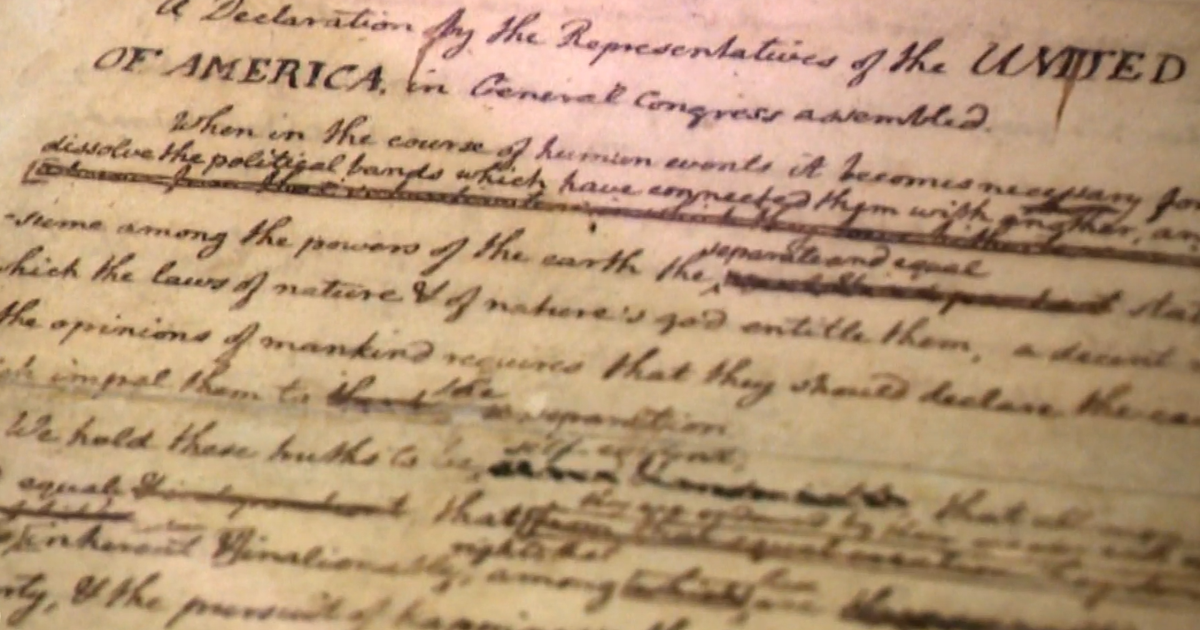
Washington — They are words etched into America’s conscience: “Life, Liberty and the pursuit of Happiness.”
They are foundational principles preserved in a rare draft of the Declaration of Independence written by Thomas Jefferson, now on display at the Library of Congress in a new exhibit titled “The Declaration’s Promise.”
“This is Jefferson’s fully-realized draft,” Ryan Reft, lead curator for the Library of Congress, told CBS News. “You can see them changing words throughout.”
The document contains edits from fellow Founding Fathers Benjamin Franklin and John Adams, like using the word “citizens” instead of “subjects.”
“They were breaking from a monarchy and creating a country based on this critical idea established in the Declaration that was new and that we were not subject to anyone,” Reft said.
And there were other changes, according to historian Kevin Butterfield, acting chief of the Manuscript Division at the Library of Congress.
“Initially, Thomas Jefferson had said, ‘We hold these rights to be sacred and undeniable.’ And Ben Franklin said, no, actually, maybe we should say ‘self-evident,'” Butterfield said.
But it was the phrase “all men are created equal” that took time to evolve.
“Initially, the ‘all men are created equal’ probably only applied to White men,” Reft said. “It ignored women, enslaved folks, Native Americans and others. But that’s the great thing about the Declaration. Even in its weaknesses, there is strength, the sense that the language he created enabled those folks, who were unequal at the time, to judge for themselves what equality was.”
The exhibit showcases the nation’s evolution through other items, like President Abraham Lincoln’s draft of the Gettysburg Address during the Civil War.
“He (Lincoln) says, well, why are we here? Why did we fight this war? And he comes down to one basic idea, equality,” Reft told CBS News.
The collection also features a Declaration of Rights read by Susan B. Anthony in support of women’s suffrage, as well as speeches by Dr. Martin Luther King Jr. and John Lewis during the Civil Rights Movement.
“These are moments to kind of look back and see where we are, and see where we should be,” Reft said.