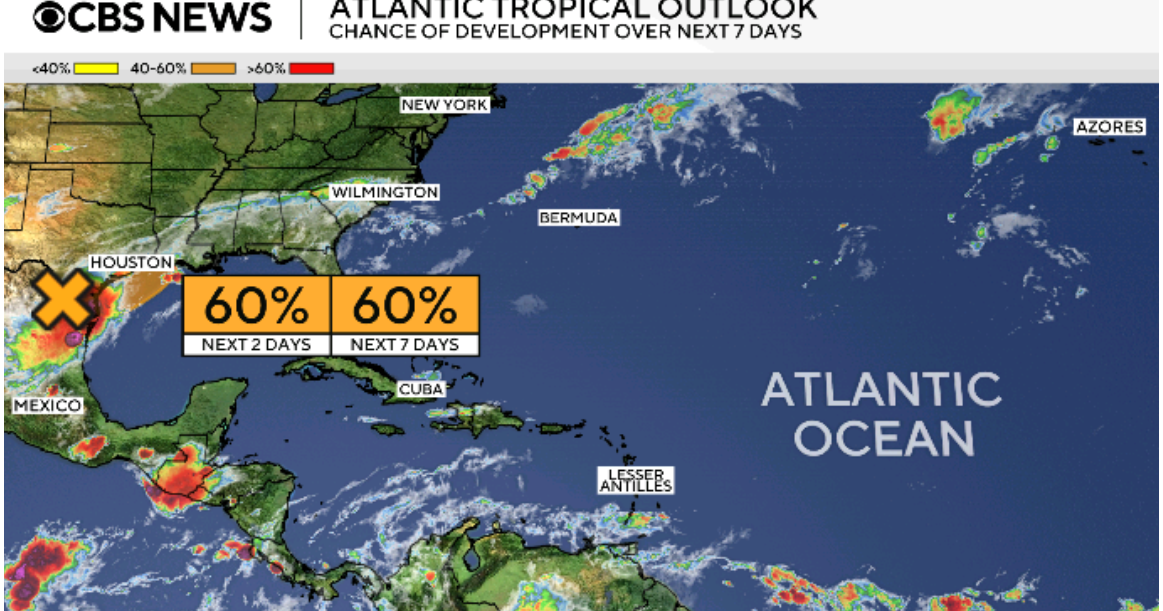
Forecasters are monitoring the potential first tropical cyclone of the 2026 Atlantic hurricane season, saying it could develop into a fully formed storm by Wednesday.
The National Hurricane Center issued a preliminary weather advisory for the system, currently a tropical disturbance called Potential Tropical Cyclone One, on Tuesday morning.
It came as record rainfall and life-threatening flash floods continued to drench parts of the South, where communities braced for up to 7 or 8 inches of additional rain throughout the rest of the week.
Potential Tropical Cyclone One was located in the western Gulf as of Tuesday evening, between Corpus Christi, Texas, and Lake Charles, Louisiana, according to the latest advisory from the National Hurricane Center. It was traveling northeast at 6 mph, with winds of 30 mph, below the 39 mph threshold required to designate it a tropical storm.
Nikki Nolan/CBS News 
The potential tropical cyclone also lacked a well-defined center as of the most recent update, although the hurricane center said the system will likely intensify and could develop into a tropical storm early Wednesday.
Whether that happens or not, the hurricane center emphasized the system could bring serious hazards to coastal sections of northeastern Texas and southwestern Louisiana, as well as parts of Alabama and Mississippi. Far-western portions of the Florida Panhandle could be affected, too. Parts of Texas and Louisiana were already seeing “dangerous flash flooding,” the hurricane center said.
Rainfall totals of 5 to 20 inches were possible for portions of the mid and upper Texas coast, southern and central Louisiana, Mississippi, Alabama, and part of Georgia and the Florida Panhandle, the hurricane center forecast.
A tropical storm warning was in place for the coast of Louisiana from Sabine Pass to Morgan City, meaning tropical storm conditions are expected within the next 24 hours.
Several major cities, including Dallas, Houston, San Antonio and New Orleans, could experience ongoing spells of excessive rainfall, especially over the next 48 hours or so, forecasts showed. Various flood watches and warnings were in effect for more than 40 million people across the region, as meteorologists predicted some areas could see rainfall rates of 2 to 4 inches per hour, or higher.
Nikki Nolan/CBS News 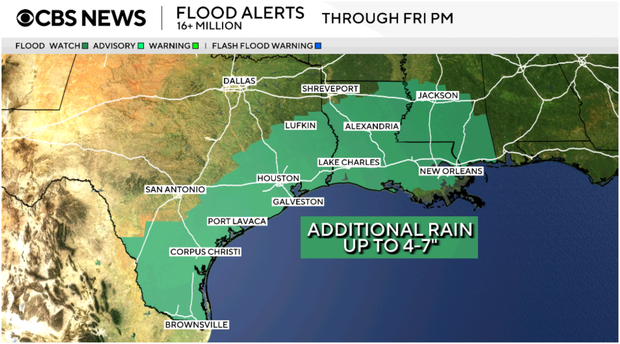
Multiple places still vulnerable to flooding before the week’s end have already been battered by heavy rain. National Weather Service offices in Austin, San Antonio and Shreveport, Louisiana, each reported record rainfall in their cities on Monday, with the latter two receiving more rain in a single day than either had seen since the late 19th century.
Texas’ capital city broke a daily rainfall record set in 1964, according to the National Weather Service.