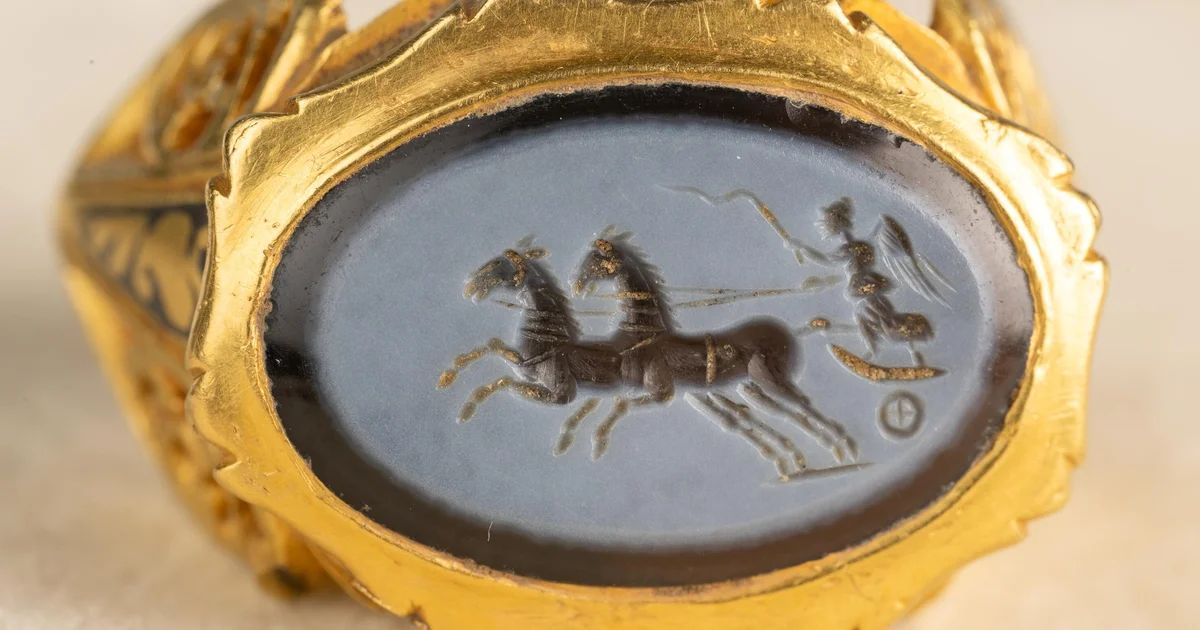
A rare gold Roman ring from more than 1,700 years ago — depicting Victoria, the goddess of victory — has proven to be a big win for an amateur metal detectorist in England.
Kevin Minto found the ring, referred to as the Ilminster Ring, while searching a field in the town that now gives the ring its name, according to the South West Heritage Trust.
“The Ilminster Ring is both large and heavy, with elaborate goldwork and a beautifully executed intaglio,” Amal Khreisheh, senior curator at South West Heritage Trust, said in a statement. “While other examples are known, these elements combine to create a spectacular ring that is only paralleled by continental discoveries.”
South West Heritage Trust 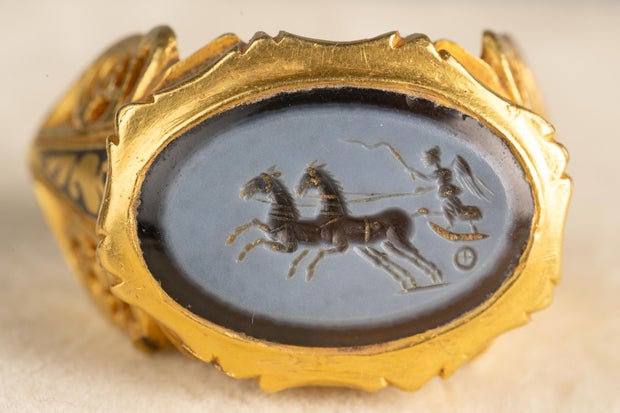
Minto received a big windfall this week when the South West Heritage Trust announced the purchase of the ring, originally found in 2018, for just over 78,000 pounds (about $105,000).
The ring dates back to about 279 AD and features an engraved gemstone, known as an intaglio, of the Roman goddess of victory — maybe more known for her Greek name, Nike — riding a chariot pulled by two horses. It weighs 48 grams, much larger than even a heavyweight ring today.
“[The ring’s] discovery sheds light on how South Somerset’s Roman inhabitants navigated a period of unrest from 286-296,” said Khreisheh. “It is likely the ring was buried shortly after, in 297, as part of a hoard including coins, lead and pottery objects.”
Ilminster is a small town in southwestern England that is part of Somerset and is known as a location for finding ancient Roman treasures. The ring was part of a larger hoard of coins also found by Minto, according to the trust.
The famous Frome Hoard, a collection of more than 52,000 Roman coins, was found in Somerset by a different amateur metal detectorist in 2010. The Frome Hoard now resides in the Museum of Somerset, where the Ilminster ring will now be displayed as well, according to the trust.
The Chew Valley Hoard, a collection of more than 2,500 silver coins worth over $5 million from the Norman Conquest of England in the early 11th century, was also found in Somerset and resides at the Museum of Somerset.