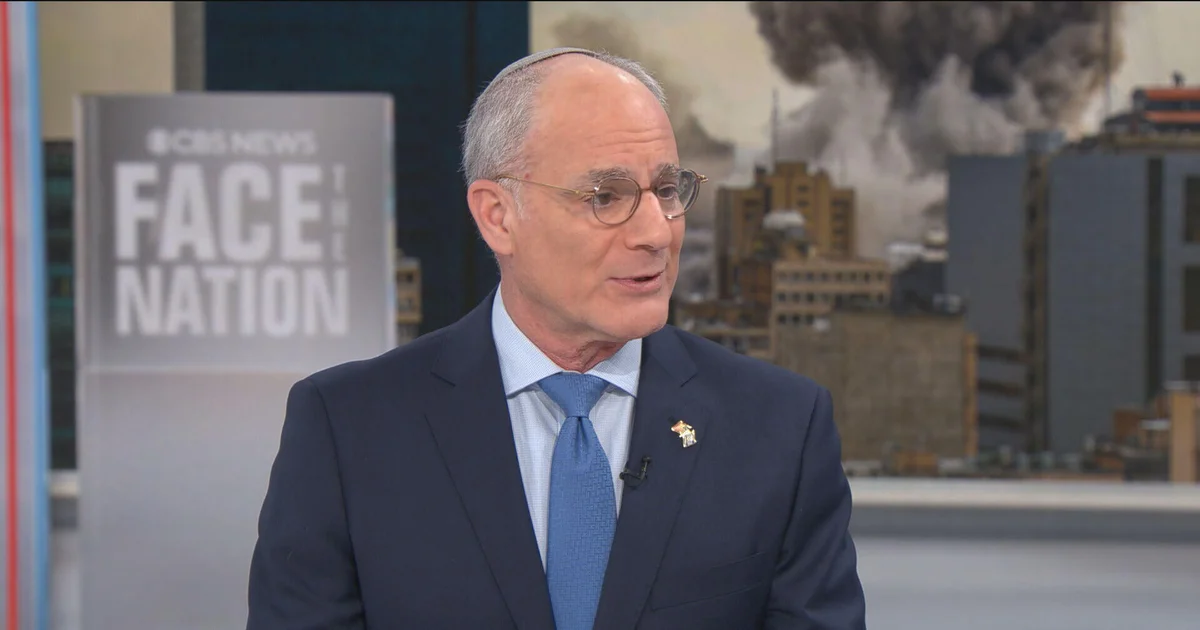
The following is the transcript of the interview with Israeli Ambassador to the U.S. Michael Leiter that aired on “Face the Nation with Margaret Brennan” on April 12, 2026.
MARGARET BRENNAN: We are joined now by Israel’s ambassador to the United States, Dr. Michael Leiter. Good morning and welcome back to the program.
DR. MICHAEL LEITER: Good morning, Margaret, good to be with you.
MARGARET BRENNAN: Israel and the US have been lockstep in this war to date. You heard the vice president sort of leave the door open to diplomacy, but President Trump also said this morning, the US is locked and loaded for an appropriate moment. Is it your understanding that Israel and the US will hold fire until the end of this two week ceasefire?
MICHAEL LEITER: We have to remember that the President has been relentless in pursuing an end to this crisis through talks. That’s the talks preceded the June war, talks preceded epic fury, the talks are going on now, and I think that if we can conclude this crisis with Iran, with this regime, this tyrannical regime, that’s pursuing nuclear weapons without going back into kinetic activity, it would probably be best for everyone. The president continues to pursue that. But right now they saw face to face, the vice president sat opposite this fellow, Qalibaf, who is directly responsible for the murder of his own people just in January, this past January, and just saw how obdurate and obstinate they are in pursuit of nuclear weapons.
MARGARET BRENNAN: When you said the talks are still going on, are there – is there any level of US-Iran contact at this point?
MICHAEL LEITER: Well, you know, the President gave the issue two weeks, and we’re just into the end of the first week, so there is another week left for the potential for continued talks. We, we know the Iranians. We know this regime. We don’t think they’re going anywhere, but it’s important to give it a chance.
MARGARET BRENNAN: Vance said, we need to see Iran give affirmative commitment to not seek a nuclear weapon, or the tools that would enable them to quickly achieve a nuclear weapon. Is your understanding that the US position is zero enrichment or are they still leaving the door open that Iran could have a civil-civilian nuclear program for medical purposes?
MICHAEL LEITER: Civilian nuclear program doesn’t entail enrichment. There are 57 countries with a civilian nuclear program that don’t have enrichment.
MARGARET BRENNAN: — But they want a little bit, you know that.
MICHAEL LEITER: No, no, if they have a little bit then they can have a lot to move from 60% which they had, to 90%. Look, you don’t build these production plants deep underground if you’re doing it for medical purposes, you have nothing to hide. These people lie. We shouldn’t be surprised when people who murder their own also lie. This has been their pursuit. They’ve been chanting for 47 years, death to America, death to Israel. That’s their goal. Let’s not —
(CROSSTALK BEGINS)
MARGARET BRENNAN: — But we’re negotiating with that same regime, right now –
MICHAEL LEITER: — We’re trying at the same time to add we’re negotiating them –
MARGARET BRENNAN: — The very same people.
(CROSSTALK ENDS)
MICHAEL LEITER: — We’re negotiating them, after eliminating their navy, after eliminating their air force, after degrading their leadership. Hopefully they’ll come to their knees and say, we’re surrendering.
MARGARET BRENNAN: Well, the President has said the war is won. Your Prime Minister said the work is not yet complete. Specifically, what part of Iran still poses a military threat to Israel? Do you still consider it an existential threat?
MICHAEL LEITER: Well, there are three things that we have to be concerned with from the beginning. Number one, the pursuit of a nuclear weapon, if they go back to that pursuit that concerns us —
MARGARET BRENNAN: — They say they aren’t —
MICHAEL LEITER: Number two, ballistic missiles. Okay, these ballistic missiles, they promised, by the way, that they don’t have a ballistic missile that could reach Europe. They lied. We saw that they do.
MARGARET BRENNAN: — You’re talking about firing on Diego Garcia?
MICHAEL LEITER: The firing on Diego Garcia. They said it was limited to 2000 kilometers. We see now they’ve got 4000 kilometers. It’s just a sprint to 8000 kilometers and to hit Chicago or 10 to fly to New Jersey. So that has
MARGARET BRENNAN: — US intel says nine years.
MICHAEL LEITER: — and proxy, well, our intel says less than nine years. Okay,
MARGARET BRENNAN: — Yeah.
MICHAEL LEITER: And our Intel has been accurate on this from the very beginning. Okay? Now it was clear we said that they’re in a sprint to achieve nuclear weapons. And Mr. Witkoff came back from the talks beforehand and said they came in, they walked into negotiations, said, we’ve got 60% ready for 11 bombs. 11 bombs at 60% means that you got a week or two until you got 90% and weapon grade. And the last thing Margaret, are the proxies. Okay, this isn’t over until there is a complete de-linkage between Iran and its proxies which have spread death, mayhem and destruction around the Middle East.
MARGARET BRENNAN: I want to come back to that in regard to Hezbollah. But just to finish what you’re talking about with intelligence, there was this highly detailed New York Times report this past week, I know you read it, extraordinary journalism. That detailed this February 11 meeting where your prime minister pitched President Trump on bombing Iran. It said the Israeli plan was to kill the Ayatollah, done. Cripple Iran’s ability to threaten its neighbors, spur a popular uprising in Iran, and then conduct regime change, leaving in place a secular leader. Obviously, all those goals were not achieved. Can you declare an end to the war without achieving that checklist?
MICHAEL LEITER: First of all, all of those goals have not been achieved, yet. This is a process. This isn’t instant soup, number one. Number two, I was in the room at that meeting. The journalists who wrote that article were not and apparently they received the information second, third hand, there’s an awful lot in that article which simply isn’t true. Which is a narrative that’s being created, interesting narrative, but not accurate. So I’d be very careful about quoting from that particular article.
MARGARET BRENNAN: Well, specifically, what, what did they get wrong? Because they say your intelligence services, the Mossad argued the Iranian regime would be so weak it could not choke off the Strait of Hormuz. That was wrong. Iran wouldn’t have–
MICHAEL LEITER: No, no we didn’t argue that. We argued the potential that we’ve got to work towards that, nothing was presented as a fact, that if we do this, this will be the outcome. It’s not science, politics is not science, military operations are not science. We presented the case that this is what we think should be done. The president makes a decision. This whole thing about the prime minister coming in and dragging the president into this, it’s – all you know for publicity purposes.
MARGARET BRENNAN: Did Mossad believe that there would be protests that would overthrow the regime and that Kurdish fighters would enter through the north?
MICHAEL LEITER: The Mossad thought that, as we saw in January, hundreds of thousands and millions of people rise up, the potential for that happening again is even greater now, and we still think it’s very great. We still think we could, that could materialize over the next couple of months but there’s no guarantee –
MARGARET BRENNAN: — Then why negotiate with the same regime that is suppressing those people?
MICHAEL LEITER: Well, you can negotiate
MARGARET BRENNAN: — Is Israel really really supportive of this diplomacy?
MICHAEL LEITER: You can negotiate – we’re supportive of the president and his efforts. Okay, we’ve been in lockstep from the beginning in the planning, in the implementation, and we’re going to end this thing together as well. So we’re completely supportive of the president’s efforts, both diplomatically and militarily.
MARGARET BRENNAN: On the proxies, the Jerusalem Post today is writing that Israel’s war in Lebanon is the price to pay for Iran reopening Hormuz. The Israeli offensive against Hezbollah, and for our viewers, they are a political party in Lebanon and they also are Iran’s strongest militia and proxy force. They’ve complicated things here. The Trump administration is holding talks Tuesday in Washington. You’ll be at the table with the ambassador from Lebanon. Hezbollah is not part of these talks. In that lead up, is Israel going to pause, reduce the strikes on Lebanon?
MICHAEL LEITER: If I can, a point of correction, Hezbollah is a terrorist organization
MARGARET BRENNAN: — It is.
MICHAEL LEITER: — which is also a political party. It’s not a political party which also has a terrorist wing. They are a terrorist organization. They’re a proxy of Iran,
MARGARET BRENNAN: — Yes.
MICHAEL LEITER: — which has an agenda of destroying the state of Israel,
MARGARET BRENNAN: — Yes.
MICHAEL LEITER: — And they fire missiles into our towns and villages
MARGARET BRENNAN: — Yes.
MICHAEL LEITER: And we have to respond. Now, we want to negotiate with Lebanon. Lebanon and Israel can live in peace tomorrow. I believe, you know, we had this initial phone call on Friday. It was a conference call, myself –
MARGARET BRENNAN: — You and the Lebanese ambassador,
MICHAEL LEITER: The Lebanese ambassador, the US Ambassador to Beirut, all moderated by the State Department official Mike Needham. It was a great conversation. And the thing we all agreed upon, that, if there was, if we just put Hezbollah on the side and just Israel and Lebanon negotiate peace. Two months, three months, we’ve got a complete peace agreement.
MARGARET BRENNAN: Let me just follow up, you said Israel has to respond. That’s different when it comes to responding to a strike from Hezbollah versus the kind of bombing that we saw this past week, particularly on Wednesday. The air strikes killed more than 350 people that day, a third of them, women and children and the elderly according to the Lebanese health ministry. The vice president said Israel had agreed to check itself with these strikes. And the President said he spoke with Bibi, your prime minister, and he said he’s going to low-key it. Can you explain what low key bombing means? Is this a reduced cadence and volume of strikes from Wednesday. What exactly did the US and Israel agree to?
MICHAEL LEITER: Reduce cadence, up cadence. Operational issues aren’t discussed on Sunday morning on television.
MARGARET BRENNAN: — Well the president did
MICHAEL LEITER: — Well, what we, we discussed is that we’re going to be in tandem with the president’s efforts in the gulf, and we support the president’s efforts. Right now, we are pursuing those who are shooting missiles against our civilians, and the operation Wednesday was targeted against operation centers of Hezbollah. Now, what they do?
MARGARET BRENNAN: — You dispute those Lebanese Government figures?
MICHAEL LEITER: Absolutely. Oh, of course, it’s like Hamas releasing figures from Gaza, their health ministry,
MARGARET BRENNAN: — But you’re negotiating with the Lebanese government
MICHAEL LEITER: Absolutely, absolutely. But the, sometimes, there’s this attempt to paint us as, you know, going after civilians. We’re going after in a targeted fashion, the terrorist infrastructure. That’s what we focus on. Now what they do Margaret, is they put their operation centers, their terrorist centers, among civilians. Now we tell them to get out. They don’t always get out, but we do what we can. Hamas does this in Gaza by building their bases within civilian centers. Hezbollah does it, and we saw the other day where Tehran sent their civilians out to the bridges and the – energy plants so they wouldn’t be, this is a crime against humanity.
MARGARET BRENNAN: Well, you have your own diplomacy on Tuesday, we will be watching for that and what happens. Thank you for your time this morning.
MICHAEL LEITER: Thank you
MARGARET BRENNAN: Be right back.