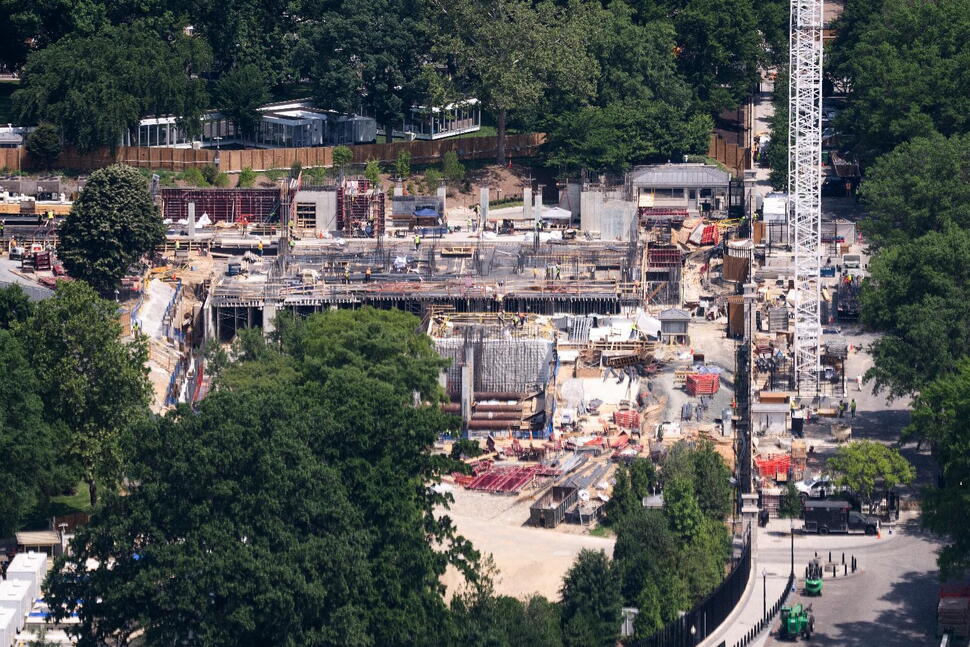
WASHINGTON (AP) — Lawyers representing the federal government argued Friday that a court could not stop construction of a White House ballroom it was already underway and because of the sensitive security concerns they say the structure is meant to address.
Attorney Yaakov Roth, speaking during an exchange with U.S. Appeals Court Judge Patricia Millett, said only Congress could stop the $400 million project. The administration has been asking the court to allow it to press on without congressional approval.
At issue is an April 16 order from U.S. District Judge Richard Leon for Trump’s Republican administration to halt aboveground work on the 90,000-square-foot (8,400-square-meter) ballroom. Leon, who was nominated to the bench by Republican President George W. Bush, allowed for construction to continue on belowground work on a bunker and other “national security facilities” at the site.
The hearing Friday centered on who has standing to challenge government steps once they have already been taken and whether that standing overrides national security.
In response to hypothetical scenarios put forward by Millett, Roth agreed that the government could bulldoze the Statue of Liberty and the White House — and the descendants of immigrants who came through Ellis Island and the enslaved people who built the White House would not have legal standing to oppose the move after the fact.
Millett, nominated to the bench by Democratic President Barack Obama, asked Roth when the construction was a “fait accompli?”
“Was it when you started doing the underground work, which is now totally completely integral and connected and inseparable from a massive ballroom on top?” she asked. “When did it become impossible for courts to stop this project?”
Roth replied: “I think it would have been improper to enjoin it even on Day One.”
The exchange was one of many during the two-hour hearing before the three-judge panel from the U.S. Court of Appeals for the District of Columbia Circuit. The hearing concluded without a decision by the judges.
The hearing concluded without a decision by the judges.
It is hard to determine how the judges might rule. While there were numerous questions for Roth over the administration’s authority and changing explanations of how it is moving forward, plaintiff attorney Tad Heuer also faced numerous questions.
The judges pressed Heuer on standing in the case and on how basic aesthetic questions can override the national security concerns.
“We have never opposed the underground construction of the bunker, which is where the government until recently has said the national security concerns lay,” Heuer said. He said construction should be halted until Congress weighs in.
“Congress can allow ballrooms to be built — it’s its property,” Heuer said.
Government lawyers have argued that the project includes critical security features to guard against a range of threats, such as drones, ballistic missiles and biohazards.
“These upgrades, alterations, and improvements are essential to protecting the President, his family, and his staff, as well as the White House itself, and the entire project flows from them,” they wrote in a court filing.
Copyright 2026 The Associated Press. All rights reserved. This material may not be published, broadcast, rewritten or redistributed.
Photos You Should See – April 2026
