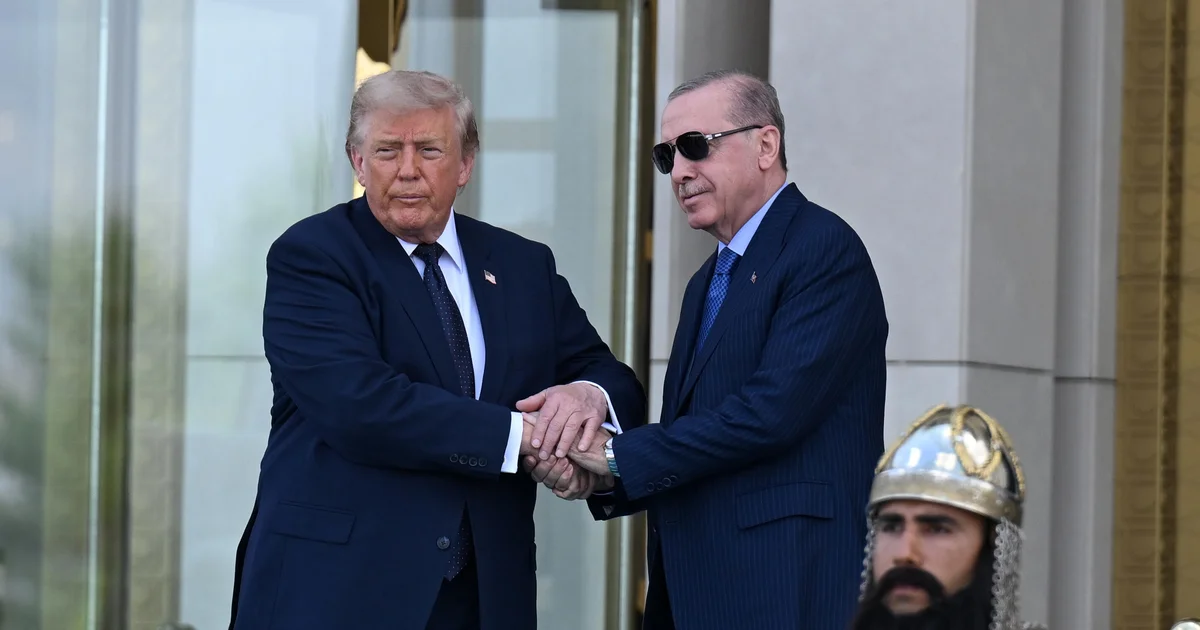
Washington — President Trump began the NATO’s summit in Turkey alongside Turkish President Recep Tayyip Erdoğan Tuesday with a clear message that Turkey is a better friend to the United States than many of its traditional Western allies.
“I was very disappointed with NATO,” the president told reporters alongside Erdoğan. “And frankly, if it weren’t held in Turkey, where my friend happens to be a very strong leader — a very strong, uh, person — it’s possible that I wouldn’t have attended. I felt I had to attend.”
The president began what Secretary of State Marco Rubio called “probably the most important meeting in NATO’s history” by announcing he’ll lift some economic sanctions on Turkey and will consider allowing Turkey to rejoin the United States’ F-35 fighter jet program, a program from which Turkey was banned in 2019 over its use of Russian military technology.
Mr. Trump said he’ll lift sanctions on Turkey imposed through the Countering America’s Adversaries Through Sanctions Act, a law deterring foreign powers from engaging in business with the adversarial Iran, Russia and North Korea.
“We’re going to be taking the sanctions off,” Mr. Trump told reporters. “It’s time to do that. Okay? We don’t want to sanction friends. It’s very simple.”
On the F-35 program, although the Trump administration is still considering what to do, Mr. Trump said the U.S. should help Turkey, a country that has “frankly has been more helpful to the United States than many other more traditional countries.”
The summit continues Mr. Trump’s continued alteration of the United States’ role in NATO and the world — one of shifting relationships with traditional U.S. allies and a push for NATO members to take on the defense responsibilities carried by the United States since the post-World War II era. At the summit, the U.S. president will continue to push NATO countries to spend 5% of their gross domestic product on defense.
He does so as the U.S. slowly pulls some of its assets out of Europe, as he reignites a tiff with Italian Prime Minister Giorgia Meloni and as his interest in acquiring Greenland unsettles and aggravates European allies. The president has at times questioned the usefulness and viability of NATO, keeping members of the 32-country alliance on edge for what he might say next.
The location of the summit in the Turkish capital of Ankara is notable, and a big win for Turkey on the international stage. Amid strained ties with some European countries, Mr. Trump has, in his two terms in office, strengthened ties with Erdoğan. Although it’s been a NATO member since 1952, Turkey is at times a controversial member, with a complex economic relationship with Russia and a bevy of systemic human rights issues.
Mr. Trump arrived in Turkey shortly before 7 a.m. ET, or 2 p.m. local time, on Tuesday, and was briefly greeted by Erdoğan before the two held their bilateral meeting.
Turkey and the F-35 program
Seated alongside Erdoğan in Ankara’s presidential compound, Mr. Trump said the U.S. will “consider” allowing Turkey to purchase the United States’ F-35 jets again, a long desired goal for Turkey. Only a handful of countries have access to the technology.
Turkey was a part of the F-35 program until 2019, when it was removed and its orders were canceled over Turkey’s connections to Russian military equipment. Congress passed legislation prohibiting the transfer of F-35 aircraft to Turkey for just that reason.
Ahead of the president’s comments on the F-35 program, Republican Sen. John Cornyn said he hopes the president won’t return Turkey to the program, and detailed the requirements for allowing the country to reenter the program.
Defense spending
Mr. Trump has long expressed his frustration with NATO members’ levels of defense spending and reliance on U.S. military capabilities and infrastructure in the post-World War II era. Since his first term, he has been pushing NATO members to increase their defense spending.
At the 2025 NATO summit last year in The Hague, NATO allies committed to investing 5% of their gross domestic product on defense by the year 2035, thanks largely to a push by Mr. Trump, and up from the previous target of 2%.
“Our goal continues to be shifting the burden of the conventional defense of Europe to our European allies and Canada,” U.S. Ambassador to NATO Matt Whitaker told reporters on a preview call Sunday. “The United States remains a proud NATO member, and I continue to show up every single day doing the important work at the alliance on behalf of President Trump, but we have responsibilities elsewhere in the world, as the world’s only superpower.”
That push to boost other countries’ defense spending and encourage “burden-shifting” will be a top focus of the president in Ankara, Whitaker said.
“Poland, the Nordic countries, the Baltic countries lead the way, and Germany is on track for the 5%, reaching it in 2029, but many others are lagging behind, and President Trump expects all allies to step up immediately, and not only get on a sustainable path to the 5% but get to 5% as soon as possible,” he said.
The U.S. currently spends roughly 3% of its GDP on defense.
Whitaker told CNBC any uncomfortable moments over the defense spending push are simply “growing pains,” as the United States does “less” in NATO.
Mr. Trump has offered harsher words for NATO members that he believes aren’t carrying their weight. Earlier this year, the president criticized Spain for opting out of the 5% commitment, threatening to “cut off all trade” with the country.
Reduced U.S. military footprint in Europe
A slow reduction of the U.S. military footprint in Europe goes hand-in-hand with the expectation that NATO countries spend increasing portions of their GDP on defense.
The Pentagon has already announced a plan to withdraw about 5,000 U.S. troops from Germany, as well as reductions in fighter jets, tanks and other equipment.
“Both our national security strategy and our national defense strategy talk about the priority we’re placing on burden-shifting in Europe, and that more capable allies in Europe will allow them to meet threats that exist in Europe that they’re perfectly able to meet, and that will allow us to focus elsewhere,” a senior U.S. official told reporters on a call on the condition of anonymity Sunday. “And so, there should be no surprise that we’re doing a posture review, or surprise that that posture review very, very well may lead to us adjusting our posture, because we’re trying to shift the burden to Europe, and we’ve been very specific about that in our major strategic documents.”
Greenland
Mr. Trump hasn’t given up his hopes of acquiring Greenland, which is problematic for NATO given that Greenland is a semi-autonomous territory within NATO member Denmark. Both Greenland and Denmark are staunchly opposed to the idea. Mr. Trump reiterated the importance of the U.S. acquiring Greenland on Tuesday, when he met with Turkey’s president.
“That’s what hurt my relationship with NATO,” he said. “Because Greenland doesn’t help Denmark. Denmark doesn’t spend money to really help Greenland. But it’s an important part for the United States. … That should be controlled by the United States, not by Denmark.”
The president’s quest has aggravated not just Greenland and Denmark, but the other Scandinavian countries and much of Europe. The Trump administration’s military campaigns in Venezuela and Iran have taken the focus off Greenland, for now, and Mr. Trump said earlier this year that using military force to take over Greenland wasn’t on the table, but that doesn’t mean the president has forgotten about the Arctic island.
The U.S. official told reporters on that call Sunday that acquiring Greenland would still be the best way to defend the U.S. and other NATO countries, although the administration is exploring other options.
“We still think that’s the best way to meet the defense needs of NATO with respect to Greenland,” the senior U.S. official said of the U.S. acquiring Greenland, “but we’re also exploring with them all other mechanisms to address those concerns. But to emphasize, there really is no disagreement amongst any NATO ally about the importance of defense considerations of Greenland. It’s about how to solve them, and how to solve them permanently.”
Tiff with Italy’s prime minister
Italian Prime Minister Giorgia Meloni, once one of Mr. Trump’s favorite foreign leaders, has quickly fallen out of favor with the U.S. president.
Last month, Mr. Trump claimed Meloni “begged me to take a photo with her,” but said he doesn’t want her as a “fan” because she was insufficiently supportive of the Trump administration on the Strait of Hormuz and Iran. In response, Italy’s foreign minister canceled a planned U.S. visit.
Meloni herself said the president’s words “stunned” her, and criticized Mr. Trump for his behavior toward his own allies. But Mr. Trump hasn’t let go of the spat. On Sunday, without any context, he posted an image of himself and Meloni with the caption, “RESTRAINING ORDER NEEDED.”
That could make things awkward in Ankara. But on Tuesday as he met with Turkey’s president, Mr. Trump took a slightly different tone.
“I don’t know, I think she’s a nice person, actually,” he said, while adding that he disagreed with her on the Strait of Hormuz.
The Strait of Hormuz
The security of the Strait of Hormuz is a top issue for European allies, many of whom are far more reliant on Middle Eastern oil than the U.S. Shipping traffic through the strait is recovering, after the U.S. and Iran agreed to reopen the waterway as part of a 60-day memorandum of understanding last month, but shippers are still wary.
U.S.-Iran talks during the fragile ceasefire are on pause for the multi-day funeral of Iran’s late Supreme Leader Ali Khamenei, killed in the initial strikes.
On Monday, Mr. Trump said the U.S. will win the war with Iran “one way or the other.”
“We’re either going to make a deal, or we’re going to finish the job,” he said in the Oval Office. “It won’t be tough to finish the job.”
Mr. Trump has been frustrated that European allies haven’t joined him in fighting Iran, and insists they haven’t done enough to help reopen the strait. When he visited the White House last month, Rutte repeatedly made the case to Mr. Trump that European allies, although they hadn’t done enough, have been helping the United States in its endeavors in Iran.
Ukraine
Mr. Trump, according to the latest schedule, is expected to meet with Ukrainian President Volodymyr Zelenskyy on the sidelines of the summit. Mr. Trump has long said that he thinks both Russia and Ukraine want to make a deal, but more than four years into Russia’s full-scale invasion of Ukraine, a resolution remains unclear.
Zelenskyy and NATO’s European members, which are much closer to the war than the U.S., will be sure to bring up the latest concerns at the summit.