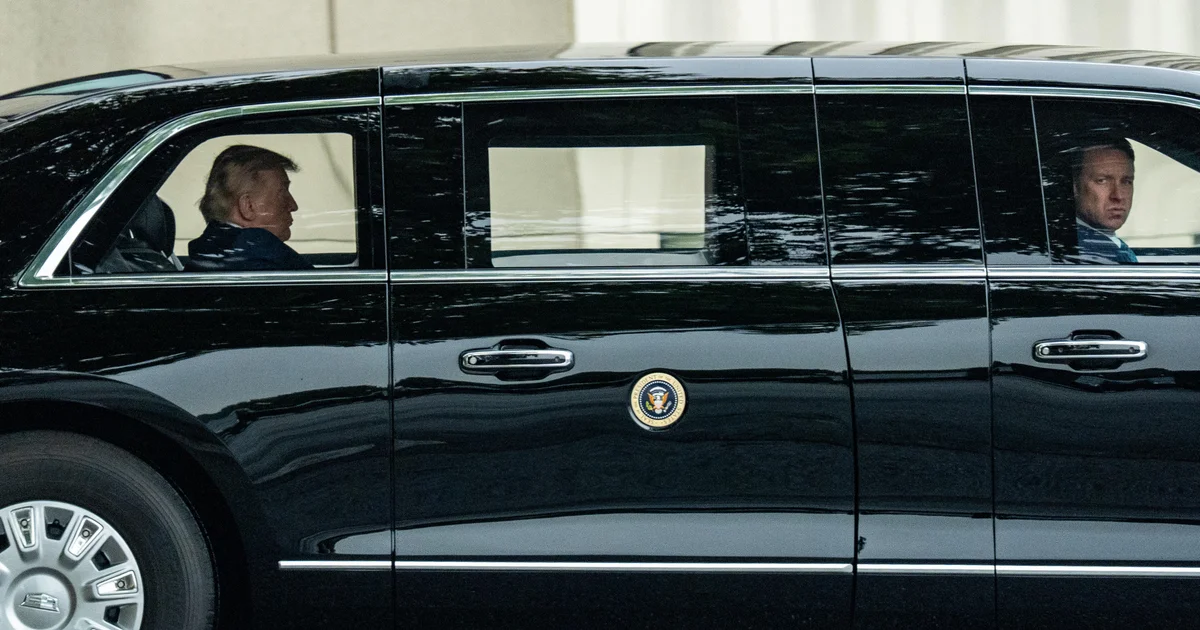
President Trump made time to visit with U.S. service members during his trip Tuesday to Walter Reed National Military Medical Center, but he did not see any of the 14 troops injured in the war he started with Iran who are also recovering at the hospital, according to the family of one soldier and another military official familiar with Mr. Trump’s visit.
The White House said Mr. Trump met with service members during his six-month checkup at the Army’s flagship medical center, but repeatedly declined to say whether the president saw soldiers injured in Operation Epic Fury.
“President Trump was honored to meet with our amazing service members and medical staff while at Walter Reed Medical Center,” said a White House spokesperson, who declined to provide any guidance on why the president did not meet with soldiers wounded in the Iran war.
Sergeant Cory Hicks was stationed at an Army post in Kuwait that was hit by an Iranian drone in March, during the first 24 hours of the conflict. The attack killed six American soldiers and injured more than 20. Hicks is one of six from the Kuwait attack still recovering at Walter Reed. He suffered a lacerated kidney, a severed spleen and a traumatic brain injury.
“I’ve come a long way — that’s for sure,” Hicks told CBS Minnesota last month. “I spent 19 years in the military so far and I love serving my country, but this [recovery from wounds] is a different battle. You’ve got to fight once you get injured.”
A day before his visit to Walter Reed, during his Memorial Day remarks at Arlington Cemetery, Mr. Trump paid tribute to 13 soldiers who had died in Operation Epic Fury, calling them “wonderful souls” who “gave their lives” to ensure Iran would never have a nuclear weapon.
Mr. Trump on Wednesday during a Cabinet meeting again referred to the 13 as “great people” and said losing them “is a terrible thing.”
“We want to lose very few, we want very few to be injured. We’re very careful, but war is war. War is dangerous.”
In March, Mr. Trump also attended the dignified transfers of the six soldiers who died in the Kuwait attack and six who died in a refueling accident over Iraq.
It is customary for American presidents to visit with troops wounded in battle. In 2004, during the Iraq War, President George W. Bush said after a visit to Walter Reed, that it was an honor “to meet the wounded who have made a decision to sacrifice for this nation’s security and for freedom in the world… It is an honor to meet their parents or their wives, their children, brave souls who support their loved one with all their heart.”
In 2017, during his first term, Mr. Trump himself paid a visit to the military hospital to present the Purple Heart to a soldier who had been wounded in Afghanistan.
Mr. Trump has previously faced scrutiny for his descriptions of wounded service members. During his first term, he said the soldiers injured in a 2020 Iranian airstrike on an American base in Iraq weren’t worth mentioning because they had suffered “headaches,” which he described as “not very serious.”
A CBS News investigation later found dozens of soldiers who had suffered brain injuries were denied the Purple Heart as part of an effort to downplay their wounds and avoid undercutting Mr. Trump. One later took his own life.
Mr. Trump has also denied reports he called U.S. Marines who died in World War I “suckers” and “losers” after he canceled a 2018 visit to the cemetery in France where they were buried.
According to the Defense Department, 409 U.S. troops have been injured in the Iran war. Last month, Defense Secretary Pete Hegseth testified to Congress that roughly 90% have returned to duty.
Troops injured in the Kuwait attack suffered from severe shrapnel wounds and head injuries. Hicks is now in a soldier recovery unit at Walter Reed and has described the heavy mental toll of the attack.
“I lost six of my battle buddies who were sitting pretty close to me and that’s a struggle within itself,” he said in the April interview. “The invisible wounds are hard to heal. A lot of them were further away from the blast than I was, so when you go through something like that, you go through a lot of guilt.”